
Mind map
Noun classifications
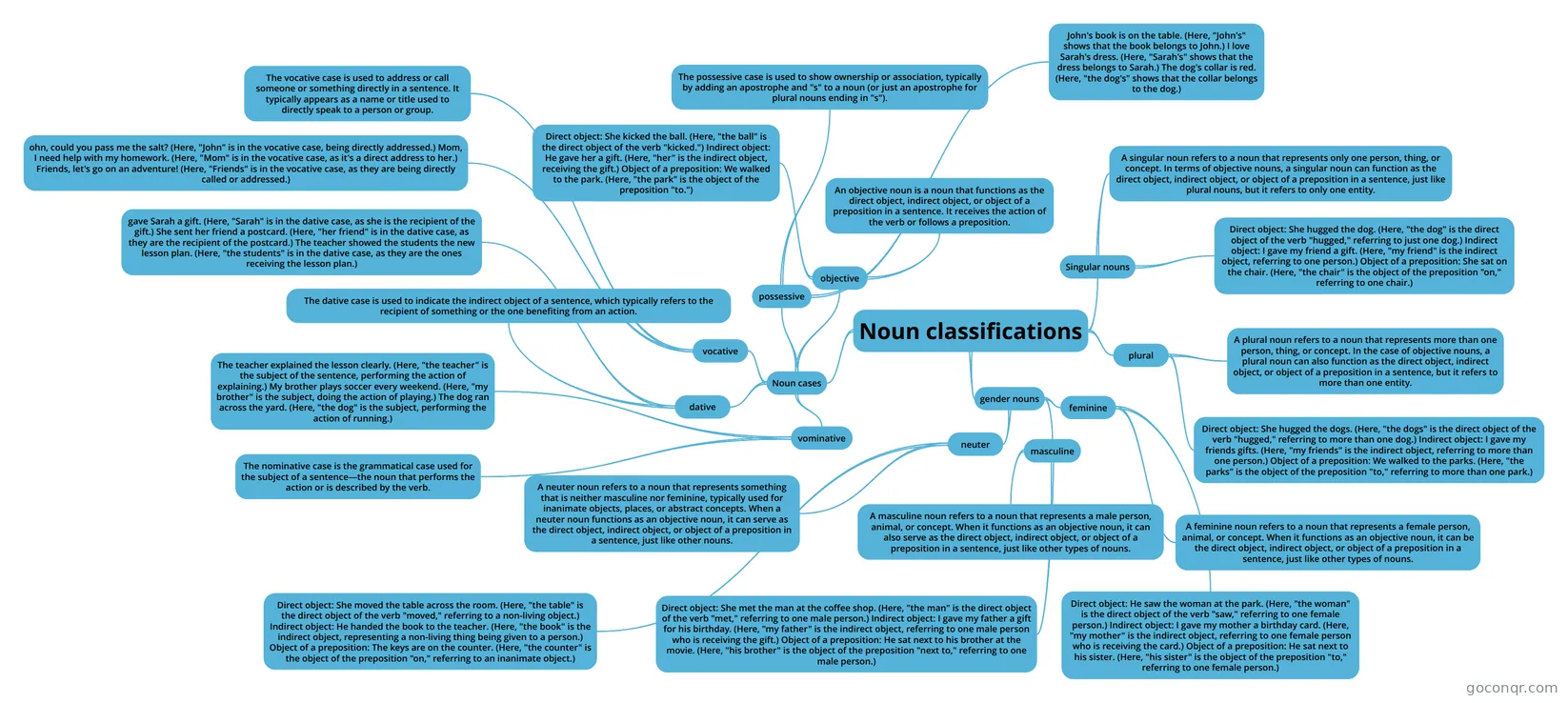
Mind map: Noun classifications
Map content
Noun classifications
Singular nouns
- A singular noun refers to a noun that represents only one person, thing, or concept. In terms of objective nouns, a singular noun can function as the direct object, indirect object, or object of a preposition in a sentence, just like plural nouns, but it refers to only one entity.
- Direct object: She hugged the dog. (Here, "the dog" is the direct object of the verb "hugged," referring to just one dog.) Indirect object: I gave my friend a gift. (Here, "my friend" is the indirect object, referring to one person.) Object of a preposition: She sat on the chair. (Here, "the chair" is the object of the preposition "on," referring to one chair.)
Noun cases
- possessive
- The possessive case is used to show ownership or association, typically by adding an apostrophe and "s" to a noun (or just an apostrophe for plural nouns ending in "s").
- John's book is on the table. (Here, "John's" shows that the book belongs to John.) I love Sarah's dress. (Here, "Sarah's" shows that the dress belongs to Sarah.) The dog's collar is red. (Here, "the dog's" shows that the collar belongs to the dog.)
- objective
- An objective noun is a noun that functions as the direct object, indirect object, or object of a preposition in a sentence. It receives the action of the verb or follows a preposition.
- Direct object: She kicked the ball. (Here, "the ball" is the direct object of the verb "kicked.") Indirect object: He gave her a gift. (Here, "her" is the indirect object, receiving the gift.) Object of a preposition: We walked to the park. (Here, "the park" is the object of the preposition "to.")
- vocative
- The vocative case is used to address or call someone or something directly in a sentence. It typically appears as a name or title used to directly speak to a person or group.
- ohn, could you pass me the salt? (Here, "John" is in the vocative case, being directly addressed.) Mom, I need help with my homework. (Here, "Mom" is in the vocative case, as it's a direct address to her.) Friends, let's go on an adventure! (Here, "Friends" is in the vocative case, as they are being directly called or addressed.)
- dative
- The dative case is used to indicate the indirect object of a sentence, which typically refers to the recipient of something or the one benefiting from an action.
- gave Sarah a gift. (Here, "Sarah" is in the dative case, as she is the recipient of the gift.) She sent her friend a postcard. (Here, "her friend" is in the dative case, as they are the recipient of the postcard.) The teacher showed the students the new lesson plan. (Here, "the students" is in the dative case, as they are the ones receiving the lesson plan.)
- vominative
- The nominative case is the grammatical case used for the subject of a sentence—the noun that performs the action or is described by the verb.
- The teacher explained the lesson clearly. (Here, "the teacher" is the subject of the sentence, performing the action of explaining.) My brother plays soccer every weekend. (Here, "my brother" is the subject, doing the action of playing.) The dog ran across the yard. (Here, "the dog" is the subject, performing the action of running.)
- possessive
gender nouns
- neuter
- A neuter noun refers to a noun that represents something that is neither masculine nor feminine, typically used for inanimate objects, places, or abstract concepts. When a neuter noun functions as an objective noun, it can serve as the direct object, indirect object, or object of a preposition in a sentence, just like other nouns.
- Direct object: She moved the table across the room. (Here, "the table" is the direct object of the verb "moved," referring to a non-living object.) Indirect object: He handed the book to the teacher. (Here, "the book" is the indirect object, representing a non-living thing being given to a person.) Object of a preposition: The keys are on the counter. (Here, "the counter" is the object of the preposition "on," referring to an inanimate object.)
- feminine
- A feminine noun refers to a noun that represents a female person, animal, or concept. When it functions as an objective noun, it can be the direct object, indirect object, or object of a preposition in a sentence, just like other types of nouns.
- Direct object: He saw the woman at the park. (Here, "the woman" is the direct object of the verb "saw," referring to one female person.) Indirect object: I gave my mother a birthday card. (Here, "my mother" is the indirect object, referring to one female person who is receiving the card.) Object of a preposition: He sat next to his sister. (Here, "his sister" is the object of the preposition "to," referring to one female person.)
- masculine
- A masculine noun refers to a noun that represents a male person, animal, or concept. When it functions as an objective noun, it can also serve as the direct object, indirect object, or object of a preposition in a sentence, just like other types of nouns.
- Direct object: She met the man at the coffee shop. (Here, "the man" is the direct object of the verb "met," referring to one male person.) Indirect object: I gave my father a gift for his birthday. (Here, "my father" is the indirect object, referring to one male person who is receiving the gift.) Object of a preposition: He sat next to his brother at the movie. (Here, "his brother" is the object of the preposition "next to," referring to one male person.)
- neuter
plural
- A plural noun refers to a noun that represents more than one person, thing, or concept. In the case of objective nouns, a plural noun can also function as the direct object, indirect object, or object of a preposition in a sentence, but it refers to more than one entity.
- Direct object: She hugged the dogs. (Here, "the dogs" is the direct object of the verb "hugged," referring to more than one dog.) Indirect object: I gave my friends gifts. (Here, "my friends" is the indirect object, referring to more than one person.) Object of a preposition: We walked to the parks. (Here, "the parks" is the object of the preposition "to," referring to more than one park.)
Information
- Description
- Mind Map on Noun classifications, created by MAHMOUD ALKHADRAA on 30/01/2025.
- Created by
- MAHMOUD ALKHADRAA
- Views
- 4
- Rating
More on Types and functions of nouns