
Mind map
Chapter 1 - Nazi History 3
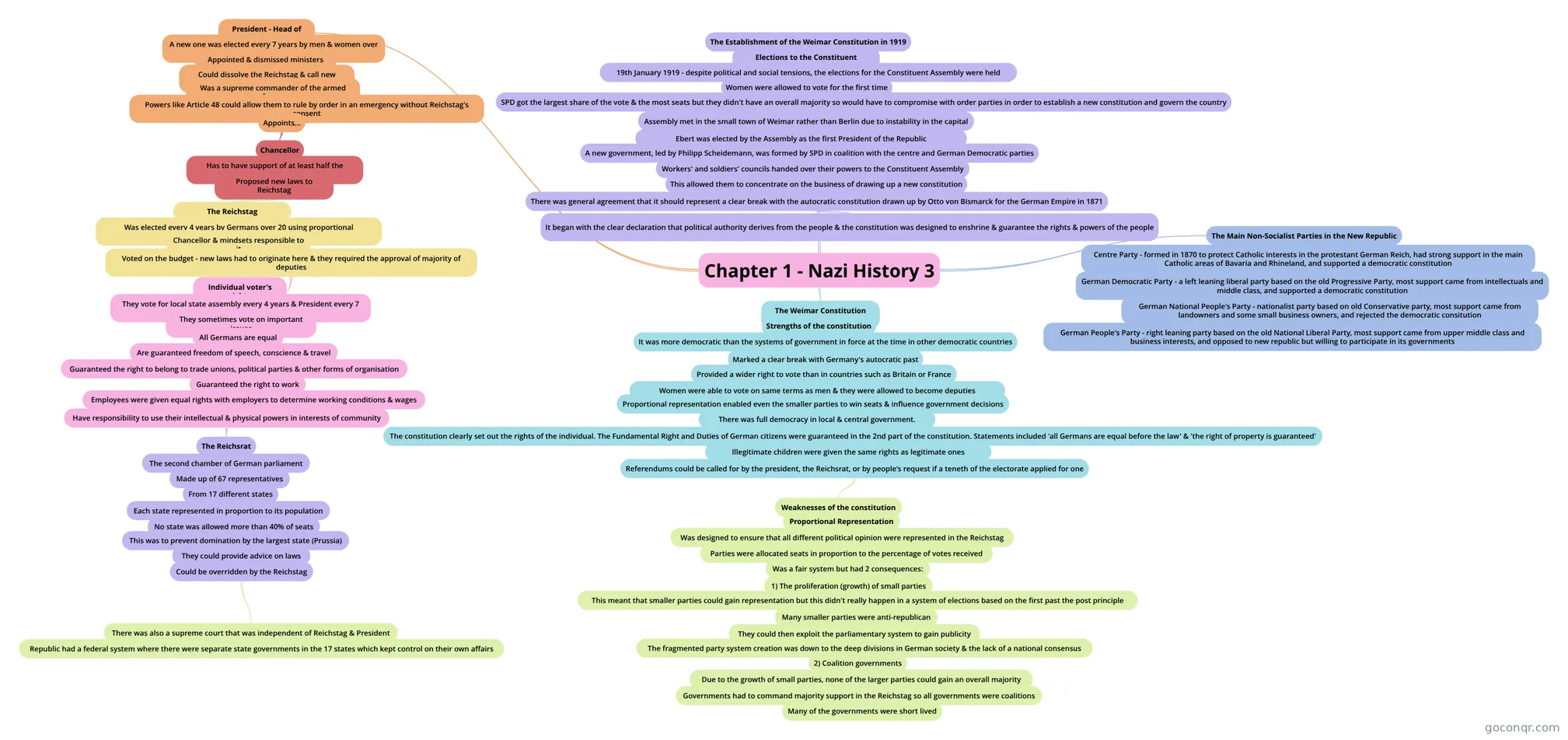
Mind map: Chapter 1 Nazi history
Map content
Chapter 1 - Nazi History 3
The Establishment of the Weimar Constitution in 1919
- Elections to the Constituent Assembly
- 19th January 1919 - despite political and social tensions, the elections for the Constituent Assembly were held
- Women were allowed to vote for the first time
- SPD got the largest share of the vote & the most seats but they didn't have an overall majority so would have to compromise with order parties in order to establish a new constitution and govern the country
- Assembly met in the small town of Weimar rather than Berlin due to instability in the capital
- Ebert was elected by the Assembly as the first President of the Republic
- A new government, led by Philipp Scheidemann, was formed by SPD in coalition with the centre and German Democratic parties
- Workers' and soldiers' councils handed over their powers to the Constituent Assembly
- This allowed them to concentrate on the business of drawing up a new constitution
- There was general agreement that it should represent a clear break with the autocratic constitution drawn up by Otto von Bismarck for the German Empire in 1871
- It began with the clear declaration that political authority derives from the people & the constitution was designed to enshrine & guarantee the rights & powers of the people
- There was general agreement that it should represent a clear break with the autocratic constitution drawn up by Otto von Bismarck for the German Empire in 1871
- This allowed them to concentrate on the business of drawing up a new constitution
- Workers' and soldiers' councils handed over their powers to the Constituent Assembly
- A new government, led by Philipp Scheidemann, was formed by SPD in coalition with the centre and German Democratic parties
- Ebert was elected by the Assembly as the first President of the Republic
- Assembly met in the small town of Weimar rather than Berlin due to instability in the capital
- SPD got the largest share of the vote & the most seats but they didn't have an overall majority so would have to compromise with order parties in order to establish a new constitution and govern the country
- Women were allowed to vote for the first time
- 19th January 1919 - despite political and social tensions, the elections for the Constituent Assembly were held
- Elections to the Constituent Assembly
The Main Non-Socialist Parties in the New Republic
- Centre Party - formed in 1870 to protect Catholic interests in the protestant German Reich, had strong support in the main Catholic areas of Bavaria and Rhineland, and supported a democratic constitution
- German Democratic Party - a left leaning liberal party based on the old Progressive Party, most support came from intellectuals and middle class, and supported a democratic constitution
- German National People's Party - nationalist party based on old Conservative party, most support came from landowners and some small business owners, and rejected the democratic consitution
- German People's Party - right leaning party based on the old National Liberal Party, most support came from upper middle class and business interests, and opposed to new republic but willing to participate in its governments
- German National People's Party - nationalist party based on old Conservative party, most support came from landowners and some small business owners, and rejected the democratic consitution
- German Democratic Party - a left leaning liberal party based on the old Progressive Party, most support came from intellectuals and middle class, and supported a democratic constitution
- Centre Party - formed in 1870 to protect Catholic interests in the protestant German Reich, had strong support in the main Catholic areas of Bavaria and Rhineland, and supported a democratic constitution
The Weimar Constitution 1919
- Strengths of the constitution
- It was more democratic than the systems of government in force at the time in other democratic countries
- Marked a clear break with Germany's autocratic past
- Provided a wider right to vote than in countries such as Britain or France
- Women were able to vote on same terms as men & they were allowed to become deputies
- Proportional representation enabled even the smaller parties to win seats & influence government decisions
- There was full democracy in local & central government.
- The constitution clearly set out the rights of the individual. The Fundamental Right and Duties of German citizens were guaranteed in the 2nd part of the constitution. Statements included 'all Germans are equal before the law' & 'the right of property is guaranteed'
- Illegitimate children were given the same rights as legitimate ones
- Referendums could be called for by the president, the Reichsrat, or by people's request if a teneth of the electorate applied for one
- Weaknesses of the constitution
- Proportional Representation
- Was designed to ensure that all different political opinion were represented in the Reichstag
- Parties were allocated seats in proportion to the percentage of votes received
- Was a fair system but had 2 consequences:
- 1) The proliferation (growth) of small parties
- This meant that smaller parties could gain representation but this didn't really happen in a system of elections based on the first past the post principle
- Many smaller parties were anti-republican
- They could then exploit the parliamentary system to gain publicity
- The fragmented party system creation was down to the deep divisions in German society & the lack of a national consensus
- 2) Coalition governments
- Due to the growth of small parties, none of the larger parties could gain an overall majority
- Governments had to command majority support in the Reichstag so all governments were coalitions
- Many of the governments were short lived
- Governments had to command majority support in the Reichstag so all governments were coalitions
- Due to the growth of small parties, none of the larger parties could gain an overall majority
- 2) Coalition governments
- The fragmented party system creation was down to the deep divisions in German society & the lack of a national consensus
- They could then exploit the parliamentary system to gain publicity
- Many smaller parties were anti-republican
- This meant that smaller parties could gain representation but this didn't really happen in a system of elections based on the first past the post principle
- 1) The proliferation (growth) of small parties
- Was a fair system but had 2 consequences:
- Parties were allocated seats in proportion to the percentage of votes received
- Was designed to ensure that all different political opinion were represented in the Reichstag
- Proportional Representation
- Weaknesses of the constitution
- Referendums could be called for by the president, the Reichsrat, or by people's request if a teneth of the electorate applied for one
- Illegitimate children were given the same rights as legitimate ones
- The constitution clearly set out the rights of the individual. The Fundamental Right and Duties of German citizens were guaranteed in the 2nd part of the constitution. Statements included 'all Germans are equal before the law' & 'the right of property is guaranteed'
- There was full democracy in local & central government.
- Proportional representation enabled even the smaller parties to win seats & influence government decisions
- Women were able to vote on same terms as men & they were allowed to become deputies
- Provided a wider right to vote than in countries such as Britain or France
- Marked a clear break with Germany's autocratic past
- It was more democratic than the systems of government in force at the time in other democratic countries
- Strengths of the constitution
President - Head of State
- A new one was elected every 7 years by men & women over 20
- Appointed & dismissed ministers
- Could dissolve the Reichstag & call new elections
- Was a supreme commander of the armed forces
- Powers like Article 48 could allow them to rule by order in an emergency without Reichstag's consent
- Appoints...
- Chancellor
- Has to have support of at least half the Reichstag
- Proposed new laws to Reichstag
- The Reichstag
- Was elected every 4 years by Germans over 20 using proportional representation
- Chancellor & mindsets responsible to it
- Voted on the budget - new laws had to originate here & they required the approval of majority of deputies
- Individual voter's rights
- They vote for local state assembly every 4 years & President every 7 years
- They sometimes vote on important issues
- All Germans are equal
- Are guaranteed freedom of speech, conscience & travel
- Guaranteed the right to belong to trade unions, political parties & other forms of organisation
- Guaranteed the right to work
- Employees were given equal rights with employers to determine working conditions & wages
- Have responsibility to use their intellectual & physical powers in interests of community
- The Reichsrat
- The second chamber of German parliament
- Made up of 67 representatives
- From 17 different states
- Each state represented in proportion to its population
- No state was allowed more than 40% of seats
- This was to prevent domination by the largest state (Prussia)
- They could provide advice on laws
- Could be overridden by the Reichstag
- There was also a supreme court that was independent of Reichstag & President
- Republic had a federal system where there were separate state governments in the 17 states which kept control on their own affairs
- There was also a supreme court that was independent of Reichstag & President
- Could be overridden by the Reichstag
- They could provide advice on laws
- This was to prevent domination by the largest state (Prussia)
- No state was allowed more than 40% of seats
- Each state represented in proportion to its population
- From 17 different states
- Made up of 67 representatives
- The second chamber of German parliament
- The Reichsrat
- Have responsibility to use their intellectual & physical powers in interests of community
- Employees were given equal rights with employers to determine working conditions & wages
- Guaranteed the right to work
- Guaranteed the right to belong to trade unions, political parties & other forms of organisation
- Are guaranteed freedom of speech, conscience & travel
- All Germans are equal
- They sometimes vote on important issues
- They vote for local state assembly every 4 years & President every 7 years
- Individual voter's rights
- Voted on the budget - new laws had to originate here & they required the approval of majority of deputies
- Chancellor & mindsets responsible to it
- Was elected every 4 years by Germans over 20 using proportional representation
- The Reichstag
- Proposed new laws to Reichstag
- Has to have support of at least half the Reichstag
- Chancellor
- Appoints...
- Powers like Article 48 could allow them to rule by order in an emergency without Reichstag's consent
- Was a supreme commander of the armed forces
- Could dissolve the Reichstag & call new elections
- Appointed & dismissed ministers
- A new one was elected every 7 years by men & women over 20
Information
- Description
- Mind Map on Chapter 1 - Nazi History 3, created by dmcelhattont10 on 20/11/2015.
- Created by
- dmcelhattont10
- Views
- 3
- Rating
More on Weimar Constitution and Government