
Mind map
Ecology and it's Domain; Conditions; Resources
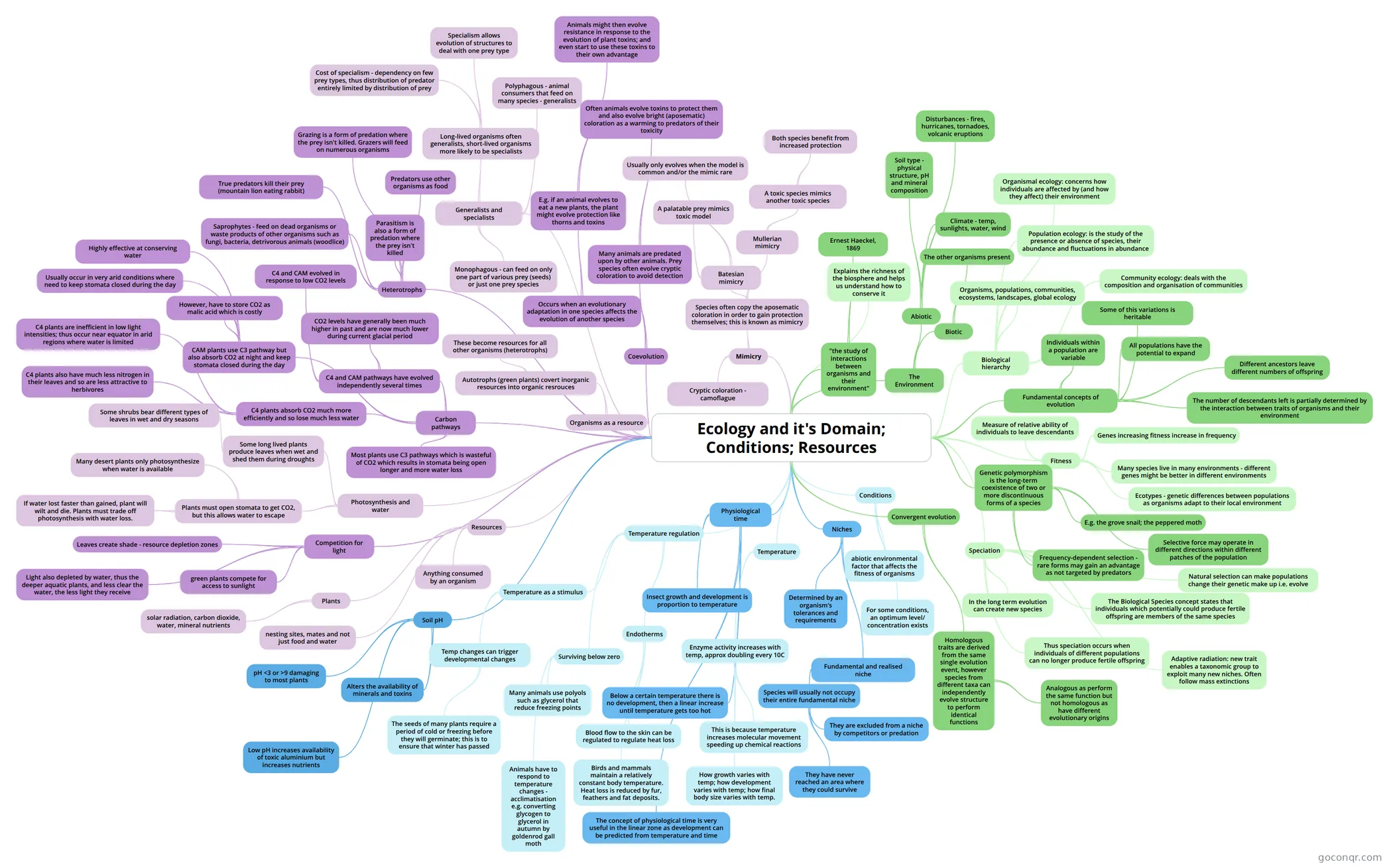
Mind map: Ecology and its Domain, Conditions, Resources
Map content
Ecology and it's Domain; Conditions; Resources
"the study of interactions between organisms and their environment"
- Ernest Haeckel, 1869
Explains the richness of the biosphere and helps us understand how to conserve it
The Environment
- Abiotic
- Climate - temp, sunlights, water, wind
- Soil type - physical structure, pH and mineral composition
- Disturbances - fires, hurricanes, tornadoes, volcanic eruptions
- Biotic
- The other organisms present
- Abiotic
Biological hierarchy
- Organisms, populations, communities, ecosystems, landscapes, global ecology
- Organismal ecology: concerns how individuals are affected by (and how they affect) their environment
- Population ecology: is the study of the presence or absence of species, their abundance and fluctuations in abundance
- Community ecology: deals with the composition and organisation of communities
Fundamental concepts of evolution
- Individuals within a population are variable
- Some of this variations is heritable
- All populations have the potential to expand
- Different ancestors leave different numbers of offspring
- The number of descendants left is partially determined by the interaction between traits of organisms and their environment
Fitness
- Measure of relative ability of individuals to leave descendants
- Genes increasing fitness increase in frequency
- Many species live in many environments - different genes might be better in different environments
- Ecotypes - genetic differences between populations as organisms adapt to their local environment
Genetic polymorphism is the long-term coexistence of two or more discontinuous forms of a species
- E.g. the grove snail; the peppered moth
- Frequency-dependent selection - rare forms may gain an advantage as not targeted by predators
- Selective force may operate in different directions within different patches of the population
Speciation
- Natural selection can make populations change their genetic make up i.e. evolve
- In the long term evolution can create new species
- The Biological Species concept states that individuals which potentially could produce fertile offspring are members of the same species
- Thus speciation occurs when individuals of different populations can no longer produce fertile offspring
- Adaptive radiation: new trait enables a taxonomic group to exploit many new niches. Often follow mass extinctions
Convergent evolution
- Homologous traits are derived from the same single evolution event, however species from different taxa can independently evolve structure to perform identical functions
- Analogous as perform the same function but not homologous as have different evolutionary origins
- Homologous traits are derived from the same single evolution event, however species from different taxa can independently evolve structure to perform identical functions
Conditions
- abiotic environmental factor that affects the fitness of organisms
- For some conditions, an optimum level/ concentration exists
Niches
- Determined by an organism's tolerances and requirements
- Fundamental and realised niche
- Species will usually not occupy their entire fundamental niche
- They have never reached an area where they could survive
- They are excluded from a niche by competitors or predation
- Species will usually not occupy their entire fundamental niche
Temperature
- Enzyme activity increases with temp, approx doubling every 10C
- This is because temperature increases molecular movement speeding up chemical reactions
- How growth varies with temp; how development varies with temp; how final body size varies with temp.
- Enzyme activity increases with temp, approx doubling every 10C
Physiological time
- Insect growth and development is proportion to temperature
- Below a certain temperature there is no development, then a linear increase until temperature gets too hot
- The concept of physiological time is very useful in the linear zone as development can be predicted from temperature and time
Temperature regulation
- Endotherms
- Birds and mammals maintain a relatively constant body temperature. Heat loss is reduced by fur, feathers and fat deposits.
- Blood flow to the skin can be regulated to regulate heat loss
- Surviving below zero
- Many animals use polyols such as glycerol that reduce freezing points
- Animals have to respond to temperature changes - acclimatisation e.g. converting glycogen to glycerol in autumn by goldenrod gall moth
- Temperature as a stimulus
- Temp changes can trigger developmental changes
- The seeds of many plants require a period of cold or freezing before they will germinate; this is to ensure that winter has passed
- Temp changes can trigger developmental changes
- Endotherms
Soil pH
- pH <3 or >9 damaging to most plants
- Alters the availability of minerals and toxins
- Low pH increases availability of toxic aluminium but increases nutrients
Resources
- Anything consumed by an organism
- nesting sites, mates and not just food and water
- Plants
- solar radiation, carbon dioxide, water, mineral nutrients
Competition for light
- green plants compete for access to sunlight
- Leaves create shade - resource depletion zones
- Light also depleted by water, thus the deeper aquatic plants, and less clear the water, the less light they receive
Photosynthesis and water
- Plants must open stomata to get CO2, but this allows water to escape
- If water lost faster than gained, plant will wilt and die. Plants must trade off photosynthesis with water loss.
- Many desert plants only photosynthesize when water is available
- Some long lived plants produce leaves when wet and shed them during droughts
- Some shrubs bear different types of leaves in wet and dry seasons
- Plants must open stomata to get CO2, but this allows water to escape
Carbon pathways
- Most plants use C3 pathways which is wasteful of CO2 which results in stomata being open longer and more water loss
- C4 plants absorb CO2 much more efficiently and so lose much less water
- C4 plants also have much less nitrogen in their leaves and so are less attractive to herbivores
- C4 plants are inefficient in low light intensities; thus occur near equator in arid regions where water is limited
- CAM plants use C3 pathway but also absorb CO2 at night and keep stomata closed during the day
- Highly effective at conserving water
- However, have to store CO2 as malic acid which is costly
- Usually occur in very arid conditions where need to keep stomata closed during the day
- C4 and CAM pathways have evolved independently several times
- CO2 levels have generally been much higher in past and are now much lower during current glacial period
- C4 and CAM evolved in response to low CO2 levels
Organisms as a resource
- Autotrophs (green plants) covert inorganic resources into organic resrouces
- These become resources for all other organisms (heterotrophs)
- Autotrophs (green plants) covert inorganic resources into organic resrouces
Heterotrophs
- Saprophytes - feed on dead organisms or waste products of other organisms such as fungi, bacteria, detrivorous animals (woodlice)
- Predators use other organisms as food
- True predators kill their prey (mountain lion eating rabbit)
- Grazing is a form of predation where the prey isn't killed. Grazers will feed on numerous organisms
- Parasitism is also a form of predation where the prey isn't killed
Generalists and specialists
- Polyphagous - animal consumers that feed on many species - generalists
- Monophagous - can feed on only one part of various prey (seeds) or just one prey species
- Long-lived organisms often generalists, short-lived organisms more likely to be specialists
- Specialism allows evolution of structures to deal with one prey type
- Cost of specialism - dependency on few prey types, thus distribution of predator entirely limited by distribution of prey
Coevolution
- Occurs when an evolutionary adaptation in one species affects the evolution of another species
- E.g. if an animal evolves to eat a new plants, the plant might evolve protection like thorns and toxins
- Animals might then evolve resistance in response to the evolution of plant toxins; and even start to use these toxins to their own advantage
- E.g. if an animal evolves to eat a new plants, the plant might evolve protection like thorns and toxins
- Many animals are predated upon by other animals. Prey species often evolve cryptic coloration to avoid detection
- Often animals evolve toxins to protect them and also evolve bright (aposematic) coloration as a warming to predators of their toxicity
- Occurs when an evolutionary adaptation in one species affects the evolution of another species
Mimicry
- Species often copy the aposematic coloration in order to gain protection themselves; this is known as mimicry
- Batesian mimicry
- A palatable prey mimics toxic model
- Usually only evolves when the model is common and/or the mimic rare
- Mullerian mimicry
- A toxic species mimics another toxic species
- Both species benefit from increased protection
- A toxic species mimics another toxic species
- Batesian mimicry
- Cryptic coloration - camoflague
- Species often copy the aposematic coloration in order to gain protection themselves; this is known as mimicry
Information
- Description
- university Environmental Geography Mind Map on Ecology and it's Domain; Conditions; Resources, created by Calli Dougall on 05/12/2015.
- Created by
- Calli Dougall
- Views
- 2
- Rating