
Mind map
Protein Metabolism and Urea Cycle
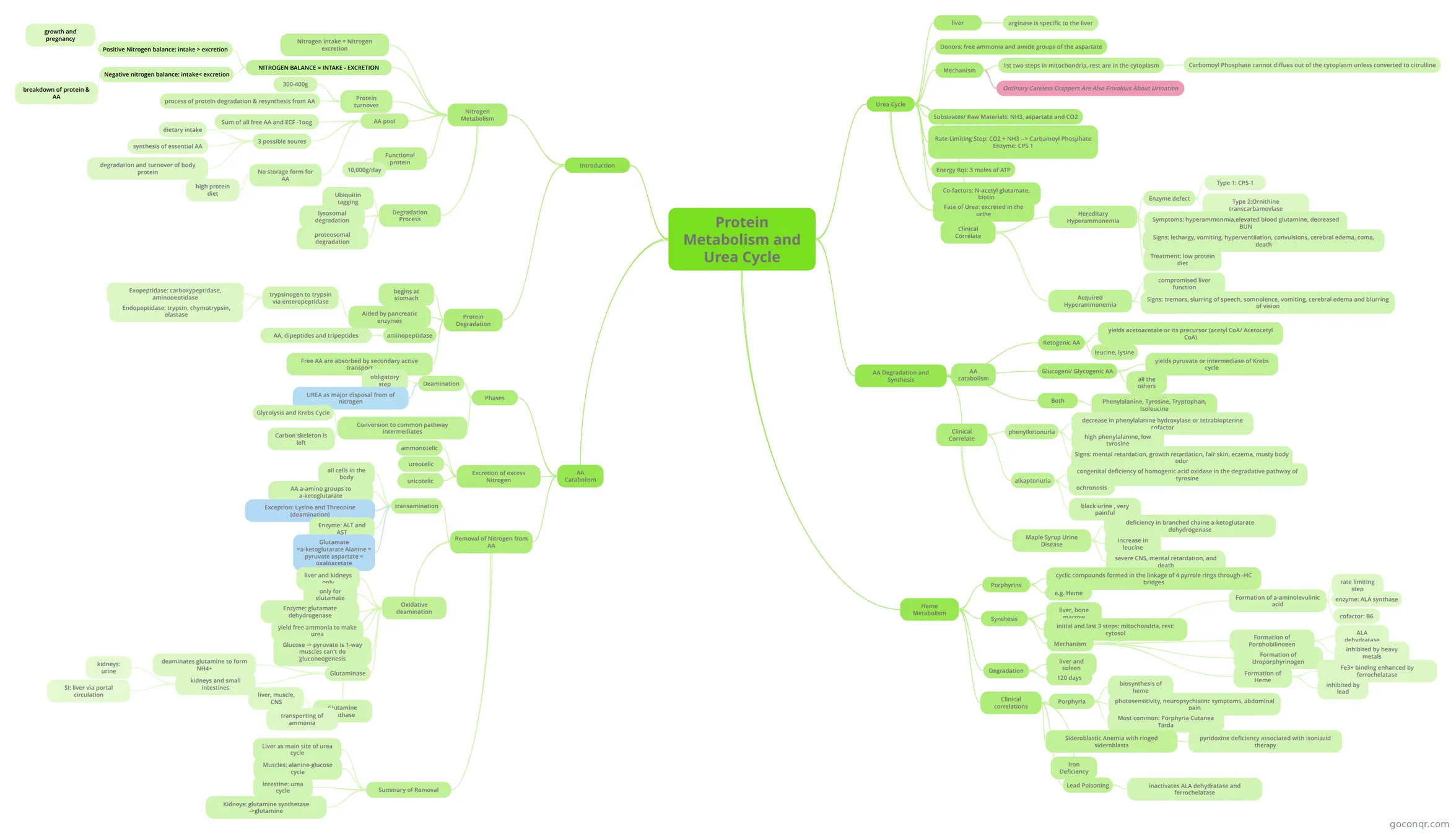
Mind map: Protein metabolism and urea cycle
Map content
Protein Metabolism and Urea Cycle
Introduction
- Nitrogen Metabolism
- NITROGEN BALANCE = INTAKE - EXCRETION
- Positive Nitrogen balance: intake > excretion
- growth and pregnancy
- Negative nitrogen balance: intake< excretion
- breakdown of protein & AA
- Positive Nitrogen balance: intake > excretion
- Nitrogen intake = Nitrogen excretion
- Protein turnover
- process of protein degradation & resynthesis from AA
- 300-400g
- AA pool
- Sum of all free AA and ECF -1oog
- 3 possible soures
- dietary intake
- synthesis of essential AA
- degradation and turnover of body protein
- No storage form for AA
- high protein diet
- Functional protein
- 10,000g/day
- Degradation Process
- Ubiquitin tagging
- lysosomal degradation
- proteosomal degradation
- NITROGEN BALANCE = INTAKE - EXCRETION
- Protein Degradation
- begins at stomach
- Aided by pancreatic enzymes
- trypsinogen to trypsin via enteropeptidase
- Exopeptidase: carboxypeptidase, aminopeptidase
- Endopeptidase: trypsin, chymotrypsin, elastase
- trypsinogen to trypsin via enteropeptidase
- aminopeptidase
- AA, dipeptides and tripeptides
- Free AA are absorbed by secondary active transport
- Nitrogen Metabolism
AA Catabolism
- Phases
- Deamination
- obligatory step
- UREA as major disposal from of nitrogen
- Conversion to common pathway intermediates
- Glycolysis and Krebs Cycle
- Carbon skeleton is left
- Deamination
- Excretion of excess Nitrogen
- ammonotelic
- toxic
- ureotelic
- non toxic water soluble urea
- uricotelic
- uric acid as semisolid guano
- ammonotelic
- Removal of Nitrogen from AA
- transamination
- all cells in the body
- AA a-amino groups to a-ketoglutarate
- Exception: Lysine and Threonine (deamination)
- Enzyme: ALT and AST
- ALT - alanine aminotransferase - pyruvate and alanine interconvert with transamination AST - aspartate aminotransferase -aspartate and oxaloacetate interconvert with transamination
- Glutamate =a-ketoglutarate Alanine = pyruvate aspartate = oxaloacetate
- Oxidative deamination
- liver and kidneys only
- only for glutamate
- Enzyme: glutamate dehydrogenase
- yield free ammonia to make urea
- Glucose -> pyruvate is 1-way muscles can't do gluconeogenesis
- Glutaminase
- deaminates glutamine to form NH4+
- kidneys and small intestines
- kidneys: urine
- SI: liver via portal circulation
- Glutamine synthase
- liver, muscle, CNS
- transporting of ammonia
- Summary of Removal
- Liver as main site of urea cycle
- Muscles: alanine-glucose cycle
- Intestine: urea cycle
- Kidneys: glutamine synthetase ->glutamine
- transamination
- Phases
Urea Cycle
- liver
- arginase is specific to the liver
- Donors: free ammonia and amide groups of the aspartate
- Mechanism
- 1st two steps in mitochondria, rest are in the cytoplasm
- Carbomoyl Phosphate cannot diffues out of the cytoplasm unless converted to citrulline
- Ordinary Careless Crappers Are Also Frivolous About Urination
- Ornithine + Carbomoyl Phosphate = Citrulline Citrulline + Aspartate = Arginosuccinate Arginosuccinate = Fumarate + Arginine Arginine = Urea + Ornithine
- 1st two steps in mitochondria, rest are in the cytoplasm
- Substrates/ Raw Materials: NH3, aspartate and CO2
- Rate Limiting Step: CO2 + NH3 --> Carbamoyl Phosphate Enzyme: CPS 1
- Energy Rqt: 3 moles of ATP
- Co-factors: N-acetyl glutamate, biotin
- Fate of Urea: excreted in the urine
- Clinical Correlate
- Hereditary Hyperammonemia
- Enzyme defect
- Type 1: CPS-1
- Type 2:Ornithine transcarbamoylase
- Symptoms: hyperammonmia,elevated blood glutamine, decreased BUN
- Signs: lethargy, vomiting, hyperventilation, convulsions, cerebral edema, coma, death
- Treatment: low protein diet
- Enzyme defect
- Acquired Hyperammonemia
- compromised liver function
- Signs: tremors, slurring of speech, somnolence, vomiting, cerebral edema and blurring of vision
- Hereditary Hyperammonemia
- liver
AA Degradation and Synthesis
- Ketogenic AA
- yields acetoacetate or its precursor (acetyl CoA/ Acetocetyl CoA)
- leucine, lysine
- Glucogeni/ Glycogenic AA
- yields pyruvate or intermediase of Krebs cycle
- all the others
- Both
- Phenylalanine, Tyrosine, Tryptophan, Isoleucine
- AA catabolism
- Clinical Correlate
- phenylketonuria
- decrease in phenylalanine hydroxylase or tetrabiopterine cofactor
- high phenylalanine, low tyrosine
- Signs: mental retardation, growth retardation, fair skin, eczema, musty body odor
- alkaptonuria
- congenital deficiency of homogenic acid oxidase in the degradative pathway of tyrosine
- ochronosis
- connective tissue is black
- black urine , very painful
- Maple Syrup Urine Disease
- deficiency in branched chaine a-ketoglutarate dehydrogenase
- increase in leucine
- severe CNS, mental retardation, and death
- phenylketonuria
- Ketogenic AA
Heme Metabolism
- Porphyrins
- cyclic compounds formed in the linkage of 4 pyrrole rings through -HC bridges
- e.g. Heme
- Synthesis
- liver, bone marrow
- initial and last 3 steps: mitochondria, rest: cytosol
- Mechanism
- Formation of a-aminolevulinic acid
- rate limiting step
- enzyme: ALA synthase
- cofactor: B6
- Formation of Porphobilinogen
- ALA dehydratase
- inhibited by heavy metals
- Formation of Uroporphyrinogen
- Formation of Heme
- Fe3+ binding enhanced by ferrochelatase
- inhibited by lead
- Formation of a-aminolevulinic acid
- Degradation
- liver and spleen
- 120 days
- Clinical correlations
- Porphyria
- biosynthesis of heme
- photosensitivity, neuropsychiatric symptoms, abdominal pain
- Most common: Porphyria Cutanea Tarda
- Sideroblastic Anemia with ringed sideroblasts
- pyridoxine deficiency associated with isoniazid therapy
- Iron Deficiency
- Lead Poisoning
- inactivates ALA dehydratase and ferrochelatase
- Porphyria
- Porphyrins
Information
- Description
- Mind Map on Protein Metabolism and Urea Cycle, created by doggie_woof22 on 07/12/2013.
- Created by
- doggie_woof22
- Views
- 74
- Rating