
Mind map
BUSS 3 (Unfinshed)
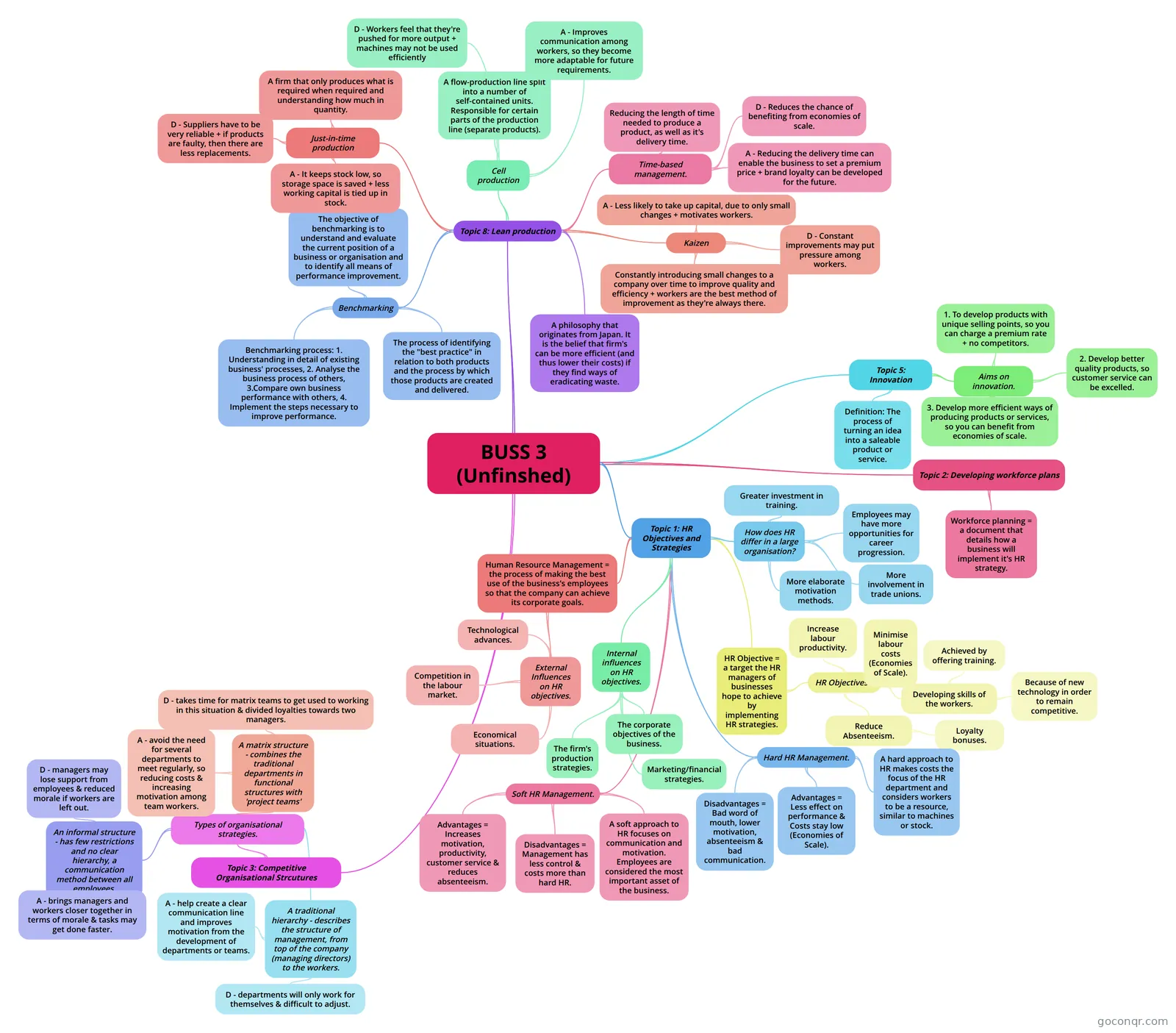
Mind map: BUSS 3 business studies
Map content
BUSS 3 (Unfinshed)
Topic 1: HR Objectives and Strategies
- Human Resource Management = the process of making the best use of the business's employees so that the company can achieve its corporate goals.
- External Influences on HR objectives.
- Economical situations.
- Technological advances.
- Competition in the labour market.
- External Influences on HR objectives.
- How does HR differ in a large organisation?
- Greater investment in training.
- More elaborate motivation methods.
- Employees may have more opportunities for career progression.
- More involvement in trade unions.
- HR Objective = a target the HR managers of businesses hope to achieve by implementing HR strategies.
- HR Objectives...
- Reduce Absenteeism.
- Loyalty bonuses.
- Increase labour productivity.
- Minimise labour costs (Economies of Scale).
- Developing skills of the workers.
- Because of new technology in order to remain competitive.
- Achieved by offering training.
- Reduce Absenteeism.
- HR Objectives...
- Internal influences on HR objectives.
- The corporate objectives of the business.
- The firm's production strategies.
- Marketing/financial strategies.
- Hard HR Management.
- A hard approach to HR makes costs the focus of the HR department and considers workers to be a resource, similar to machines or stock.
- Advantages = Less effect on performance & Costs stay low (Economies of Scale).
- Disadvantages = Bad word of mouth, lower motivation, absenteeism & bad communication.
- Soft HR Management.
- A soft approach to HR focuses on communication and motivation. Employees are considered the most important asset of the business.
- Advantages = Increases motivation, productivity, customer service & reduces absenteeism.
- Disadvantages = Management has less control & costs more than hard HR.
- Human Resource Management = the process of making the best use of the business's employees so that the company can achieve its corporate goals.
Topic 2: Developing workforce plans
- Workforce planning = a document that details how a business will implement it's HR strategy.
Topic 3: Competitive Organisational Strcutures
- Types of organisational strategies.
- A traditional hierarchy - describes the structure of management, from top of the company (managing directors) to the workers.
- A - help create a clear communication line and improves motivation from the development of departments or teams.
- D - departments will only work for themselves & difficult to adjust.
- A matrix structure - combines the traditional departments in functional structures with 'project teams'
- A - avoid the need for several departments to meet regularly, so reducing costs & increasing motivation among team workers.
- D - takes time for matrix teams to get used to working in this situation & divided loyalties towards two managers.
- An informal structure - has few restrictions and no clear hierarchy, a communication method between all employees.
- A - brings managers and workers closer together in terms of morale & tasks may get done faster.
- D - managers may lose support from employees & reduced morale if workers are left out.
- A traditional hierarchy - describes the structure of management, from top of the company (managing directors) to the workers.
- Types of organisational strategies.
Topic 5: Innovation
- Definition: The process of turning an idea into a saleable product or service.
- Aims on innovation.
- 1. To develop products with unique selling points, so you can charge a premium rate + no competitors.
- 2. Develop better quality products, so customer service can be excelled.
- 3. Develop more efficient ways of producing products or services, so you can benefit from economies of scale.
Topic 8: Lean production
- A philosophy that originates from Japan. It is the belief that firm's can be more efficient (and thus lower their costs) if they find ways of eradicating waste.
- Time-based management.
- Reducing the length of time needed to produce a product, as well as it's delivery time.
- A - Reducing the delivery time can enable the business to set a premium price + brand loyalty can be developed for the future.
- D - Reduces the chance of benefiting from economies of scale.
- Kaizen
- Constantly introducing small changes to a company over time to improve quality and efficiency + workers are the best method of improvement as they're always there.
- A - Less likely to take up capital, due to only small changes + motivates workers.
- D - Constant improvements may put pressure among workers.
- Cell production
- A flow-production line split into a number of self-contained units. Responsible for certain parts of the production line (separate products).
- A - Improves communication among workers, so they become more adaptable for future requirements.
- D - Workers feel that they're pushed for more output + machines may not be used efficiently
- Benchmarking
- The process of identifying the "best practice" in relation to both products and the process by which those products are created and delivered.
- The objective of benchmarking is to understand and evaluate the current position of a business or organisation and to identify all means of performance improvement.
- Benchmarking process: 1. Understanding in detail of existing business' processes, 2. Analyse the business process of others, 3.Compare own business performance with others, 4. Implement the steps necessary to improve performance.
- Just-in-time production
- A firm that only produces what is required when required and understanding how much in quantity.
- A - It keeps stock low, so storage space is saved + less working capital is tied up in stock.
- D - Suppliers have to be very reliable + if products are faulty, then there are less replacements.
Information
- Description
- Mind Map on BUSS 3 (Unfinshed), created by mattkiruba on 10/12/2013.
- Created by
- mattkiruba
- Views
- 52
- Rating