
4636743
Description

Mind Map by Emily Sutton, updated more than 1 year ago
|
|
Created by Emily Sutton
almost 10 years ago
|
|
Comparing rates of transpiration using a potometer
- Measure water uptake, but most of the water taken up by
a leafy shoot is lost through transpiration, so the rate of
uptake is almost the same as rate of transpiration
- can be used to measure water uptake by the same shoot
under different conditions or can compare the uptake by
leafy shoots of different species under the same conditions
- can be used to measure water uptake by the same shoot
under different conditions or can compare the uptake by
leafy shoots of different species under the same conditions
- How to set up a potometer:
- 1) cut leafy shoot under water, so no air enters xylem
- 2) Under water, fill potometer with water, ensure no air bubbles
- 3) fit leafy shoot to potometer with rubber tubing under water, to
prevent air bubbles forming in apparatus of xylem
- 4) remove potometer and shoot from water, seal joints with Vaseline and dry carefully
- 5) Introduce an air bubble or meniscus into capillary tube
- 6) Measure distance air bubble or meniscus moves in a given time
- 7) use water reservoir to bring air bubble or meniscus back to the start point. Repeat
measurement number of times and calculate mean distance
- 8) experiment may be repeated to compare rates of water uptake under different conditions, eg altered light intensity or air movement
- 8) experiment may be repeated to compare rates of water uptake under different conditions, eg altered light intensity or air movement
- 7) use water reservoir to bring air bubble or meniscus back to the start point. Repeat
measurement number of times and calculate mean distance
- 6) Measure distance air bubble or meniscus moves in a given time
- 5) Introduce an air bubble or meniscus into capillary tube
- 4) remove potometer and shoot from water, seal joints with Vaseline and dry carefully
- 3) fit leafy shoot to potometer with rubber tubing under water, to
prevent air bubbles forming in apparatus of xylem
- 2) Under water, fill potometer with water, ensure no air bubbles
- 1) cut leafy shoot under water, so no air enters xylem
- Practical Exercises
- Method using a constant time:
- 1) Set up the potometer as described below
- 2) Ensure air bubble is moving along scale
- 3) Measure distance, mm, that air bubble travels in 300 seconds
- 4) Repeat reading 4 more times, moving
air bubble to beginning of scale with water
from reservoir, as necessary, and calculate
mean distance
- 5) rate of air bubble movement calculated as: mean rate of air bubble movement
= mean distance moved by air bubble in 300 secs / 300
- mm s^-1
- mm s^-1
- 5) rate of air bubble movement calculated as: mean rate of air bubble movement
= mean distance moved by air bubble in 300 secs / 300
- 4) Repeat reading 4 more times, moving
air bubble to beginning of scale with water
from reservoir, as necessary, and calculate
mean distance
- 3) Measure distance, mm, that air bubble travels in 300 seconds
- 2) Ensure air bubble is moving along scale
- 1) Set up the potometer as described below
- Alternative method using constant
distance
- 1) set up potometer
- 2) Ensure air bubble moving along
scale
- 3) Record time taken, secs, for air bubble to move
20mm
- 4) repeat 4 times
- 5) mean rate of air bubble movement = 20 / mean time to move 20mm
- mm s^-1
- mm s^-1
- 5) mean rate of air bubble movement = 20 / mean time to move 20mm
- 4) repeat 4 times
- 3) Record time taken, secs, for air bubble to move
20mm
- 2) Ensure air bubble moving along
scale
- 1) set up potometer
- Method using a constant time:
- Converting rate of air bubble movement into rate of transpiration:
- 1) measure diameter of capillary in mm with ruler. Area of cross section is (pi r^2)
- 2) distance the air bubble has moved in given time (h) is found as above
- 3) volume of water taken up into shoot = (pi r^2 h) mm^3s^-1
- 3) volume of water taken up into shoot = (pi r^2 h) mm^3s^-1
- 2) distance the air bubble has moved in given time (h) is found as above
- 1) measure diameter of capillary in mm with ruler. Area of cross section is (pi r^2)
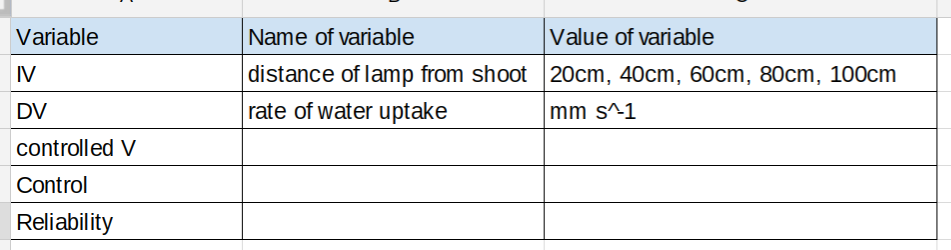
- Experiment to determine the effect
of light intensity on transpiration
- Further work - determine effect of wind
speed on transpiration, as above, with the
apparatus shielded from air movementand
using a hand held hair drier on lowest temp,
point at the shoot.
- Different air speed settings
can show qualitatively the
effect of increased air speed
- air speed measure with anemometer, but can't ensure all leaves exposed to
same air flow, so quantitative experiment cannot be reliably performed
- Different air speed settings
can show qualitatively the
effect of increased air speed
- Further work - determine effect of wind
speed on transpiration, as above, with the
apparatus shielded from air movementand
using a hand held hair drier on lowest temp,
point at the shoot.
Media attachments
Want to create your own Mind Maps for free with GoConqr? Learn more.