
497864
Description

Mind Map by sian.allison, updated more than 1 year ago

|
Created by sian.allison
about 12 years ago
|
|
Covalent Bonding
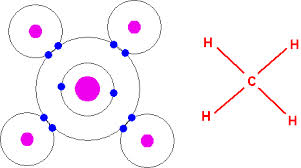
- Covalent Bonding is when atoms share
electrons with each other so they have
full outer shells
- Sharing Electrons
- This gives them a full outer shell with the
electronic structure of a noble gas
- Each covalent bond provides one shared electron for each atom
- Each covalent bond provides one shared electron for each atom
- Each atom has to make enough
covalent bonds to fill up its outer
shell
- This gives them a full outer shell with the
electronic structure of a noble gas
- Simple Molecular substances
- The atoms form very
strong covalent bonds to
form small molecules of
several atoms
- The attraction between these
molecules are very weak
- Intermolecular forces
- Intermolecular forces
- The result of these feeble
intermolecular forces is that the
melting and boiling points are very low
because the molecules are easily
parted from each other
- Its the intermolecular forces that get broken when simple
molecular substances melt or boil. Not the stronger
covalent bonds
- Its the intermolecular forces that get broken when simple
molecular substances melt or boil. Not the stronger
covalent bonds
- Most molecular
substances are gases or
liquids at room temp but
they can be solid
- Molecular substances dont conduct
electricity there are no ions so no electrical
charge
- The atoms form very
strong covalent bonds to
form small molecules of
several atoms
- Giant Covalent Structures are Macromolecules
- Similar to giant ionic structures except there are
no charged ions
- All the atoms are bonded to each
other by strong covalent bonds
- This means that they
have very high melting
and boiling points
- They dont conduct electricity not even when
molten (except graphite)
- The main examples are diamond and
graphite which are both made only from
carbon atoms and silicon dioxide
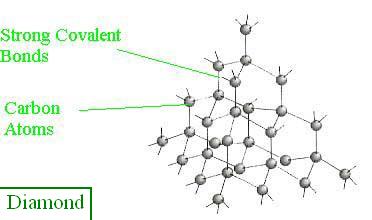
- Diamond
- Each carbon atom forms four covalent bonds in a
very rigid giant covalent structure. This structure
make diamond the hardest natural substance so its
used for drill tips
- Each carbon atom forms four covalent bonds in a
very rigid giant covalent structure. This structure
make diamond the hardest natural substance so its
used for drill tips
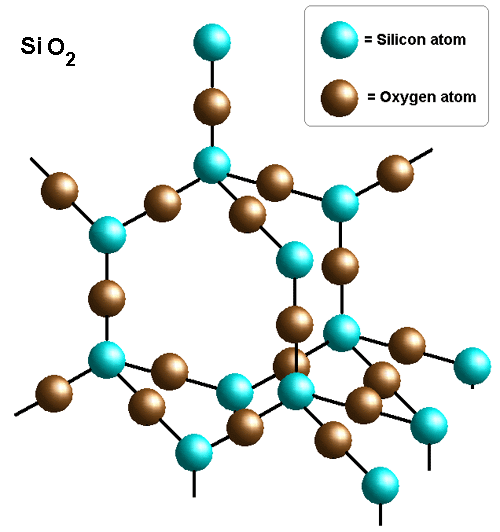
- Silicon Dioxide
- Sometimes called silica this is what sand
is made of. Each grain of sand is one giant
structure of silicon and oxygen
- Sometimes called silica this is what sand
is made of. Each grain of sand is one giant
structure of silicon and oxygen
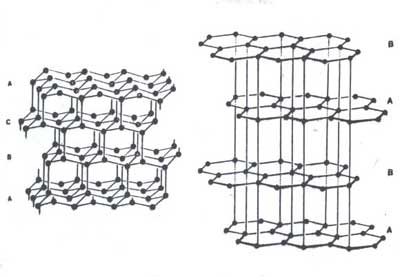
- Graphite
- Each carbon atom only forms three covalent bonds. This creates layers
which are free to slide over each other. So the graphite is soft and slippery.
The layers are held together loosely so that they can be rubbed off onto
paper. This is because of the weak intermolecular forces between the
layers. Graphite is the only non-metal which is a good conductor of heat
and electricity. Each carbon atom has one delocalised (free) electron and
its these free electrons that conduct heat and electricity
- Each carbon atom only forms three covalent bonds. This creates layers
which are free to slide over each other. So the graphite is soft and slippery.
The layers are held together loosely so that they can be rubbed off onto
paper. This is because of the weak intermolecular forces between the
layers. Graphite is the only non-metal which is a good conductor of heat
and electricity. Each carbon atom has one delocalised (free) electron and
its these free electrons that conduct heat and electricity
- Diamond
- Similar to giant ionic structures except there are
no charged ions
Media attachments
Want to create your own Mind Maps for free with GoConqr? Learn more.