
Mind map
Constitutional Foundations and Underpinnings
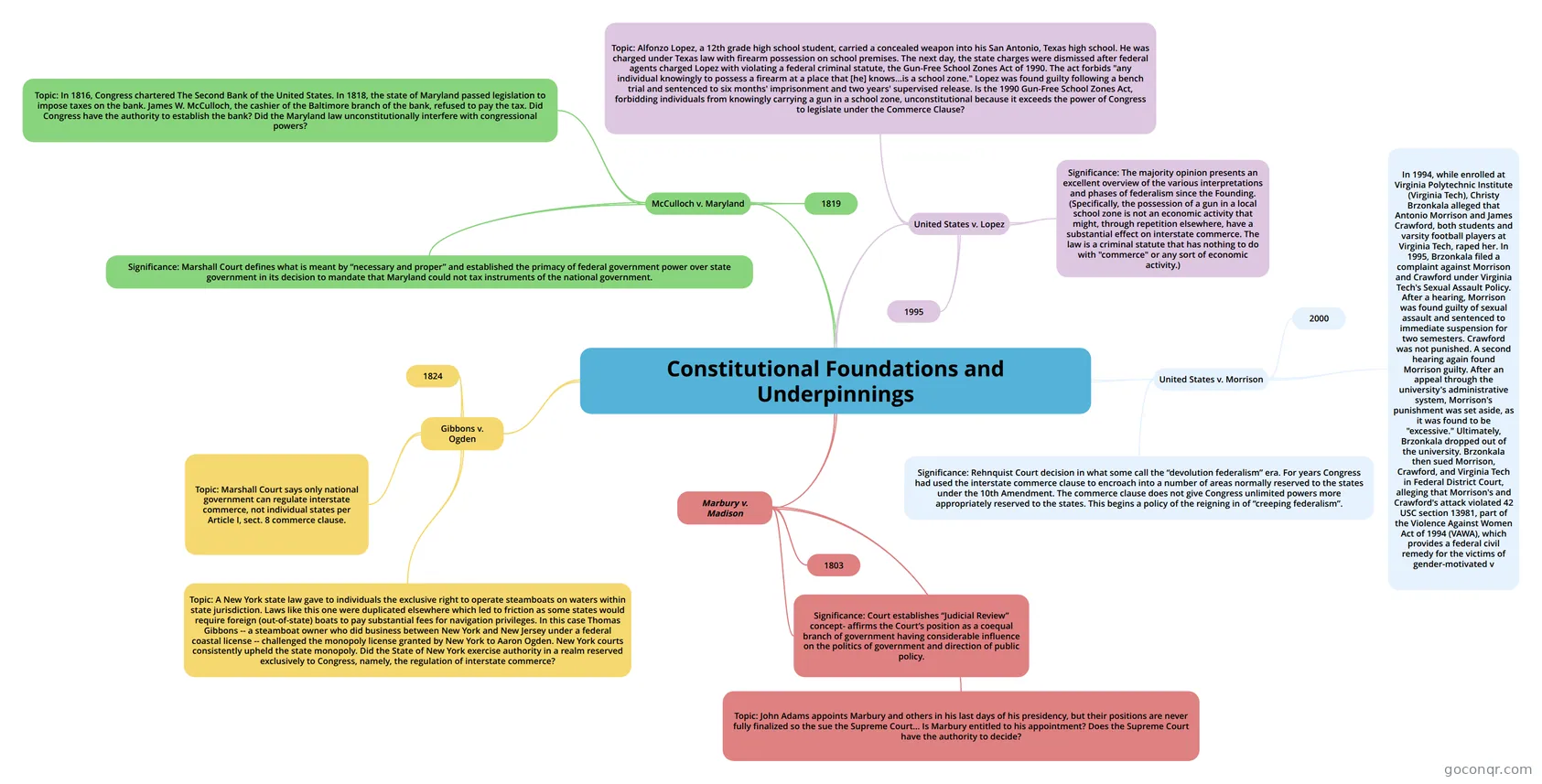
Mind map: Constitutional foundations and underpinnings
Map content
Constitutional Foundations and Underpinnings
Marbury v. Madison
- 1803
- Significance: Court establishes “Judicial Review” concept- affirms the Court’s position as a coequal branch of government having considerable influence on the politics of government and direction of public policy.
- Topic: John Adams appoints Marbury and others in his last days of his presidency, but their positions are never fully finalized so the sue the Supreme Court... Is Marbury entitled to his appointment? Does the Supreme Court have the authority to decide?
Gibbons v. Ogden
- 1824
- Topic: Marshall Court says only national government can regulate interstate commerce, not individual states per Article I, sect. 8 commerce clause.
- Topic: A New York state law gave to individuals the exclusive right to operate steamboats on waters within state jurisdiction. Laws like this one were duplicated elsewhere which led to friction as some states would require foreign (out-of-state) boats to pay substantial fees for navigation privileges. In this case Thomas Gibbons -- a steamboat owner who did business between New York and New Jersey under a federal coastal license -- challenged the monopoly license granted by New York to Aaron Ogden. New York courts consistently upheld the state monopoly. Did the State of New York exercise authority in a realm reserved exclusively to Congress, namely, the regulation of interstate commerce?
United States v. Lopez
- 1995
- Topic: Alfonzo Lopez, a 12th grade high school student, carried a concealed weapon into his San Antonio, Texas high school. He was charged under Texas law with firearm possession on school premises. The next day, the state charges were dismissed after federal agents charged Lopez with violating a federal criminal statute, the Gun-Free School Zones Act of 1990. The act forbids "any individual knowingly to possess a firearm at a place that [he] knows...is a school zone." Lopez was found guilty following a bench trial and sentenced to six months' imprisonment and two years' supervised release. Is the 1990 Gun-Free School Zones Act, forbidding individuals from knowingly carrying a gun in a school zone, unconstitutional because it exceeds the power of Congress to legislate under the Commerce Clause?
- Significance: The majority opinion presents an excellent overview of the various interpretations and phases of federalism since the Founding. (Specifically, the possession of a gun in a local school zone is not an economic activity that might, through repetition elsewhere, have a substantial effect on interstate commerce. The law is a criminal statute that has nothing to do with "commerce" or any sort of economic activity.)
McCulloch v. Maryland
- 1819
- Topic: In 1816, Congress chartered The Second Bank of the United States. In 1818, the state of Maryland passed legislation to impose taxes on the bank. James W. McCulloch, the cashier of the Baltimore branch of the bank, refused to pay the tax. Did Congress have the authority to establish the bank? Did the Maryland law unconstitutionally interfere with congressional powers?
- Significance: Marshall Court defines what is meant by “necessary and proper” and established the primacy of federal government power over state government in its decision to mandate that Maryland could not tax instruments of the national government.
United States v. Morrison
- 2000
- Significance: Rehnquist Court decision in what some call the “devolution federalism” era. For years Congress had used the interstate commerce clause to encroach into a number of areas normally reserved to the states under the 10th Amendment. The commerce clause does not give Congress unlimited powers more appropriately reserved to the states. This begins a policy of the reigning in of “creeping federalism”.
- In 1994, while enrolled at Virginia Polytechnic Institute (Virginia Tech), Christy Brzonkala alleged that Antonio Morrison and James Crawford, both students and varsity football players at Virginia Tech, raped her. In 1995, Brzonkala filed a complaint against Morrison and Crawford under Virginia Tech's Sexual Assault Policy. After a hearing, Morrison was found guilty of sexual assault and sentenced to immediate suspension for two semesters. Crawford was not punished. A second hearing again found Morrison guilty. After an appeal through the university's administrative system, Morrison's punishment was set aside, as it was found to be "excessive." Ultimately, Brzonkala dropped out of the university. Brzonkala then sued Morrison, Crawford, and Virginia Tech in Federal District Court, alleging that Morrison's and Crawford's attack violated 42 USC section 13981, part of the Violence Against Women Act of 1994 (VAWA), which provides a federal civil remedy for the victims of gender-motivated v
Information
- Description
- Mind Map on Constitutional Foundations and Underpinnings, created by seguinkid on 17/04/2016.
- Created by
- seguinkid
- Views
- 5
- Tags
- Rating