
Mind map
Biology - Module 5
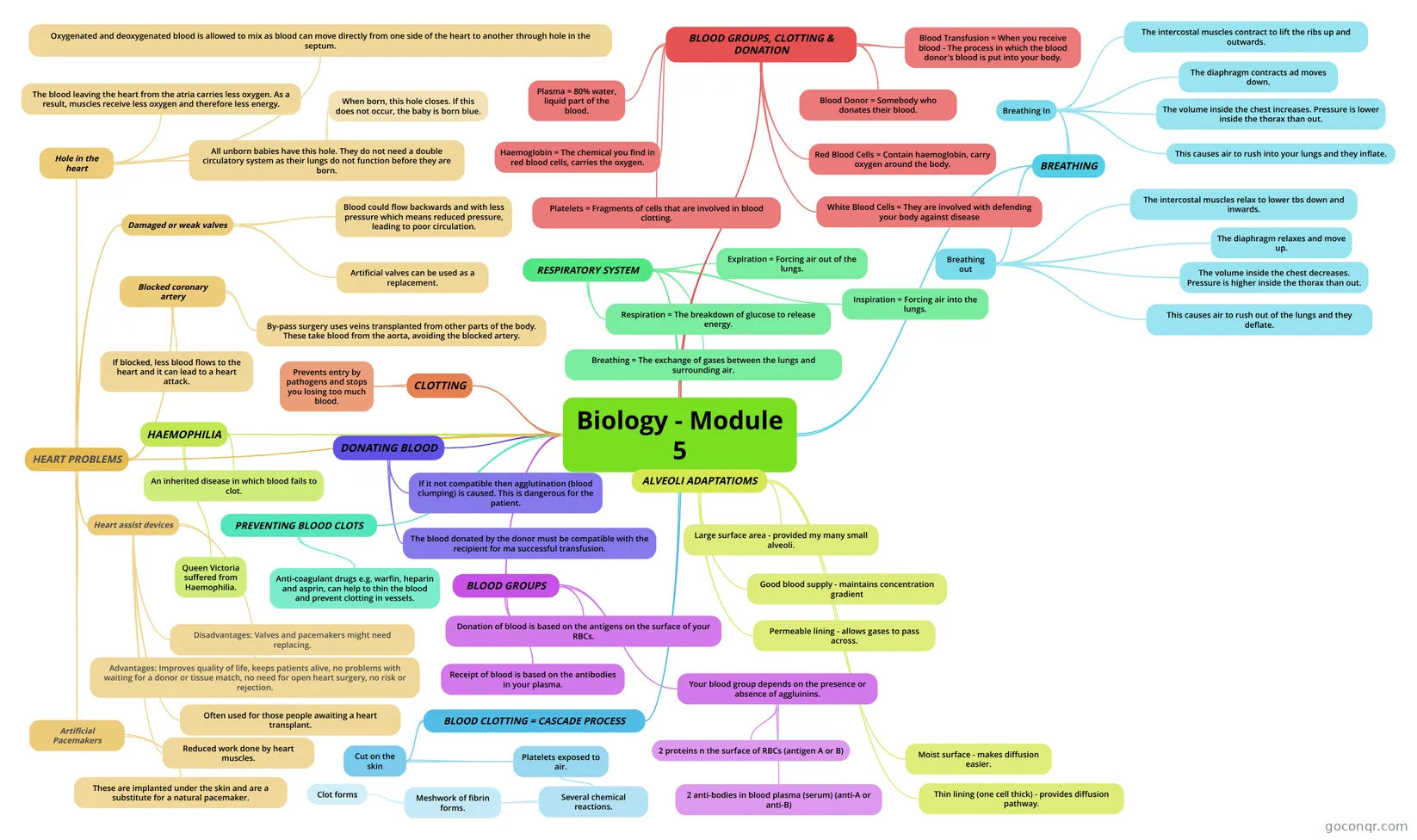
Mind map: Biology module 5: blood and heart
Map content
Biology - Module 5
HEART PROBLEMS
- Hole in the heart
- Oxygenated and deoxygenated blood is allowed to mix as blood can move directly from one side of the heart to another through hole in the septum.
- The blood leaving the heart from the atria carries less oxygen. As a result, muscles receive less oxygen and therefore less energy.
- All unborn babies have this hole. They do not need a double circulatory system as their lungs do not function before they are born.
- When born, this hole closes. If this does not occur, the baby is born blue.
- Damaged or weak valves
- Blood could flow backwards and with less pressure which means reduced pressure, leading to poor circulation.
- Artificial valves can be used as a replacement.
- Blocked coronary artery
- If blocked, less blood flows to the heart and it can lead to a heart attack.
- By-pass surgery uses veins transplanted from other parts of the body. These take blood from the aorta, avoiding the blocked artery.
- Heart assist devices
- Reduced work done by heart muscles.
- Often used for those people awaiting a heart transplant.
- Advantages: Improves quality of life, keeps patients alive, no problems with waiting for a donor or tissue match, no need for open heart surgery, no risk or rejection.
- Disadvantages: Valves and pacemakers might need replacing.
- Artificial Pacemakers
- These are implanted under the skin and are a substitute for a natural pacemaker.
- Hole in the heart
BLOOD GROUPS, CLOTTING & DONATION
- Haemoglobin = The chemical you find in red blood cells, carries the oxygen.
- Platelets = Fragments of cells that are involved in blood clotting.
- White Blood Cells = They are involved with defending your body against disease
- Red Blood Cells = Contain haemoglobin, carry oxygen around the body.
- Plasma = 80% water, liquid part of the blood.
- Blood Donor = Somebody who donates their blood.
- Blood Transfusion = When you receive blood - The process in which the blood donor's blood is put into your body.
CLOTTING
- Prevents entry by pathogens and stops you losing too much blood.
HAEMOPHILIA
- An inherited disease in which blood fails to clot.
- Queen Victoria suffered from Haemophilia.
PREVENTING BLOOD CLOTS
- Anti-coagulant drugs e.g. warfin, heparin and asprin, can help to thin the blood and prevent clotting in vessels.
BLOOD CLOTTING = CASCADE PROCESS
- Cut on the skin
- Platelets exposed to air.
- Several chemical reactions.
- Meshwork of fibrin forms.
- Clot forms
- Meshwork of fibrin forms.
- Several chemical reactions.
- Platelets exposed to air.
- Cut on the skin
DONATING BLOOD
- The blood donated by the donor must be compatible with the recipient for ma successful transfusion.
- If it not compatible then agglutination (blood clumping) is caused. This is dangerous for the patient.
BLOOD GROUPS
- Your blood group depends on the presence or absence of aggluinins.
- 2 proteins n the surface of RBCs (antigen A or B)
- 2 anti-bodies in blood plasma (serum) (anti-A or anti-B)
- Donation of blood is based on the antigens on the surface of your RBCs.
- Receipt of blood is based on the antibodies in your plasma.
- Your blood group depends on the presence or absence of aggluinins.
RESPIRATORY SYSTEM
- Inspiration = Forcing air into the lungs.
- Expiration = Forcing air out of the lungs.
- Breathing = The exchange of gases between the lungs and surrounding air.
- Respiration = The breakdown of glucose to release energy.
BREATHING
- Breathing In
- The intercostal muscles contract to lift the ribs up and outwards.
- The diaphragm contracts ad moves down.
- The volume inside the chest increases. Pressure is lower inside the thorax than out.
- This causes air to rush into your lungs and they inflate.
- Breathing out
- The intercostal muscles relax to lower tbs down and inwards.
- The diaphragm relaxes and move up.
- The volume inside the chest decreases. Pressure is higher inside the thorax than out.
- This causes air to rush out of the lungs and they deflate.
- Breathing In
ALVEOLI ADAPTATIOMS
- Good blood supply - maintains concentration gradient
- Large surface area - provided my many small alveoli.
- Permeable lining - allows gases to pass across.
- Moist surface - makes diffusion easier.
- Thin lining (one cell thick) - provides diffusion pathway.
Information
- Description
- GCSE Biology (B5) Mind Map on Biology - Module 5, created by alice.finlay on 02/02/2014.
- Created by
- alice.finlay
- Views
- 269
- Tags
- Rating