
Mind map
Population
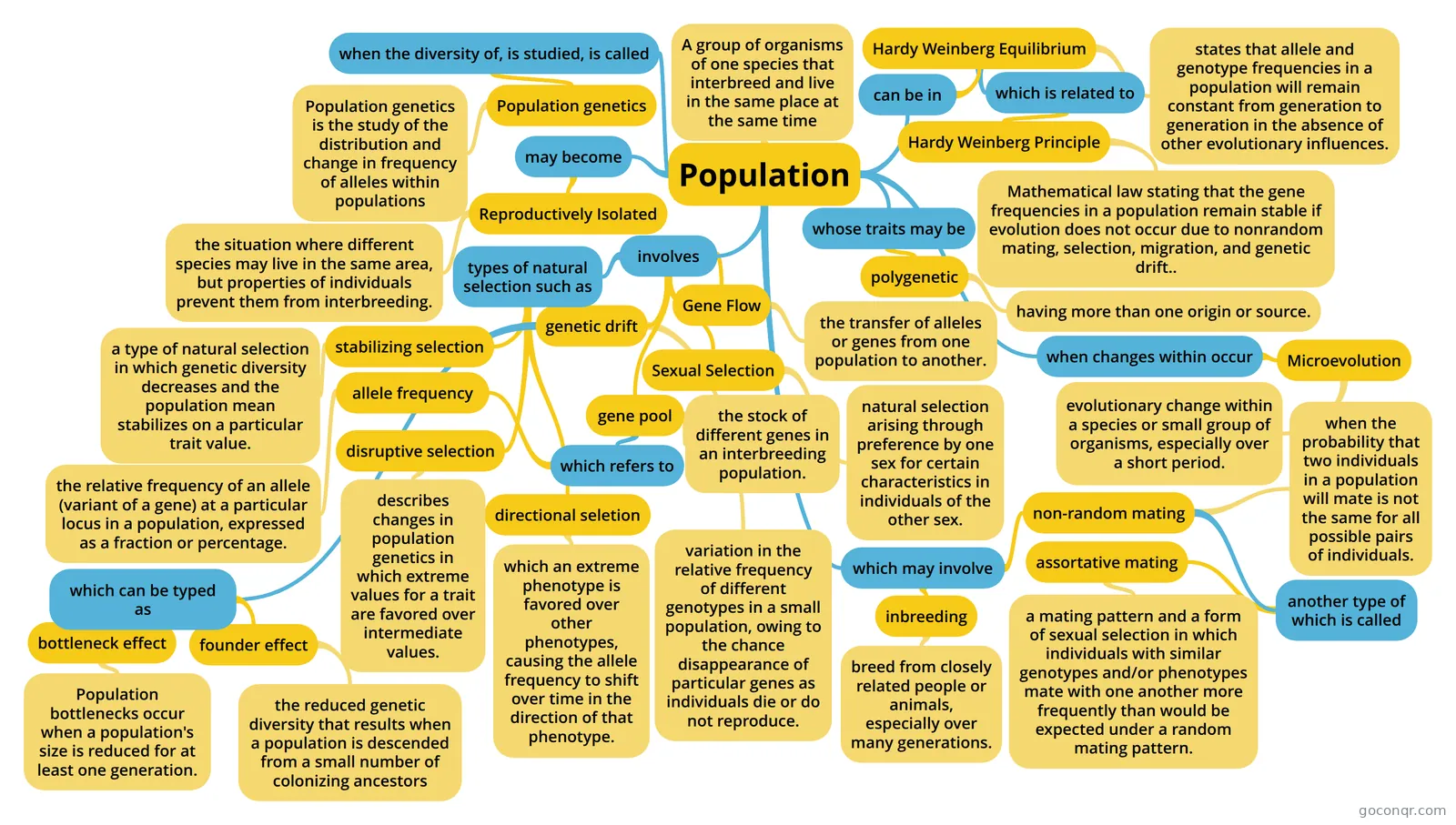
Mind map: Population in biology
Map content
Population
when changes within occur
- Microevolution
- evolutionary change within a species or small group of organisms, especially over a short period.
- Microevolution
when the diversity of, is studied, is called
- Population genetics
- Population genetics is the study of the distribution and change in frequency of alleles within populations
- Population genetics
involves
- gene pool
- which refers to
- allele frequency
- the relative frequency of an allele (variant of a gene) at a particular locus in a population, expressed as a fraction or percentage.
- allele frequency
- the stock of different genes in an interbreeding population.
- which refers to
- Gene Flow
- the transfer of alleles or genes from one population to another.
- genetic drift
- which can be typed as
- bottleneck effect
- Population bottlenecks occur when a population's size is reduced for at least one generation.
- founder effect
- the reduced genetic diversity that results when a population is descended from a small number of colonizing ancestors
- bottleneck effect
- variation in the relative frequency of different genotypes in a small population, owing to the chance disappearance of particular genes as individuals die or do not reproduce.
- which can be typed as
- types of natural selection such as
- stabilizing selection
- a type of natural selection in which genetic diversity decreases and the population mean stabilizes on a particular trait value.
- directional seletion
- which an extreme phenotype is favored over other phenotypes, causing the allele frequency to shift over time in the direction of that phenotype.
- disruptive selection
- describes changes in population genetics in which extreme values for a trait are favored over intermediate values.
- stabilizing selection
- Sexual Selection
- natural selection arising through preference by one sex for certain characteristics in individuals of the other sex.
- gene pool
can be in
- Hardy Weinberg Equilibrium
- which is related to
- Hardy Weinberg Principle
- Mathematical law stating that the gene frequencies in a population remain stable if evolution does not occur due to nonrandom mating, selection, migration, and genetic drift..
- Hardy Weinberg Principle
- states that allele and genotype frequencies in a population will remain constant from generation to generation in the absence of other evolutionary influences.
- which is related to
- Hardy Weinberg Equilibrium
may become
- Reproductively Isolated
- the situation where different species may live in the same area, but properties of individuals prevent them from interbreeding.
- Reproductively Isolated
which may involve
- inbreeding
- breed from closely related people or animals, especially over many generations.
- non-random mating
- another type of which is called
- assortative mating
- a mating pattern and a form of sexual selection in which individuals with similar genotypes and/or phenotypes mate with one another more frequently than would be expected under a random mating pattern.
- assortative mating
- when the probability that two individuals in a population will mate is not the same for all possible pairs of individuals.
- another type of which is called
- inbreeding
whose traits may be
- polygenetic
- having more than one origin or source.
- polygenetic
A group of organisms of one species that interbreed and live in the same place at the same time
Information
- Description
- Advanced placement Biology Mind Map on Population, created by elgefur on 22/04/2016.
- Created by
- elgefur
- Views
- 26
- Rating
More on Population Genetics and Evolutionary Mechanisms