
Mind map
Remedies for inflation
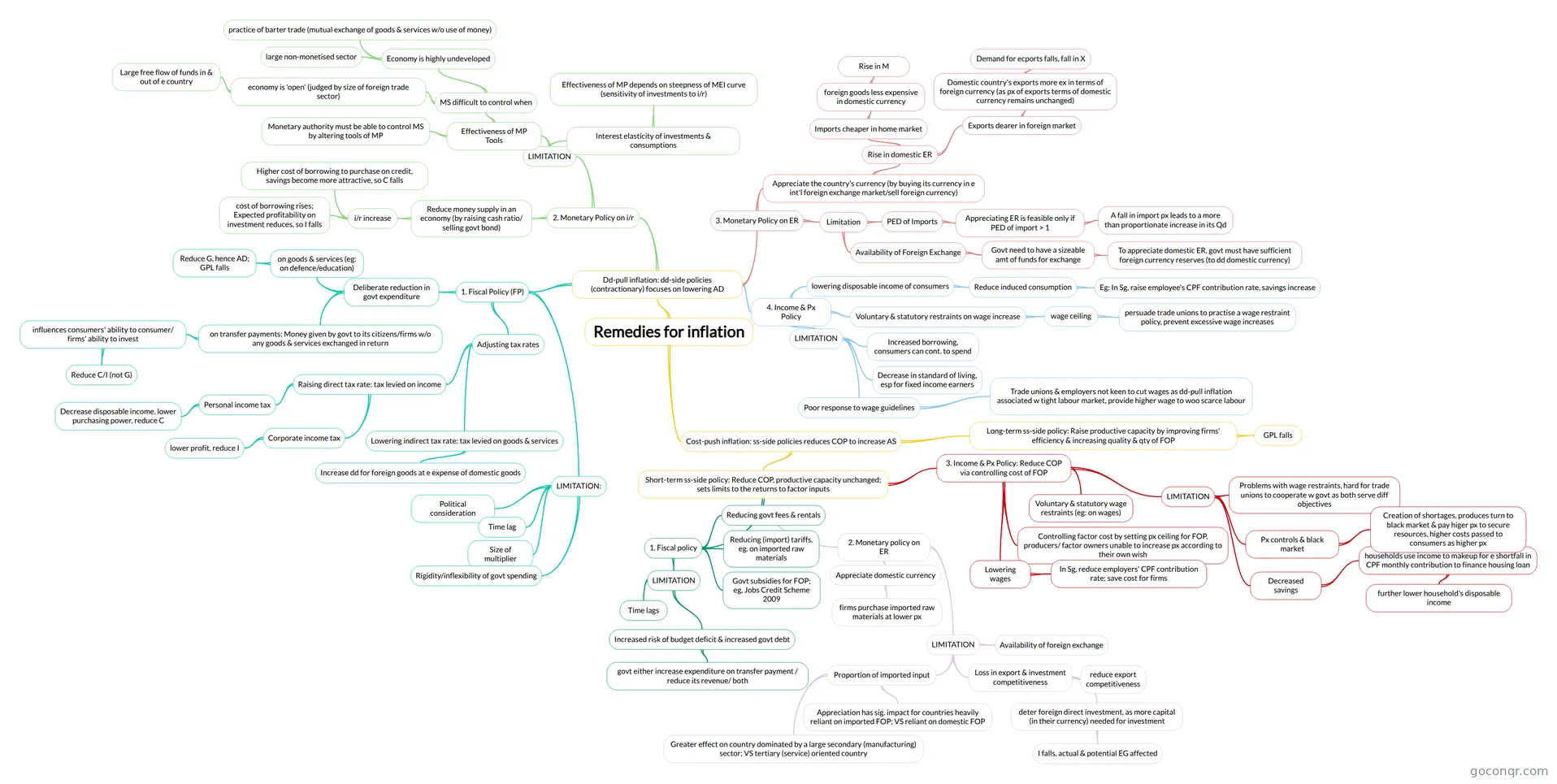
Mind map: Remedies for inflation
Map content
Remedies for inflation
Dd-pull inflation: dd-side policies (contractionary) focuses on lowering AD
- 1. Fiscal Policy (FP)
- Deliberate reduction in govt expenditure
- on goods & services (eg: on defence/education)
- Reduce G, hence AD; GPL falls
- on transfer payments: Money given by govt to its citizens/firms w/o any goods & services exchanged in return
- influences consumers' ability to consumer/ firms' ability to invest
- Reduce C/I (not G)
- influences consumers' ability to consumer/ firms' ability to invest
- on goods & services (eg: on defence/education)
- Adjusting tax rates
- Raising direct tax rate: tax levied on income
- Personal income tax
- Decrease disposable income, lower purchasing power, reduce C
- Corporate income tax
- lower profit, reduce I
- Personal income tax
- Lowering indirect tax rate: tax levied on goods & services
- Increase dd for foreign goods at e expense of domestic goods
- Raising direct tax rate: tax levied on income
- LIMITATION:
- Size of multiplier
- Rigidity/inflexibility of govt spending
- Political consideration
- Time lag
- Deliberate reduction in govt expenditure
- 2. Monetary Policy on i/r
- Reduce money supply in an economy (by raising cash ratio/ selling govt bond)
- i/r increase
- cost of borrowing rises; Expected profitability on investment reduces, so I falls
- Higher cost of borrowing to purchase on credit, savings become more attractive, so C falls
- i/r increase
- LIMITATION
- Effectiveness of MP Tools
- Monetary authority must be able to control MS by altering tools of MP
- MS difficult to control when
- economy is 'open' (judged by size of foreign trade sector)
- Large free flow of funds in & out of e country
- Economy is highly undeveloped
- large non-monetised sector
- practice of barter trade (mutual exchange of goods & services w/o use of money)
- economy is 'open' (judged by size of foreign trade sector)
- Interest elasticity of investments & consumptions
- Effectiveness of MP depends on steepness of MEI curve (sensitivity of investments to i/r)
- Effectiveness of MP Tools
- Reduce money supply in an economy (by raising cash ratio/ selling govt bond)
- 3. Monetary Policy on ER
- Appreciate the country's currency (by buying its currency in e int'l foreign exchange market/sell foreign currency)
- Rise in domestic ER
- Exports dearer in foreign market
- Domestic country's exports more ex in terms of foreign currency (as px of exports terms of domestic currency remains unchanged)
- Demand for ecports falls, fall in X
- Domestic country's exports more ex in terms of foreign currency (as px of exports terms of domestic currency remains unchanged)
- Imports cheaper in home market
- foreign goods less expensive in domestic currency
- Rise in M
- foreign goods less expensive in domestic currency
- Exports dearer in foreign market
- Rise in domestic ER
- Limitation
- PED of Imports
- Appreciating ER is feasible only if PED of import > 1
- A fall in import px leads to a more than proportionate increase in its Qd
- Appreciating ER is feasible only if PED of import > 1
- Availability of Foreign Exchange
- Govt need to have a sizeable amt of funds for exchange
- To appreciate domestic ER, govt must have sufficient foreign currency reserves (to dd domestic currency)
- Govt need to have a sizeable amt of funds for exchange
- PED of Imports
- Appreciate the country's currency (by buying its currency in e int'l foreign exchange market/sell foreign currency)
- 4. Income & Px Policy
- lowering disposable income of consumers
- Reduce induced consumption
- Eg: In Sg, raise employee's CPF contribution rate, savings increase
- Reduce induced consumption
- Voluntary & statutory restraints on wage increase
- wage ceiling
- persuade trade unions to practise a wage restraint policy, prevent excessive wage increases
- wage ceiling
- LIMITATION
- Increased borrowing, consumers can cont. to spend
- Decrease in standard of living, esp for fixed income earners
- Poor response to wage guidelines
- Trade unions & employers not keen to cut wages as dd-pull inflation associated w tight labour market, provide higher wage to woo scarce labour
- lowering disposable income of consumers
- 1. Fiscal Policy (FP)
Cost-push inflation: ss-side policies reduces COP to increase AS
- Short-term ss-side policy: Reduce COP, productive capacity unchanged; sets limits to the returns to factor inputs
- 1. Fiscal policy
- Reducing (import) tariffs, eg. on imported raw materials
- Reducing govt fees & rentals
- Govt subsidies for FOP; eg, Jobs Credit Scheme 2009
- LIMITATION
- Time lags
- Increased risk of budget deficit & increased govt debt
- govt either increase expenditure on transfer payment / reduce its revenue/ both
- 2. Monetary policy on ER
- Appreciate domestic currency
- firms purchase imported raw materials at lower px
- LIMITATION
- Proportion of imported input
- Appreciation has sig. impact for countries heavily reliant on imported FOP; VS reliant on domestic FOP
- Greater effect on country dominated by a large secondary (manufacturing) sector; VS tertiary (service) oriented country
- Loss in export & investment competitiveness
- reduce export competitiveness
- deter foreign direct investment, as more capital (in their currency) needed for investment
- I falls, actual & potential EG affected
- Availability of foreign exchange
- Proportion of imported input
- Appreciate domestic currency
- 3. Income & Px Policy: Reduce COP via controlling cost of FOP
- Voluntary & statutory wage restraints (eg: on wages)
- Controlling factor cost by setting px ceiling for FOP, producers/ factor owners unable to increase px according to their own wish
- Lowering wages
- In Sg, reduce employers' CPF contribution rate; save cost for firms
- LIMITATION
- Problems with wage restraints, hard for trade unions to cooperate w govt as both serve diff objectives
- Decreased savings
- households use income to makeup for e shortfall in CPF monthly contribution to finance housing loan
- further lower household's disposable income
- households use income to makeup for e shortfall in CPF monthly contribution to finance housing loan
- Px controls & black market
- Creation of shortages, produces turn to black market & pay higer px to secure resources, higher costs passed to consumers as higher px
- 1. Fiscal policy
- Long-term ss-side policy: Raise productive capacity by improving firms' efficiency & increasing quality & qty of FOP
- GPL falls
- Short-term ss-side policy: Reduce COP, productive capacity unchanged; sets limits to the returns to factor inputs
Information
- Description
- Mind Map on Remedies for inflation, created by Mavis Cyn on 09/10/2016.
- Created by
- Mavis Cyn
- Views
- 0
- Rating