
Mind map
Costs and Revenues Overview
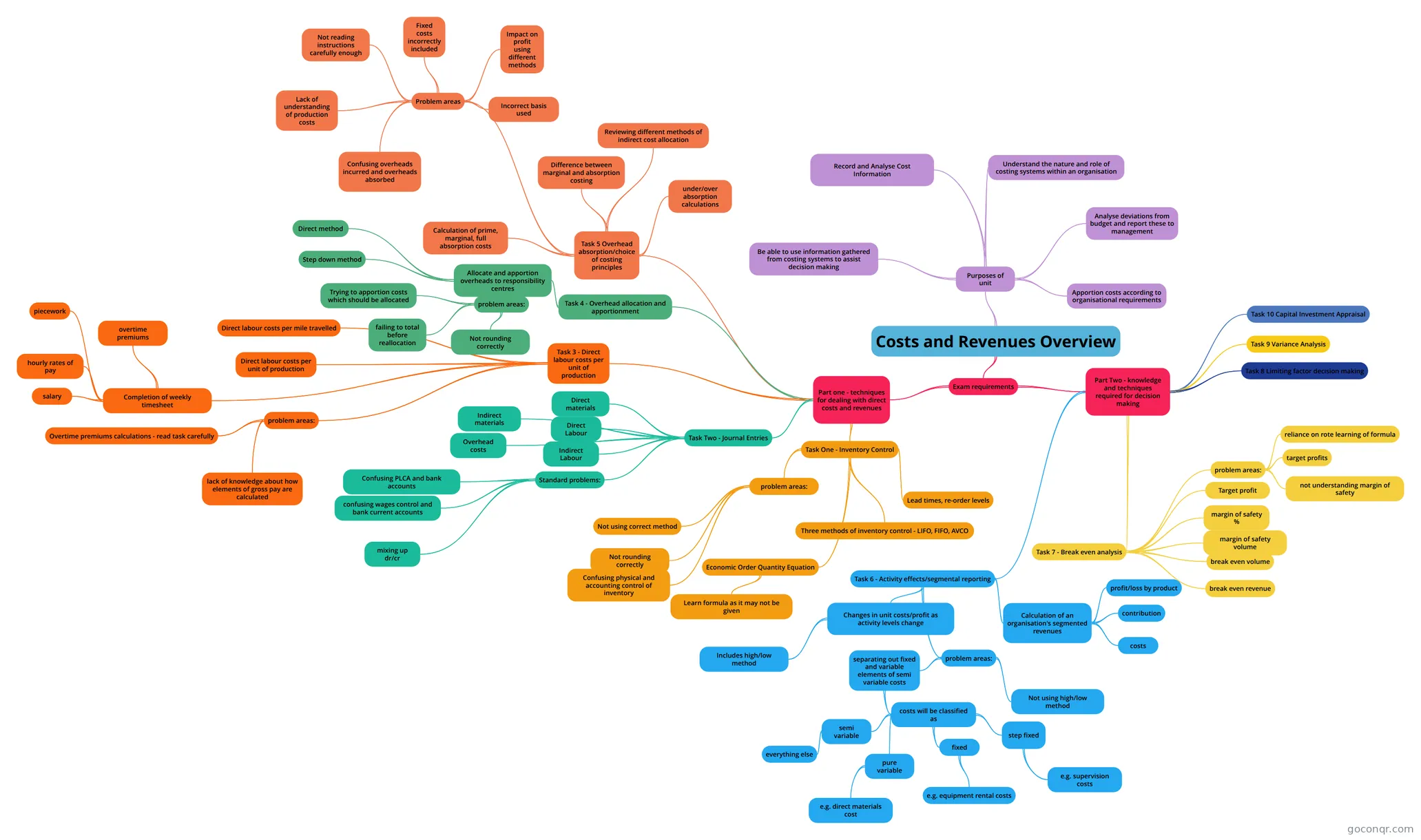
Mind map: costs and revenues overview
Map content
Costs and Revenues Overview
Purposes of unit
- Understand the nature and role of costing systems within an organisation
- Record and Analyse Cost Information
- Apportion costs according to organisational requirements
- Be able to use information gathered from costing systems to assist decision making
- Analyse deviations from budget and report these to management
Exam requirements
- Part one - techniques for dealing with direct costs and revenues
- Task One - Inventory Control
- Three methods of inventory control - LIFO, FIFO, AVCO
- Economic Order Quantity Equation
- Learn formula as it may not be given
- Lead times, re-order levels
- problem areas:
- Not using correct method
- Confusing physical and accounting control of inventory
- Not rounding correctly
- Task Two - Journal Entries
- Direct materials
- Indirect materials
- Direct Labour
- Indirect Labour
- Overhead costs
- Standard problems:
- confusing wages control and bank current accounts
- Confusing PLCA and bank accounts
- mixing up dr/cr
- Task 3 - Direct labour costs per unit of production
- Direct labour costs per unit of production
- Direct labour costs per mile travelled
- Completion of weekly timesheet
- salary
- hourly rates of pay
- piecework
- overtime premiums
- problem areas:
- lack of knowledge about how elements of gross pay are calculated
- Overtime premiums calculations - read task carefully
- Task 4 - Overhead allocation and apportionment
- Allocate and apportion overheads to responsibility centres
- Direct method
- Step down method
- problem areas:
- failing to total before reallocation
- Trying to apportion costs which should be allocated
- Not rounding correctly
- Allocate and apportion overheads to responsibility centres
- Task 5 Overhead absorption/choice of costing principles
- under/over absorption calculations
- Reviewing different methods of indirect cost allocation
- Difference between marginal and absorption costing
- Calculation of prime, marginal, full absorption costs
- Problem areas
- Incorrect basis used
- Not reading instructions carefully enough
- Confusing overheads incurred and overheads absorbed
- Fixed costs incorrectly included
- Impact on profit using different methods
- Lack of understanding of production costs
- Task One - Inventory Control
- Part Two - knowledge and techniques required for decision making
- Task 6 - Activity effects/segmental reporting
- Changes in unit costs/profit as activity levels change
- Includes high/low method
- Calculation of an organisation's segmented revenues
- costs
- contribution
- profit/loss by product
- problem areas:
- separating out fixed and variable elements of semi variable costs
- costs will be classified as
- pure variable
- e.g. direct materials cost
- fixed
- e.g. equipment rental costs
- step fixed
- e.g. supervision costs
- semi variable
- everything else
- pure variable
- costs will be classified as
- Not using high/low method
- separating out fixed and variable elements of semi variable costs
- Changes in unit costs/profit as activity levels change
- Task 7 - Break even analysis
- break even volume
- break even revenue
- margin of safety volume
- Target profit
- margin of safety %
- problem areas:
- reliance on rote learning of formula
- target profits
- not understanding margin of safety
- Task 8 Limiting factor decision making
- Task 9 Variance Analysis
- Task 10 Capital Investment Appraisal
- Task 6 - Activity effects/segmental reporting
- Part one - techniques for dealing with direct costs and revenues
Information
- Description
- AAT Level 3 Costs and Revenues Mind Map on Costs and Revenues Overview, created by Francois Erasmus on 28/09/2016.
- Created by
- Francois Erasmus
- Views
- 1
- History
-
- Created by Liz Barraclough · Apr 15, 2015
- Copied by Francois Erasmus · Sep 28, 2016
- Rating