
Mind map
Express trust
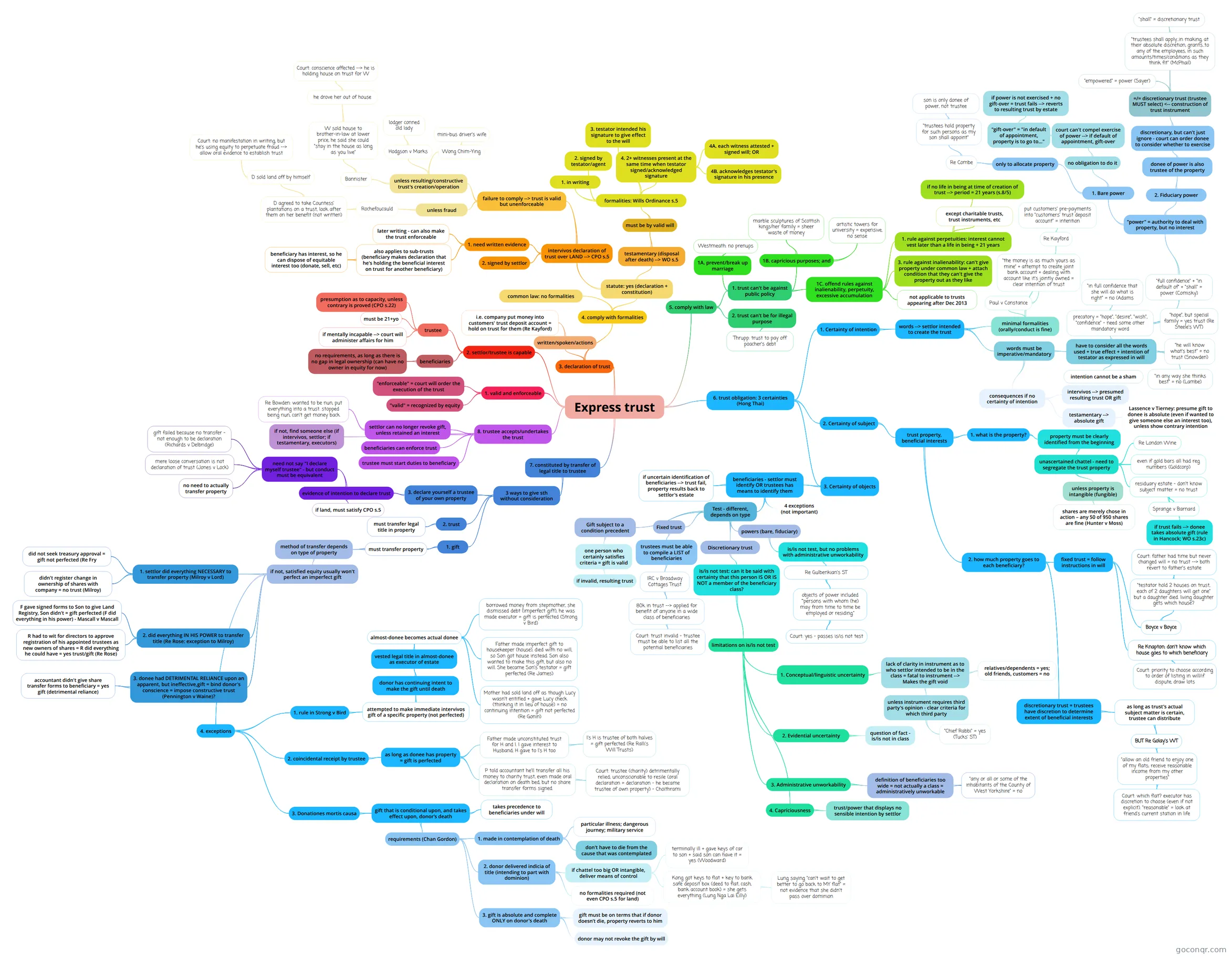
Mind map: express trust
Map content
Express trust
1. valid and enforceable
- "enforceable" = court will order the execution of the trust
- "valid" = recognized by equity
2. settlor/trustee is capable
- trustee
- presumption as to capacity, unless contrary is proved (CPO s.22)
- must be 21+yo
- if mentally incapable --> court will administer affairs for him
- beneficiaries
- no requirements, as long as there is no gap in legal ownership (can have no owner in equity for now)
- trustee
3. declaration of trust
- 4. comply with formalities
- common law: no formalities
- statute: yes (declaration + constitution)
- intervivos declaration of trust over LAND --> CPO s.5
- 1. need written evidence
- later writing - can also make the trust enforceable
- also applies to sub-trusts (beneficiary makes declaration that he's holding the beneficial interest on trust for another beneficiary)
- beneficiary has interest, so he can dispose of equitable interest too (donate, sell, etc)
- 2. signed by settlor
- failure to comply --> trust is valid but unenforceable
- unless fraud
- Rochefoucauld
- D agreed to take Countess' plantations on a trust, look after them on her benefit (not written)
- D sold land off by himself
- Court: no manifestation in writing, but he's using equity to perpetuate fraud --> allow oral evidence to establish trust
- D sold land off by himself
- D agreed to take Countess' plantations on a trust, look after them on her benefit (not written)
- Rochefoucauld
- unless resulting/constructive trust's creation/operation
- Bannister
- W sold house to brother-in-law at lower price, he said she could "stay in the house as long as you live"
- he drove her out of house
- Court: conscience affected --> he is holding house on trust for W
- he drove her out of house
- W sold house to brother-in-law at lower price, he said she could "stay in the house as long as you live"
- Hodgson v Marks
- lodger conned old lady
- Wong Chim-Ying
- mini-bus driver's wife
- Bannister
- unless fraud
- 1. need written evidence
- testamentary (disposal after death) --> WO s.5
- must be by valid will
- formalities: Wills Ordinance s.5
- 1. in writing
- 2. signed by testator/agent
- 3. testator intended his signature to give effect to the will
- 4. 2+ witnesses present at the same time when testator signed/acknowledged signature
- 4A. each witness attested + signed will; OR
- 4B. acknowledges testator's signature in his presence
- formalities: Wills Ordinance s.5
- must be by valid will
- intervivos declaration of trust over LAND --> CPO s.5
- written/spoken/actions
- i.e. company put money into customers' trust deposit account = hold on trust for them (Re Kayford)
- 4. comply with formalities
6. trust obligation: 3 certainties (Hong Thai)
- 1. Certainty of intention
- words --> settlor intended to create the trust
- minimal formalities (orally/conduct is fine)
- Paul v Constance
- “the money is as much yours as mine” + attempt to create joint bank account + dealing with account like it's jointly owned = clear intention of trust
- Re Kayford
- put customers' pre-payments into "customers' trust deposit account" = intention
- Paul v Constance
- words must be imperative/mandatory
- have to consider all the words used + true effect + intention of testator as expressed in will
- "he will know what's best" = no trust (Snowden)
- precatory = "hope", "desire", "wish", "confidence" - need some other mandatory word
- "in full confidence that she will do what is right" = no (Adams
- "hope", but special family = yes trust (Re Steele's WT)
- "full confidence" + "in default of" + "shall" = power (Comisky)
- "power" = authority to deal with property, but no interest
- 1. Bare power
- only to allocate property
- Re Combe
- "trustees hold property for such persons as my son shall appoint"
- son is only donee of power, not trustee
- "trustees hold property for such persons as my son shall appoint"
- Re Combe
- no obligation to do it
- court can't compel exercise of power --> if default of appointment, gift-over
- "gift-over" = "in default of appointment, property is to go to..."
- if power is not exercised + no gift-over = trust fails --> reverts to resulting trust by estate
- "gift-over" = "in default of appointment, property is to go to..."
- court can't compel exercise of power --> if default of appointment, gift-over
- only to allocate property
- 2. Fiduciary power
- donee of power is also trustee of the property
- discretionary, but can't just ignore - court can order donee to consider whether to exercise
- =/= discretionary trust (trustee MUST select) <-- construction of trust instrument
- "trustees shall apply...in making, at their absolute discretion, grants...to any of the employees, in such amounts/times/conditions as they think fit" (McPhail)
- "shall" = discretionary trust
- "empowered" = power (Sayer)
- "trustees shall apply...in making, at their absolute discretion, grants...to any of the employees, in such amounts/times/conditions as they think fit" (McPhail)
- =/= discretionary trust (trustee MUST select) <-- construction of trust instrument
- discretionary, but can't just ignore - court can order donee to consider whether to exercise
- donee of power is also trustee of the property
- 1. Bare power
- "power" = authority to deal with property, but no interest
- "in any way she thinks best" = no (Lambe)
- intention cannot be a sham
- consequences if no certainty of intention
- intervivos --> presumed resulting trust OR gift
- testamentary --> absolute gift
- Lassence v Tierney: presume gift to donee is absolute (even if wanted to give someone else an interest too), unless show contrary intention
- have to consider all the words used + true effect + intention of testator as expressed in will
- minimal formalities (orally/conduct is fine)
- words --> settlor intended to create the trust
- 2. Certainty of subject
- trust property, beneficial interests
- 1. what is the property?
- property must be clearly identified from the beginning
- unascertained chattel - need to segregate the trust property
- Re London Wine
- even if gold bars all had reg numbers (Goldcorp)
- unless property is intangible (fungible)
- shares are merely chose in action – any 50 of 950 shares are fine (Hunter v Moss)
- residuary estate - don't know subject matter = no trust
- Sprange v Barnard
- if trust fails --> donee takes absolute gift (rule in Hancock; WO s.23c)
- unascertained chattel - need to segregate the trust property
- property must be clearly identified from the beginning
- 2. how much property goes to each beneficiary?
- fixed trust = follow instructions in will
- Boyce v Boyce
- "testator hold 2 houses on trust, each of 2 daughters will get one" but a daughter died. living daughter gets which house?
- Court: father had time but never changed will = no trust --> both revert to father's estate
- "testator hold 2 houses on trust, each of 2 daughters will get one" but a daughter died. living daughter gets which house?
- Re Knapton: don't know which house goes to which beneficiary
- Court: priority to choose according to order of listing in will/if dispute, draw lots
- Boyce v Boyce
- discretionary trust = trustees have discretion to determine extent of beneficial interests
- as long as trust's actual subject matter is certain, trustee can distribute
- BUT Re Golay's WT
- "allow an old friend to enjoy one of my flats; receive reasonable income from my other properties"
- Court: which flat? executor has discretion to choose (even if not explicit). "reasonable" = look at friend's current station in life
- "allow an old friend to enjoy one of my flats; receive reasonable income from my other properties"
- BUT Re Golay's WT
- as long as trust's actual subject matter is certain, trustee can distribute
- fixed trust = follow instructions in will
- 1. what is the property?
- trust property, beneficial interests
- 3. Certainty of objects
- beneficiaries - settlor must identify OR trustees has means to identify them
- if uncertain identification of beneficiaries --> trust fail, property results back to settlor's estate
- 4 exceptions (not important)
- Test - different, depends on type
- Fixed trust
- trustees must be able to compile a LIST of beneficiaries
- IRC v Broadway Cottages Trust
- 80k in trust --> applied for benefit of anyone in a wide class of beneficiaries
- Court: trust invalid - trustee must be able to list all the potential beneficiaries
- 80k in trust --> applied for benefit of anyone in a wide class of beneficiaries
- IRC v Broadway Cottages Trust
- trustees must be able to compile a LIST of beneficiaries
- Discretionary trust
- is/is not test: can it be said with certainty that this person IS OR IS NOT a member of the beneficiary class?
- limitations on is/is not test
- 1. Conceptual/linguistic uncertainty
- lack of clarity in instrument as to who settlor intended to be in the class = fatal to instrument --> Makes the gift void
- relatives/dependents = yes; old friends, customers = no
- unless instrument requires third party's opinion - clear criteria for which third party
- "Chief Rabbi" = yes (Tucks' ST)
- lack of clarity in instrument as to who settlor intended to be in the class = fatal to instrument --> Makes the gift void
- 2. Evidential uncertainty
- question of fact - is/is not in class
- 3. Administrative unworkability
- definition of beneficiaries too wide = not actually a class = administratively unworkable
- "any or all or some of the inhabitants of the County of West Yorkshire" = no
- definition of beneficiaries too wide = not actually a class = administratively unworkable
- 4. Capriciousness
- trust/power that displays no sensible intention by settlor
- 1. Conceptual/linguistic uncertainty
- limitations on is/is not test
- is/is not test: can it be said with certainty that this person IS OR IS NOT a member of the beneficiary class?
- powers (bare, fiduciary)
- is/is not test, but no problems with administrative unworkability
- Re Gulbenkian's ST
- objects of power included ‘“persons with whom (he) may from time to time be employed or residing.”
- Court: yes - passes is/is not test
- objects of power included ‘“persons with whom (he) may from time to time be employed or residing.”
- Re Gulbenkian's ST
- is/is not test, but no problems with administrative unworkability
- Gift subject to a condition precedent
- one person who certainly satisfies criteria = gift is valid
- if invalid, resulting trust
- one person who certainly satisfies criteria = gift is valid
- Fixed trust
- beneficiaries - settlor must identify OR trustees has means to identify them
- 1. Certainty of intention
5. comply with law
- 1. trust can't be against public policy
- 1A. prevent/break up marriage
- Westmeath: no prenups
- 1B. capricious purposes; and
- marble sculptures of Scottish kings/her family = sheer waste of money
- artistic towers for university = expensive, no sense
- 1C. offend rules against inalienability, perpetuity, excessive accumulation
- 1. rule against perpetuities: interest cannot vest later than a life in being + 21 years
- except charitable trusts, trust instruments, etc
- if no life in being at time of creation of trust --> period = 21 years (s.8/5)
- 3. rule against inalienability: can't give property under common law + attach condition that they can't give the property out as they like
- not applicable to trusts appearing after Dec 2013
- 1. rule against perpetuities: interest cannot vest later than a life in being + 21 years
- 1A. prevent/break up marriage
- 2. trust can't be for illegal purpose
- Thrupp: trust to pay off poacher's debt
- 1. trust can't be against public policy
7. constituted by transfer of legal title to trustee
- 3 ways to give sth without consideration
- 1. gift
- must transfer property
- method of transfer depends on type of property
- if not, satisfied equity usually won't perfect an imperfect gift
- 1. settlor did everything NECESSARY to transfer property (Milroy v Lord)
- did not seek treasury approval = gift not perfected (Re Fry
- didn't register change in ownership of shares with company = no trust (Milroy)
- 2. did everything IN HIS POWER to transfer title (Re Rose: exception to Milroy)
- F gave signed forms to Son to give Land Registry, Son didn't = gift perfected (F did everything in his power) - Mascall v Mascall
- R had to wit for directors to approve registration of his appointed trustees as new owners of shares = R did everything he could have = yes trust/gift (Re Rose)
- 3. donee had DETRIMENTAL RELIANCE upon an apparent, but ineffective,gift = bind donor's conscience = impose constructive trust (Pennington v Waine)?
- accountant didn't give share transfer forms to beneficiary = yes gift (detrimental reliance)
- 4. exceptions
- 1. rule in Strong v Bird
- attempted to make immediate intervivos gift of a specific property (not perfected)
- donor has continuing intent to make the gift until death
- vested legal title in almost-donee as executor of estate
- almost-donee becomes actual donee
- borrowed money from stepmother, she dismissed debt (imperfect gift), he was made executor = gift is perfected (Strong v Bird)
- Father made imperfect gift to housekeeper (house), died with no will, so Son got house instead. Son also wanted to make this gift, but also no will. She became Son's testator = gift perfected (Re James)
- Mother had sold land off as though Lucy wasn't entitled + gave Lucy check (thinking it in lieu of house) = no continuing intention = gift not perfected (Re Gonin)
- almost-donee becomes actual donee
- vested legal title in almost-donee as executor of estate
- donor has continuing intent to make the gift until death
- attempted to make immediate intervivos gift of a specific property (not perfected)
- 2. coincidental receipt by trustee
- as long as donee has property = gift is perfected
- Father made unconstituted trust for H and I. I gave interest to Husband; H gave to I's H too
- I's H is trustee of both halves = gift perfected (Re Ralli's Will Trusts)
- P told accountant he'll transfer all his money to charity trust, even made oral declaration on death bed, but no share transfer forms signed.
- Court: trustee (charity) detrimentally relied; unconscionable to resile (oral declaration = declaration - he became trustee of own property) - Choithrami
- Father made unconstituted trust for H and I. I gave interest to Husband; H gave to I's H too
- as long as donee has property = gift is perfected
- 3. Donationes mortis causa
- gift that is conditional upon, and takes effect upon, donor’s death
- takes precedence to beneficiaries under will
- requirements (Chan Gordon)
- 1. made in contemplation of death
- particular illness; dangerous journey; military service
- don't have to die from the cause that was contemplated
- 2. donor delivered indicia of title (intending to part with dominion)
- if chattel too big OR intangible, deliver means of control
- terminally ill + gave keys of car to son + said son can have it = yes (Woodward)
- Kong got keys to flat + key to bank safe deposit box (deed to flat, cash, bank account book) = she gets everything (Lung Nga Lai Eilly)
- Lung saying "can't wait to get better to go back to MY flat" = not evidence that she didn't pass over dominion
- no formalities required (not even CPO s.5 for land)
- if chattel too big OR intangible, deliver means of control
- 3. gift is absolute and complete ONLY on donor's death
- gift must be on terms that if donor doesn’t die, property reverts to him
- donor may not revoke the gift by will
- 1. made in contemplation of death
- gift that is conditional upon, and takes effect upon, donor’s death
- 1. rule in Strong v Bird
- 1. settlor did everything NECESSARY to transfer property (Milroy v Lord)
- if not, satisfied equity usually won't perfect an imperfect gift
- method of transfer depends on type of property
- must transfer property
- 2. trust
- must transfer legal title in property
- 3. declare yourself a trustee of your own property
- evidence of intention to declare trust
- if land, must satisfy CPO s.5
- need not say "I declare myself trustee" - but conduct must be equivalent
- no need to actually transfer property
- mere loose conversation is not declaration of trust (Jones v Lock)
- gift failed because no transfer - not enough to be declaration (Richards v Delbridge)
- evidence of intention to declare trust
- 1. gift
- 3 ways to give sth without consideration
8. trustee accepts/undertakes the trust
- if not, find someone else (if intervivos, settlor; if testamentary, executors)
- settlor can no longer revoke gift, unless retained an interest
- Re Bowden: wanted to be nun, put everything into a trust. stopped being nun, can't get money back
- beneficiaries can enforce trust
- trustee must start duties to beneficiary
Information
- Description
- Mind Map on Express trust, created by Joanna Ip on 21/11/2016.
- Created by
- Joanna Ip
- Views
- 0
- Rating