
Mind map
Waste Management in the UK
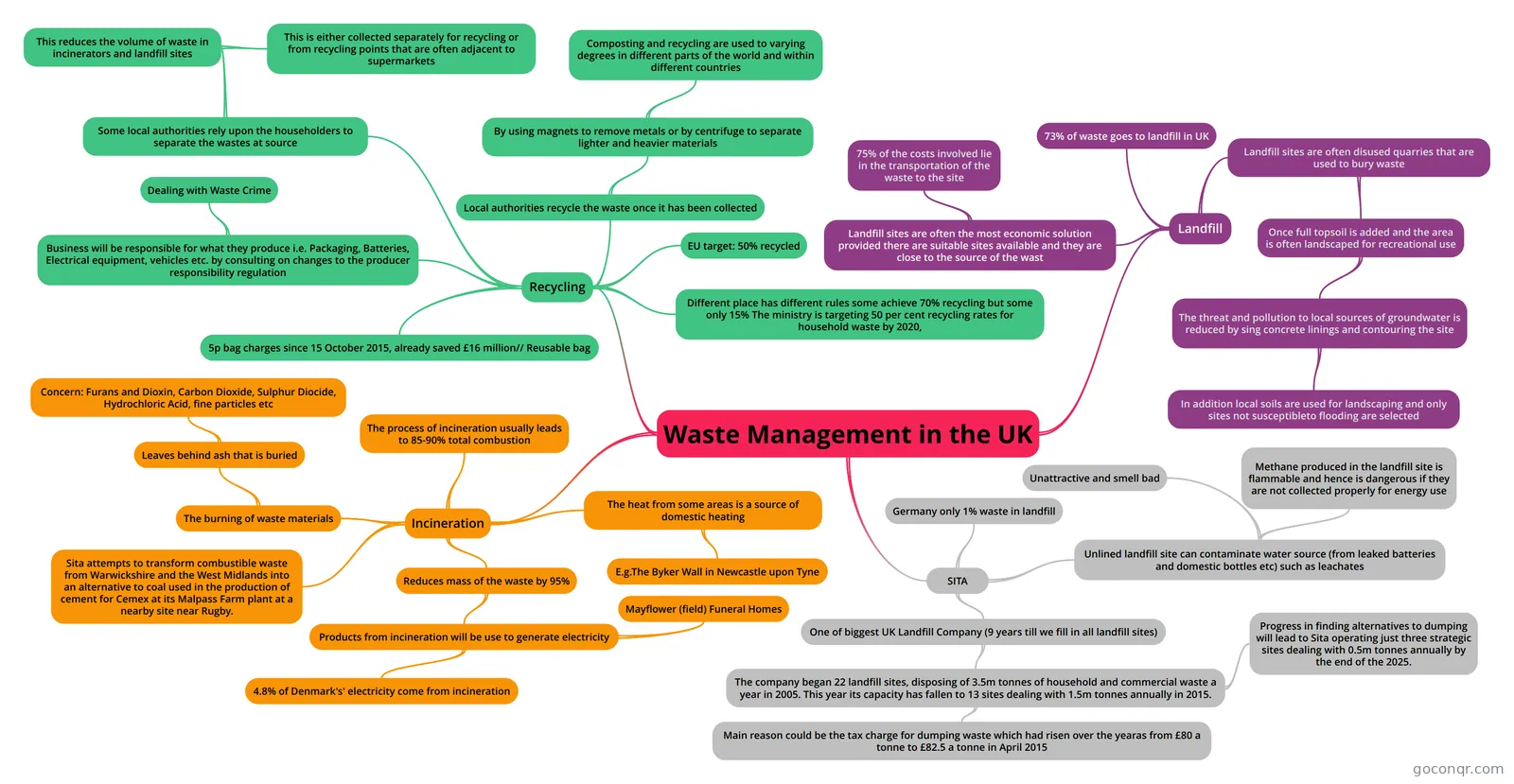
Mind map: Waste Management in the UK
Map content
Waste Management in the UK
Recycling
- Local authorities recycle the waste once it has been collected
- By using magnets to remove metals or by centrifuge to separate lighter and heavier materials
- Composting and recycling are used to varying degrees in different parts of the world and within different countries
- By using magnets to remove metals or by centrifuge to separate lighter and heavier materials
- Some local authorities rely upon the householders to separate the wastes at source
- This reduces the volume of waste in incinerators and landfill sites
- This is either collected separately for recycling or from recycling points that are often adjacent to supermarkets
- This reduces the volume of waste in incinerators and landfill sites
- Different place has different rules some achieve 70% recycling but some only 15% The ministry is targeting 50 per cent recycling rates for household waste by 2020,
- EU target: 50% recycled
- 5p bag charges since 15 October 2015, already saved £16 million// Reusable bag
- Business will be responsible for what they produce i.e. Packaging, Batteries, Electrical equipment, vehicles etc. by consulting on changes to the producer responsibility regulation
- Dealing with Waste Crime
- Local authorities recycle the waste once it has been collected
Landfill
- Landfill sites are often disused quarries that are used to bury waste
- Once full topsoil is added and the area is often landscaped for recreational use
- The threat and pollution to local sources of groundwater is reduced by sing concrete linings and contouring the site
- In addition local soils are used for landscaping and only sites not susceptibleto flooding are selected
- The threat and pollution to local sources of groundwater is reduced by sing concrete linings and contouring the site
- Once full topsoil is added and the area is often landscaped for recreational use
- Landfill sites are often the most economic solution provided there are suitable sites available and they are close to the source of the wast
- 75% of the costs involved lie in the transportation of the waste to the site
- 73% of waste goes to landfill in UK
- Landfill sites are often disused quarries that are used to bury waste
Incineration
- The burning of waste materials
- Leaves behind ash that is buried
- Concern: Furans and Dioxin, Carbon Dioxide, Sulphur Diocide, Hydrochloric Acid, fine particles etc
- Leaves behind ash that is buried
- The process of incineration usually leads to 85-90% total combustion
- The heat from some areas is a source of domestic heating
- E.g.The Byker Wall in Newcastle upon Tyne
- Sita attempts to transform combustible waste from Warwickshire and the West Midlands into an alternative to coal used in the production of cement for Cemex at its Malpass Farm plant at a nearby site near Rugby.
- Reduces mass of the waste by 95%
- Products from incineration will be use to generate electricity
- 4.8% of Denmark's' electricity come from incineration
- Mayflower (field) Funeral Homes
- Products from incineration will be use to generate electricity
- The burning of waste materials
SITA
- One of biggest UK Landfill Company (9 years till we fill in all landfill sites)
- The company began 22 landfill sites, disposing of 3.5m tonnes of household and commercial waste a year in 2005. This year its capacity has fallen to 13 sites dealing with 1.5m tonnes annually in 2015.
- Progress in finding alternatives to dumping will lead to Sita operating just three strategic sites dealing with 0.5m tonnes annually by the end of the 2025.
- Main reason could be the tax charge for dumping waste which had risen over the yearas from £80 a tonne to £82.5 a tonne in April 2015
- The company began 22 landfill sites, disposing of 3.5m tonnes of household and commercial waste a year in 2005. This year its capacity has fallen to 13 sites dealing with 1.5m tonnes annually in 2015.
- Germany only 1% waste in landfill
- Unlined landfill site can contaminate water source (from leaked batteries and domestic bottles etc) such as leachates
- Unattractive and smell bad
- Methane produced in the landfill site is flammable and hence is dangerous if they are not collected properly for energy use
- One of biggest UK Landfill Company (9 years till we fill in all landfill sites)
Information
- Description
- Mind Map on Waste Management in the UK, created by Anna Duffy on 25/11/2016.
- Created by
- Anna Duffy
- Views
- 0
- Rating