
Mind map
Ancient Greece and Persia
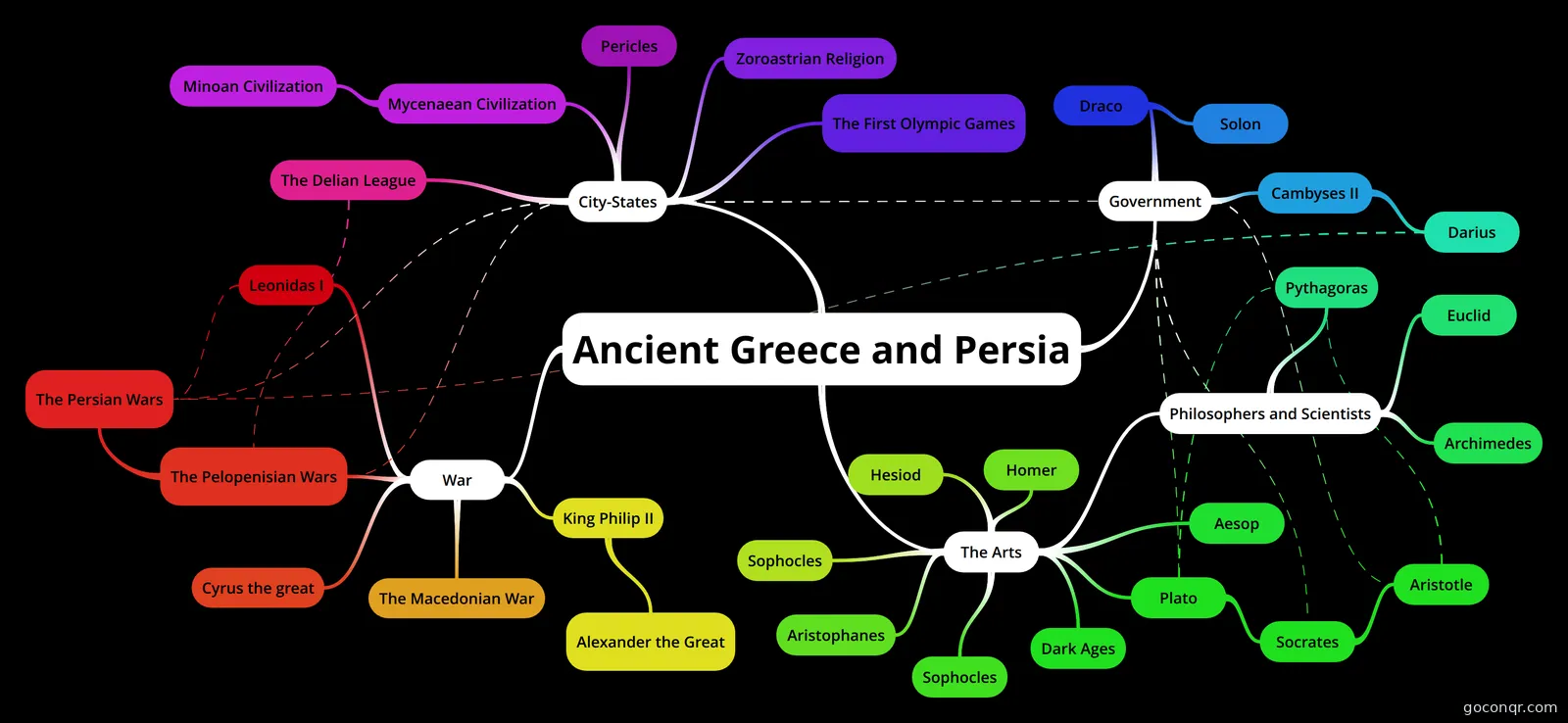
Mind map: Ancient Greece and Persia
Map content
Ancient Greece and Persia
The Arts
- Dark Ages
- Homer
- One of the most famous literary geniuses of all time. He is responsible for the writings of the Iliad and the Odyssey. Not much is known about Homer as a person other than that he was Blind and has been described as “Shadowy” It is thought that he didn’t live much longer than the Trojan War because obviously he wrote about it in his poems.
- Plato
- Plato was the student of Socrates and the teacher of Aristotle. Is one of the most respected Philosophers of all time. He was born into a wealthy and powerful family. Plato founded the first academy which is the ancestor of all modern universities. Male scholars would come from all over to study mathematics and the sciences. He wrote many outstanding pieces of literature such as The Republic. There have been many frescos and paintings of plato that are well preserved.
- Socrates
- Socrates was an Athenian Philosopher.
- Aristotle
- One of the greatest Philosophers of all time. Was a student of Plato who was a student of Socrates and taught Alexander the great. Made significant contributions to logic, metaphysics, mathematics, physics, biology, botany, ethics, politics, agriculture, medicine, dance and theatre. He classified human knowledge into categories that we still use today such as mathematical, biology, and ethics.
- Sophocles
- One of Greece's great playwrights. He lived near Athens. He wrote 123 dramas in total the most famous being “Oedipus the King”. At one point he was chosen the manage money for the Delian league. He was the first to introduce the use of a background scene or prop to establish the location. He also introduced the idea of using a third actor in plays which was previously unused.
- Hesiod
- Hesiod is one of the oldest known Greek poets and is often referred to as the “Father of Greek Didactic Poetry” Two of his epics have survived “Theogony” and “Works and Days”. His story “Theogony” is about the beginning of the world and how all the gods came to be. He believed his stories were being written by the muses speaking through him.
- Aesop
- He is a legendary greek Fabulist whose stories are still told today. His background is not well known or what family he is from. There is also a theory that he was not a real person Aesop was merely a name given to the collection of stories. His stories are not known for their plot but instead more for there moral teachings.
- Sophocles
- One of Greece's great playwrights. He lived near Athens. He wrote 123 dramas in total the most famous being “Oedipus the King”. At one point he was chosen the manage money for the Delian league. He was the first to introduce the use of a background scene or prop to establish the location. He also introduced the idea of using a third actor in plays which was previously unused.
- Philosophers and Scientists
- Pythagoras
- He was born in Greece and died in Italy. He founded the Pythagorean brotherhood which later inspired philosophers such as Plato and Aristotle. He is a noted philosopher and Mathematician for his work on things such as the Pythagorean theorem and making the first connections between math and music. His mathematical theories are still used and taught today.
- Archimedes
- He was a Greek mathematician and inventor although he lived in Sicily Italy. He discovered the relationship between the surface and volume of a sphere and its circumscribing cylinder. He also invented a device for raising water known as the Archimedes screw that is still used in some countries today.
- Euclid
- He was a Greek mathematician. He is sometimes called "The father of Geometry". His book "Elements" was a combination of the ideas from other philososphers of the time.
- Pythagoras
- Aristophanes
- Was a Greek comedian whose works were well preserved. His works were full of fantasy and satire. They were also a way of political criticism. Not much is known about his life except that he was an Athenian citizen. His plays involved the events of the day and included conflicts based around Athens and Sparta and the Peloponnesian war.
Government
- Cambyses II
- The son of Cyrus the Great. He was not like his father and destroyed other cultures after conquering them. Ruled Persia until Darius came into power.
- Darius
- Was the leader of Persia after seizing throne from Cambyses II. He built roads all across Persia. He also circulated one form of currency throughout the kingdom which increased trade overall. He also found new ways to govern people without living in their city.
- Draco
- He wrote one of the first fully comprehensive law systems for Athens. His laws punished most crimes no matter how trivial, with death. The laws he wrote were in effect until 594 when Salon replaced them when he became the Archon.
- Solon
- He was an Athenian statesman and noted poet. At the time many of the poorer Greeks were in debt to the government and in some cases being sold into slavery. He ended their debt and freed many of the slaves. He ended government by birth and tried to promote trade from people who were not making enough money just farming.Solon wrote a code of laws that were an update on Draco’s current code that were incredibly inhumane.
- Cambyses II
City-States
- The First Olympic Games
- The first olympic games were held in 776 B.C.E. at Olympia near the City-State of Athens. The games were held in honour of Zeus and drew competitors and spectators from all over Greece. The first Olympic event was a foot race. The victors of the Olympic games were written down after each game giving an accurate timeline of Greece. A large stadium was built on Olympia, Greece which is where the name of the games is from. Women were not allowed to watch or compete in the events.
- The Delian League
- The league was a group of city-states led by Athens to liberate Greek cities from Persia and to help defend against other Persian attacks. Most of the money given from other cities went to improving the naval fleet in Athens. One of the main problems of the Delian league is that when members tried to leave they would be attacked by Athens. An example of this is the island of Naxos. Two good things accomplished by the Delian league is that one form of currency began to be circulated throughout the involved countries. The league also made it easier for Athens to promote democracy.
- Mycenaean Civilization
- The Mycenaean Civilization occupied much of Greece from 1400 to 1100 BCE. It contained many of the early Greek cities including Sparta and Athens. They had very advanced architecture with large block and circular pillars. They also had advanced military armor made with bronze and ivory.
- Minoan Civilization
- The Minoans inhabited the island of Crete. The next civilization to come after them was the Mycenaeans. One of the most significant things the Minoans left behind was their elaborate architecture and art. They made large fresco's with very well preserved colors.
- Zoroastrian Religion
- An ancient Persian religion started by a Persian prophet named Zoroaster. It was practiced in certain Persian cities and still is practiced in some countries such as Iran and India. The religion teaches that the earth is a battleground between the spirits of good and evil. Traces of this religion can still be found in Christianity, Judaism, and Islam.
- Pericles
- He was an Athenian statesman who helped to develop Democracy and the overall empire of Athens. He also is responsible for the construction of the Acropolis.
- The First Olympic Games
War
- Cyrus the great
- Led Persia from 550-539 B.C.E. Was a great military leader. Unlike other leaders that tried to destroy the local religions and customs he was very respectful of these. This helped him build a strong empire with trade throughout. Father of Cambyses II.
- King Philip II
- The father of Alexander the Great, and ruler of Macedonia. He made his country of farmers and village dwellers into a military power. He conquered most of Greece. Macedonia was considered primitive by most of Greece because they had a traditional monarchy.
- Alexander the Great
- He was born 356 BCE and died June 13, 323 BCE in Babylon. He was the King of Macedonia a Greek city-state. He was taught for 3 years by Aristotle which inspired his interest in philosophy. He wanted to defeat Persia from when he was young in order to get all of their wealth to pay off 500 talents he owed for his military. In 334 BCE he attacked the Persians. They had a plan to kill him that failed and when the Persian line broke they were defeated. This was at the time Darius was alive and most of his greek mercenaries were killled.
- The Pelopenisian Wars
- The wars were between the City-States Athens and Sparta. The first war was from 460 to 446 B.C.E. and the second war was from 431 to 404 B.C.E. The Spartans attacked after seeing the growing military power from Athens. With help from the Delian league Athens was forming a massive naval fleet and other defenses against the Spartans. After the first war a treaty was made. In 432 B.C.E. Sparta declared that Athens had broken said treaty and began preparing for war. The Nike of Paionios was erected after an Athenian victory over Sparta. The Spartans eventually won and caused the end of the Delian league.
- The Persian Wars
- The Persian wars were a series of attempts by Persia to invade Greece in the 5th century B.C.E. The Persians were expanding into mainland Europe and wanted to also conquer Athens and the rest of Greece. The Greeks won at the end preserving their culture which many aspects of are still prominent in today’s society. Many famous battles were fought during this time including those at Marathon, Thermopylae, and Plataea. The Persian force caused the Greek city states of Athens and Sparta to unite. Darius III was the ruler of Persia at the time.
- Leonidas I
- He was a Spartan king who led the small band of greek and the 300 spartans against the Persian king Xerxes at the battle of Thermopylae. All of his men and he were killed in the battle but they bought the greeks the time they needed to win the battle. He died in 480 BCE.
- The Macedonian War
- They were a series of fights between the kingdom of Macedonia and Rome. The wars were started by King Philip V in hopes of conquering Rome. In the end Philip V son, Perseus, was taken to Rome and the kingdom of Macedonia was divided into four sections ruled by Rome.
- Cyrus the great
Information
- Description
- Mind Map on Ancient Greece and Persia, created by Analise Stich on 19/12/2016.
- Created by
- Analise Stich
- Views
- 43
- Rating