
7301928
Description

Mind Map by Khalil Adams, updated more than 1 year ago
More


Chemistry: Everything about Atoms
- The Structure of an
Atom
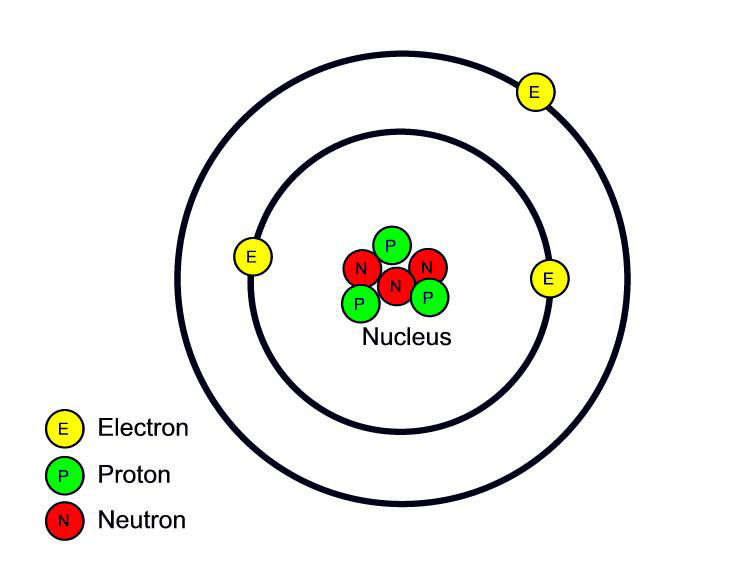
- atoms form everything in our universe.
- They consist of
three particles:
the proton,
neutron and
electron.
- electrons have a -1
charge.
- electrons 'circle'
around the nucleus of
the atom in 'orbitals'.
- electrons 'circle'
around the nucleus of
the atom in 'orbitals'.
- protons have a +1
charge
- Relative mass: 1
- Relative mass: 1
- neutrons
don't have a
charge!
- Relative mass:
1
- Relative mass:
1
- electrons have a -1
charge.
- They consist of
three particles:
the proton,
neutron and
electron.
- atoms form everything in our universe.
- Nuclear Symbols
- you can work out the number of
protons, neutrons and electrons
from the nuclear symbol
- mass number: the
number of protons
and neutrons in the
atom's nucleus
- atomic (proton)
number:
number of
protons in the
atom.
- all atoms of the same
element have the same
proton number!
- all atoms of the same
element have the same
proton number!
- you can work out the number of
protons, neutrons and electrons
from the nuclear symbol
- Atoms and Ions
- neutral atoms (no charge) have the same electron and proton
number.
- the neutron number is
just the mass number minus
the atomic number, i.e. "the
top minus the bottom"
(Nuclear Symbols)
- Ions
- Ions have different number of protons and
electrons.
- Negative ions (e.g. Br-) have
more electrons than protons.
- Positive ions (e.g. Mg2+) have more protons than
electrons.
- Ions are easy to spot: they always have a plus or
minus charge (+ or -) next to them! If the charge is
a plus, it means an electron has been lost, e.g.
Mg2+ means that the Magnesium ion has lost two
electrons. If there is a minus sign, it means
electrons have been gained. For example, 3-
means 3 electrons have been lost!
- Ions have different number of protons and
electrons.
- neutral atoms (no charge) have the same electron and proton
number.
- Isotopes
- Isotopes of an element are atoms with the same
proton number, but different neutron number.
- basically atoms with the same
number of protons but
different neutron number are
isotopes.
- different
isotopes of the
same element
react
(chemically) the
same way
- basically atoms with the same
number of protons but
different neutron number are
isotopes.
- Isotopes of an element are atoms with the same
proton number, but different neutron number.
- Atomic Theory
- An explanation supported by many experiments; is
still subject to new experimental data, can be
modified, and is considered successful if it can be
used to make predictions that are true
- Dalton’s Atomic
Theory
- Thanks to advancements in science since
Democritus’s day, Dalton was able to
perform experiments that allowed him to
refine and support his hypotheses. He
studied numerous chemical reactions,
making care- ful observations and
measurements along the way. He was able
to deter- mine the mass ratios of the
elements involved in those reactions. The
results of his research are known as
Dalton’s atomic theory, which he proposed
in 1803.
- Thanks to advancements in science since
Democritus’s day, Dalton was able to
perform experiments that allowed him to
refine and support his hypotheses. He
studied numerous chemical reactions,
making care- ful observations and
measurements along the way. He was able
to deter- mine the mass ratios of the
elements involved in those reactions. The
results of his research are known as
Dalton’s atomic theory, which he proposed
in 1803.
- Dmitri Mendeleev
- Arranged elements into 7 groups with similar properties. He discovered
that the properties of elements "were periodic functions of the their
atomic weights". This became known as the Periodic Law.
- Arranged elements into 7 groups with similar properties. He discovered
that the properties of elements "were periodic functions of the their
atomic weights". This became known as the Periodic Law.
- Schrodinger
- Viewed electrons as continuous clouds and
introduced "wave mechanics" as a mathematical
model of the atom
- Viewed electrons as continuous clouds and
introduced "wave mechanics" as a mathematical
model of the atom
- An explanation supported by many experiments; is
still subject to new experimental data, can be
modified, and is considered successful if it can be
used to make predictions that are true
- Coulombic Attraction
- Attraction that occurs
between oppositley
charge particles
- Attraction between protons (+) in the
nucleus to the electrons (-) surrounding the
nucleus
- Attraction between protons (+) in the
nucleus to the electrons (-) surrounding the
nucleus
- Effective Nuclear Charge
- Net positive charge 'felt' by the
VALENCE electrons
- Net positive charge 'felt' by the
VALENCE electrons
- Attraction that occurs
between oppositley
charge particles
- Ionization Energy
- Its the energy required to
completely remove an electron
from a gaseous atom or ion
- Its the energy required to
completely remove an electron
from a gaseous atom or ion
- Electronegativity
- Property of an atom which increases with is
tendency to attract the electrons of a bond
- It is a measure of an atom's ability to
attract electrons to form a chemical
bond
- Property of an atom which increases with is
tendency to attract the electrons of a bond
Media attachments

Want to create your own Mind Maps for free with GoConqr? Learn more.