
Mind map
NATURE
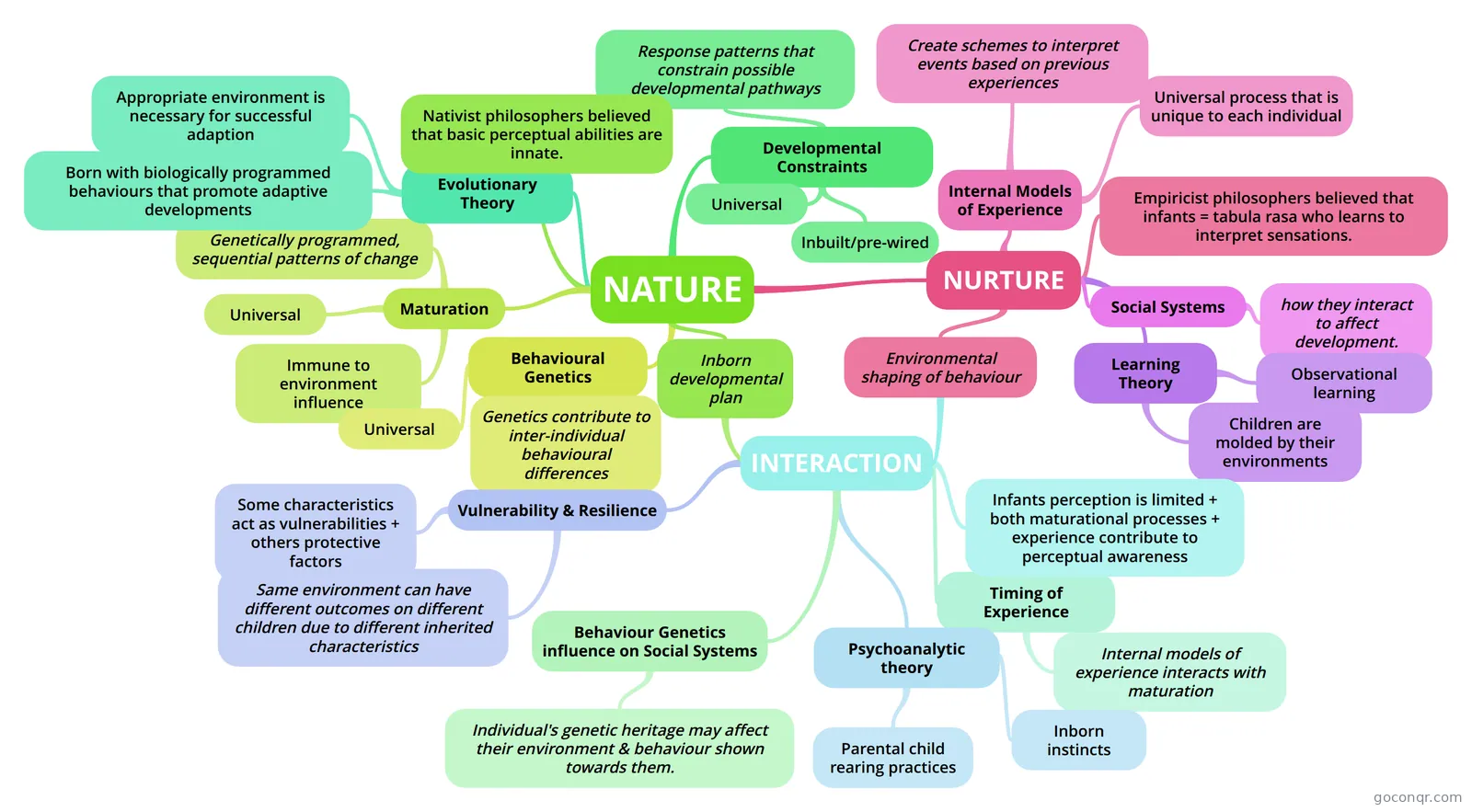
Mind map: nature vs nurture in development
Map content
NATURE
NURTURE
- Environmental shaping of behaviour
- "There is no such thing as an inheritance of capacity, talent, temperament and behavioural characteristics." Watson 1925
- INTERACTION
- Contemporary researchers nw believe attributes such as intelligence, temperament & personality are the result of an interaction between biological predisposition & environmental forces.
- "Biology + environment are as inseparable as conjoined twins who share a common heart." Halpern 1997
- Timing of Experience
- Internal models of experience interacts with maturation
- eg: critical periods for attachment formation (Bowlby 1969).
- Internal models of experience interacts with maturation
- Behaviour Genetics influence on Social Systems
- Individual's genetic heritage may affect their environment & behaviour shown towards them.
- eg: born with high IQ = more stimulating environment
- Individual's genetic heritage may affect their environment & behaviour shown towards them.
- Vulnerability & Resilience
- Same environment can have different outcomes on different children due to different inherited characteristics
- eg: some children in disadvantaged circumstances show no adverse effects.
- Some characteristics act as vulnerabilities + others protective factors
- eg; high IQ = protective factor Irritable = vulnerability
- Same environment can have different outcomes on different children due to different inherited characteristics
- Psychoanalytic theory
- Originated with Freud's Psychosexual Theory. Uncnscious motives usually repressed.
- Inborn instincts
- Parental child rearing practices
- Infants perception is limited + both maturational processes + experience contribute to perceptual awareness
- Smith + Katz 1996
- Internal Models of Experience
- Create schemes to interpret events based on previous experiences
- Universal process that is unique to each individual
- Social Systems
- eg: Family, community, culture
- how they interact to affect development.
- Learning Theory
- Behaviourism Watson believes children are tabula rasa
- Skinner belives that development is a reflection of operant conditioning as children are passively shaped by reinforcers & punishments.
- Children are molded by their environments
- Bandura Bobo Doll - modelling
- Observational learning
- Empiricist philosophers believed that infants = tabula rasa who learns to interpret sensations.
- Environmental shaping of behaviour
Inborn developmental plan
- eg; milestones, norms
- "Differences among people are due to differences in germ cells with which they were born." Wiggam 1923.
Maturation
- Genetically programmed, sequential patterns of change
- eg: walking, talking
- Universal
- Immune to environment influence
- Genetically programmed, sequential patterns of change
Developmental Constraints
- Response patterns that constrain possible developmental pathways
- eg: sucking, tracking objects
- Universal
- Inbuilt/pre-wired
- Response patterns that constrain possible developmental pathways
Behavioural Genetics
- Genetics contribute to inter-individual behavioural differences
- eg; intelligence, depression, sociability
- Universal
- Genetics contribute to inter-individual behavioural differences
Evolutionary Theory
- Born with biologically programmed behaviours that promote adaptive developments
- Evolved through natural selection. Certain adaptive characteristics have sensitive periods.
- Appropriate environment is necessary for successful adaption
- Born with biologically programmed behaviours that promote adaptive developments
Nativist philosophers believed that basic perceptual abilities are innate.
Information
- Description
- Developmental Mind Map on NATURE, created by sterling-l on 06/05/2013.
- Created by
- sterling-l
- Views
- 166
- Tags
- Rating