
Mind map
Delegated legislation
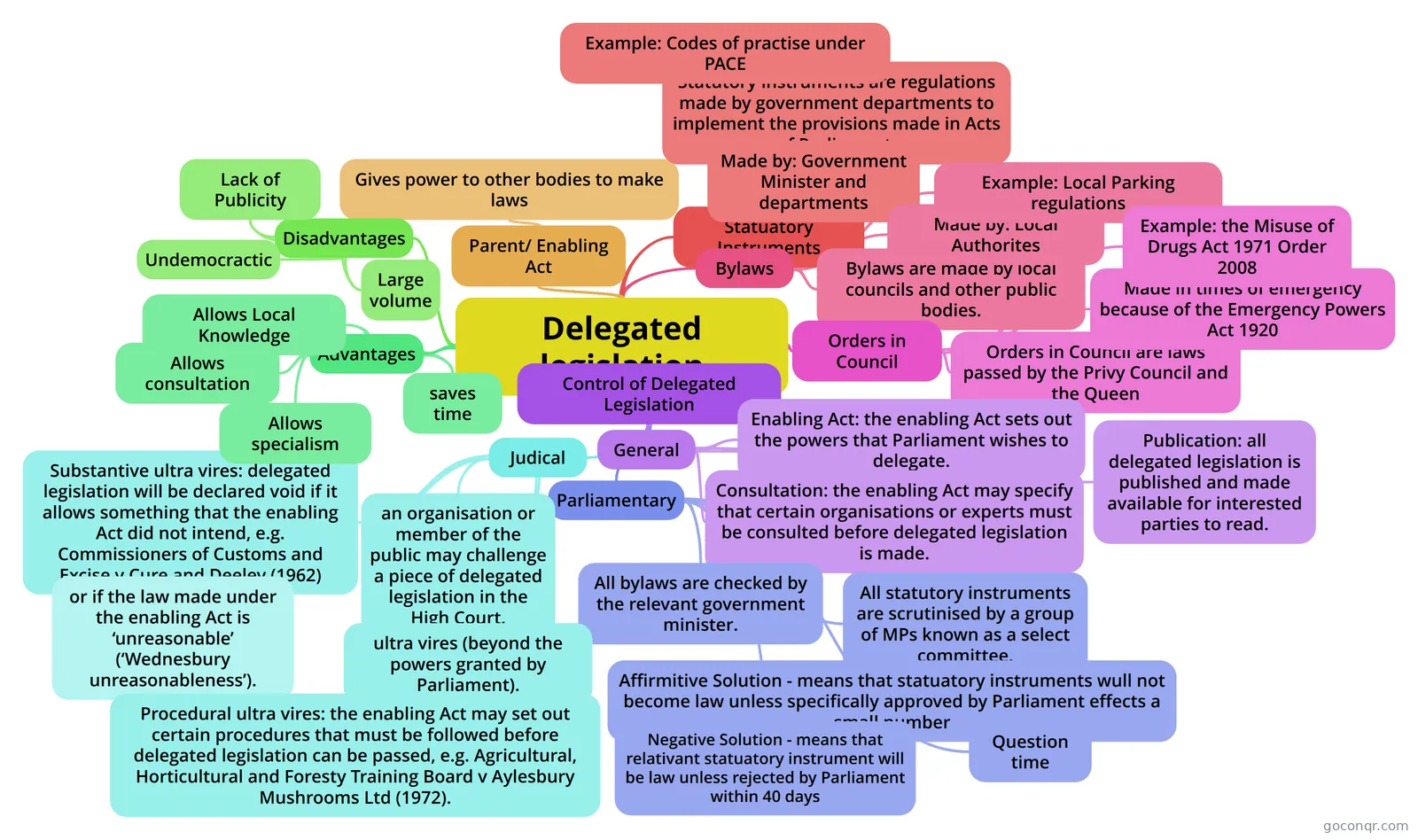
Mind map: Delegated legislation
Map content
Delegated legislation
Parent/ Enabling Act
- Gives power to other bodies to make laws
Statuatory Instruments
- Statutory instruments are regulations made by government departments to implement the provisions made in Acts of Parliament.
- Made by: Government Minister and departments
- Example: Codes of practise under PACE
Bylaws
- Bylaws are made by local councils and other public bodies.
- Made by: Local Authorites
- Example: Local Parking regulations
Orders in Council
- Orders in Council are laws passed by the Privy Council and the Queen
- Made in times of emergency because of the Emergency Powers Act 1920
- Example: the Misuse of Drugs Act 1971 Order 2008
Control of Delegated Legislation
- General
- Enabling Act: the enabling Act sets out the powers that Parliament wishes to delegate.
- Consultation: the enabling Act may specify that certain organisations or experts must be consulted before delegated legislation is made.
- Publication: all delegated legislation is published and made available for interested parties to read.
- Parliamentary
- All bylaws are checked by the relevant government minister.
- All statutory instruments are scrutinised by a group of MPs known as a select committee.
- Affirmitive Solution - means that statuatory instruments wull not become law unless specifically approved by Parliament effects a small number
- Question time
- Negative Solution - means that relativant statuatory instrument will be law unless rejected by Parliament within 40 days
- Judical
- an organisation or member of the public may challenge a piece of delegated legislation in the High Court.
- ultra vires (beyond the powers granted by Parliament).
- Substantive ultra vires: delegated legislation will be declared void if it allows something that the enabling Act did not intend, e.g. Commissioners of Customs and Excise v Cure and Deeley (1962)
- or if the law made under the enabling Act is ‘unreasonable’ (‘Wednesbury unreasonableness’).
- Procedural ultra vires: the enabling Act may set out certain procedures that must be followed before delegated legislation can be passed, e.g. Agricultural, Horticultural and Foresty Training Board v Aylesbury Mushrooms Ltd (1972).
- General
Advantages
- saves time
- Allows specialism
- Allows consultation
- Allows Local Knowledge
Disadvantages
- Undemocractic
- Lack of Publicity
- Large volume
Information
- Description
- Law Mind Map on Delegated legislation, created by lauren.pastor201 on 06/05/2013.
- Created by
- lauren.pastor201
- Views
- 541
- Tags
- Rating