
Mind map
Effectiveness of congress
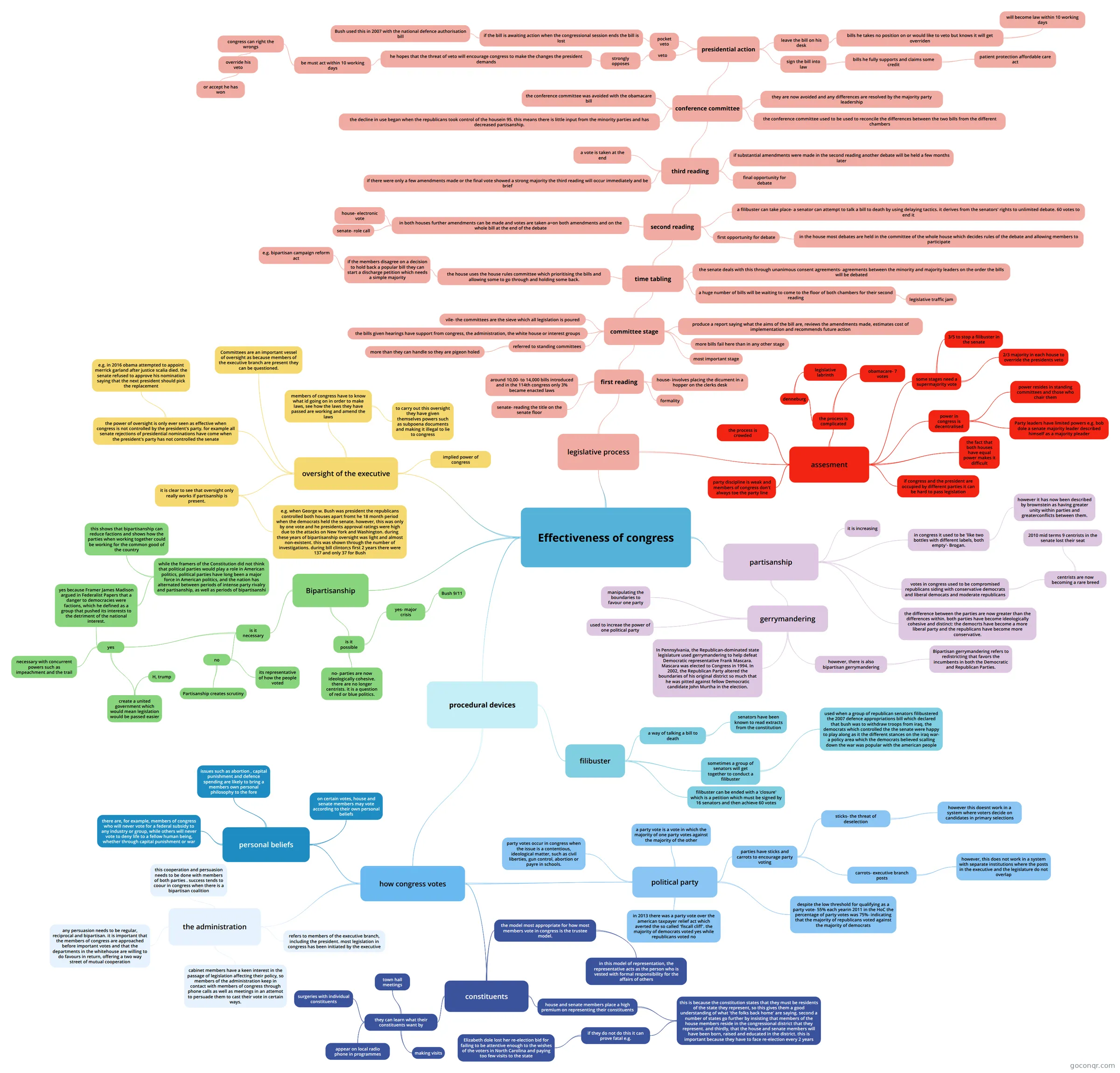
Mind map: Effectiveness of Congress
Map content
Effectiveness of congress
legislative process
- assesment
- the process is crowded
- the process is complicated
- denneburg
- legislative labrinth
- obamacare- 7 votes
- denneburg
- some stages need a supermajority vote
- 3/5 to stop a filibuster in the senate
- 2/3 majority in each house to override the presidents veto
- power in congress is decentralised
- power resides in standing committees and those who chair them
- Party leaders have limited powers e.g. bob dole a senate majority leader described himself as a majority pleader
- the fact that both houses have equal power makes it difficult
- if congress and the president are occupied by different parties it can be hard to pass legislation
- party discipline is weak and members of congress don't always toe the party line
- first reading
- formality
- house- involves placing the dicument in a hopper on the clerks desk
- senate- reading the title on the senate floor
- around 10,00- to 14,000 bills introduced and in the 114th congress only 3% became enacted laws
- committee stage
- most important stage
- more bills fail here than in any other stage
- referred to standing committees
- more than they can handle so they are pigeon holed
- the bills given hearings have support from congress, the administration, the white house or interest groups
- vile- the committees are the sieve which all legislation is poured
- produce a report saying what the aims of the bill are, reviews the amendments made, estimates cost of implementation and recommends future action
- time tabling
- a huge number of bills will be waiting to come to the floor of both chambers for their second reading
- legislative traffic jam
- the senate deals with this through unanimous consent agreements- agreements between the minority and majority leaders on the order the bills will be debated
- the house uses the house rules committee which prioritising the bills and allowing some to go through and holding some back.
- if the members disagree on a decision to hold back a popular bill they can start a discharge petition which needs a simple majority
- e.g. bipartisan campaign reform act
- if the members disagree on a decision to hold back a popular bill they can start a discharge petition which needs a simple majority
- second reading
- first opportunity for debate
- in the house most debates are held in the committee of the whole house which decides rules of the debate and allowing members to participate
- in both houses further amendments can be made and votes are taken a=on both amendments and on the whole bill at the end of the debate
- house- electronic vote
- senate- role call
- a filibuster can take place- a senator can attempt to talk a bill to death by using delaying tactics. it derives from the senators' rights to unlimited debate. 60 votes to end it
- third reading
- final opportunity for debate
- if substantial amendments were made in the second reading another debate will be held a few months later
- if there were only a few amendments made or the final vote showed a strong majority the third reading will occur immediately and be brief
- a vote is taken at the end
- conference committee
- the conference committee used to be used to reconcile the differences between the two bills from the different chambers
- they are now avoided and any differences are resolved by the majority party leadership
- the decline in use began when the republicans took control of the housein 95. this means there is little input from the minority parties and has decreased partisanship.
- the conference committee was avoided with the obamacare bill
- presidential action
- sign the bill into law
- bills he fully supports and claims some credit
- patient protection affordable care act
- bills he fully supports and claims some credit
- leave the bill on his desk
- bills he takes no position on or would like to veto but knows it will get overriden
- will become law within 10 working days
- bills he takes no position on or would like to veto but knows it will get overriden
- veto
- strongly opposes
- he hopes that the threat of veto will encourage congress to make the changes the president demands
- be must act within 10 working days
- congress can right the wrongs
- override his veto
- or accept he has won
- override his veto
- congress can right the wrongs
- be must act within 10 working days
- he hopes that the threat of veto will encourage congress to make the changes the president demands
- strongly opposes
- pocket veto
- if the bill is awaiting action when the congressional session ends the bill is lost
- Bush used this in 2007 with the national defence authorisation bill
- if the bill is awaiting action when the congressional session ends the bill is lost
- sign the bill into law
- first opportunity for debate
- a huge number of bills will be waiting to come to the floor of both chambers for their second reading
- assesment
partisanship
- gerrymandering
- manipulating the boundaries to favour one party
- used to increae the power of one political party
- In Pennsylvania, the Republican-dominated state legislature used gerrymandering to help defeat Democratic representative Frank Mascara. Mascara was elected to Congress in 1994. In 2002, the Republican Party altered the boundaries of his original district so much that he was pitted against fellow Democratic candidate John Murtha in the election.
- however, there is also bipartisan gerrymandering
- Bipartisan gerrymandering refers to redistricting that favors the incumbents in both the Democratic and Republican Parties.
- it is increasing
- in congress it used to be 'like two bottles with different labels, both empty'- Brogan.
- however it has now been described by brownstein as having greater unity within parties and greaterconflicts between them.
- votes in congress used to be compromised republicans siding with conservative democrats and liberal democats and moderate republicans
- centrists are now becoming a rare breed
- 2010 mid terms 9 centrists in the senate lost their seat
- centrists are now becoming a rare breed
- the difference between the parties are now greater than the differences within. both parties have become ideologically cohesive and distinct: the democrts have become a more liberal party and the republicans have become more conservative.
- gerrymandering
procedural devices
- filibuster
- a way of talking a bill to death
- senators have been known to read extracts from the constitution
- sometimes a group of senators will get together to conduct a filibuster
- used when a group of republican senators filibustered the 2007 defence appropriations bill which declared that bush was to withdraw troops from iraq. the democrats which controlled the the senate were happy to play along as it the different stances on the iraq war- a policy area which the democrats believed scalling down the war was popular with the american people
- filibuster can be ended with a 'closure' which is a petition which must be signed by 16 senators and then achieve 60 votes
- a way of talking a bill to death
- how congress votes
- political party
- party votes occur in congress when the issue is a contentious, ideological matter, such as civil liberties, gun control, abortion or payre in schools.
- a party vote is a vote in which the majority of one party votes against the majority of the other
- parties have sticks and carrots to encourage party voting
- sticks- the threat of deselection
- however this doesnt work in a system where voters decide on candidates in primary selections
- carrots- executive branch posts
- however, this does not work in a system with separate institutions where the posts in the executive and the legislature do not overlap
- sticks- the threat of deselection
- despite the low threshold for qualifying as a party vote- 55% each yearin 2011 in the HoC the percentage of party votes was 75%- indicating that the majority of republicans voted against the majority of democrats
- in 2013 there was a party vote over the american taxpayer relief act which averted the so called 'fiscall cliff'. the majority of democrats voted yes while republicans voted no
- constituents
- the model most appropriate for how most members vote in congress is the trustee model.
- in this model of representation, the representative acts as the person who is vested with formal responsibility for the affairs of others
- house and senate members place a high premium on representing their constituents
- this is because the constitution states that they must be residents of the state they represent, so this gives them a good understanding of what 'the folks back home' are saying. second a number of states go further by insisting that members of the house members reside in the congressional district that they represent. and thirdly, that the house and senate members will have been born, raised and educated in the district. this is important because they have to face re-election every 2 years
- if they do not do this it can prove fatal e.g.
- Elizabeth dole lost her re-election bid for failing to be attentive enough to the wishes of the voters in North Carolina and paying too few visits to the state
- if they do not do this it can prove fatal e.g.
- this is because the constitution states that they must be residents of the state they represent, so this gives them a good understanding of what 'the folks back home' are saying. second a number of states go further by insisting that members of the house members reside in the congressional district that they represent. and thirdly, that the house and senate members will have been born, raised and educated in the district. this is important because they have to face re-election every 2 years
- they can learn what their constituents want by
- town hall meetings
- surgeries with individual constituents
- making visits
- appear on local radio phone in programmes
- the model most appropriate for how most members vote in congress is the trustee model.
- the administration
- refers to members of the executive branch, including the president. most legislation in congress has been initiated by the executive
- cabinet members have a keen interest in the passage of legislation affecting their policy, so members of the administration keep in contact with members of congress through phone calls as well as meetings in an attemot to persuade them to cast their vote in certain ways.
- any persuasion needs to be regular, reciprocal and bipartisan. it is important that the members of congress are approached before important votes and that the departments in the whitehouse are willing to do favours in return, offering a two way street of mutual cooperation
- this cooperation and persuasion needs to be done with members of both parties . success tends to coour in congress when there is a bipartisan coalition
- personal beliefs
- on certain votes, house and senate members may vote according to their own personal beliefs
- issues such as abortion , capital punishment and defence spending are likely to bring a members own personal philosophy to the fore
- there are, for example, members of congress who will never vote for a federal subsidy to any industry or group, while others will never vote to deny life to a fellow human being, whether through capital punishment or war
- political party
- filibuster
oversight of the executive
- implied power of congress
- members of congress have to know what id going on in order to make laws, see how the laws they have passed are working and amend the laws
- to carry out this oversight they have given themselves powers such as subpoena documents and making it illegal to lie to congress
- Committees are an important vessel of oversight as because members of the executive branch are present they can be questioned.
- the power of oversight is only ever seen as effective when congress is not controlled by the president's party. for example all senate rejections of presidential nominations have come when the president's party has not controlled the senate
- e.g. in 2016 obama attempted to appoint merrick garland after justice scalia died. the senate refused to approve his nomination saying that the next president should pick the replacement
- it is clear to see that oversight only really works if partisanship is present.
- e.g. when George w. Bush was president the republicans controlled both houses apart fromt he 18 month period when the democrats held the senate. however, this was only by one vote and he presidents approval ratings were high due to the attacks on New York and Washington. during these years of bipartisanship oversight was light and almost non-existent. this was shown through the number of investigations. during bill clinton;s first 2 years there were 137 and only 37 for Bush
Bipartisanship
- is it necessary
- yes
- create a united government which would mean legislation would be passed easier
- H, trump
- necessary with concurrent powers such as impeachment and the trail
- yes because Framer James Madison argued in Federalist Papers that a danger to democracies were factions, which he defined as a group that pushed its interests to the detriment of the national interest.
- while the framers of the Constitution did not think that political parties would play a role in American politics, political parties have long been a major force in American politics, and the nation has alternated between periods of intense party rivalry and partisanship, as well as periods of bipartisanshi
- this shows that bipartisanship can reduce factions and shows how the parties when working together could be working for the common good of the country
- while the framers of the Constitution did not think that political parties would play a role in American politics, political parties have long been a major force in American politics, and the nation has alternated between periods of intense party rivalry and partisanship, as well as periods of bipartisanshi
- create a united government which would mean legislation would be passed easier
- no
- Partisanship creates scrutiny
- its representative of how the people voted
- yes
- is it possible
- yes- major crisis
- Bush 9/11
- no- parties are now ideologically cohesive. there are no longer centrists. it is a question of red or blue politics.
- yes- major crisis
- is it necessary
Information
- Description
- A2 Government and Politics A2 (congress) Mind Map on Effectiveness of congress, created by Truely Costen on 20/01/2017.
- Created by
- Truely Costen
- Views
- 4
- Rating
More on Congressional Behavior and Voting