
Mind map
The Corporate Responsibility to Respect
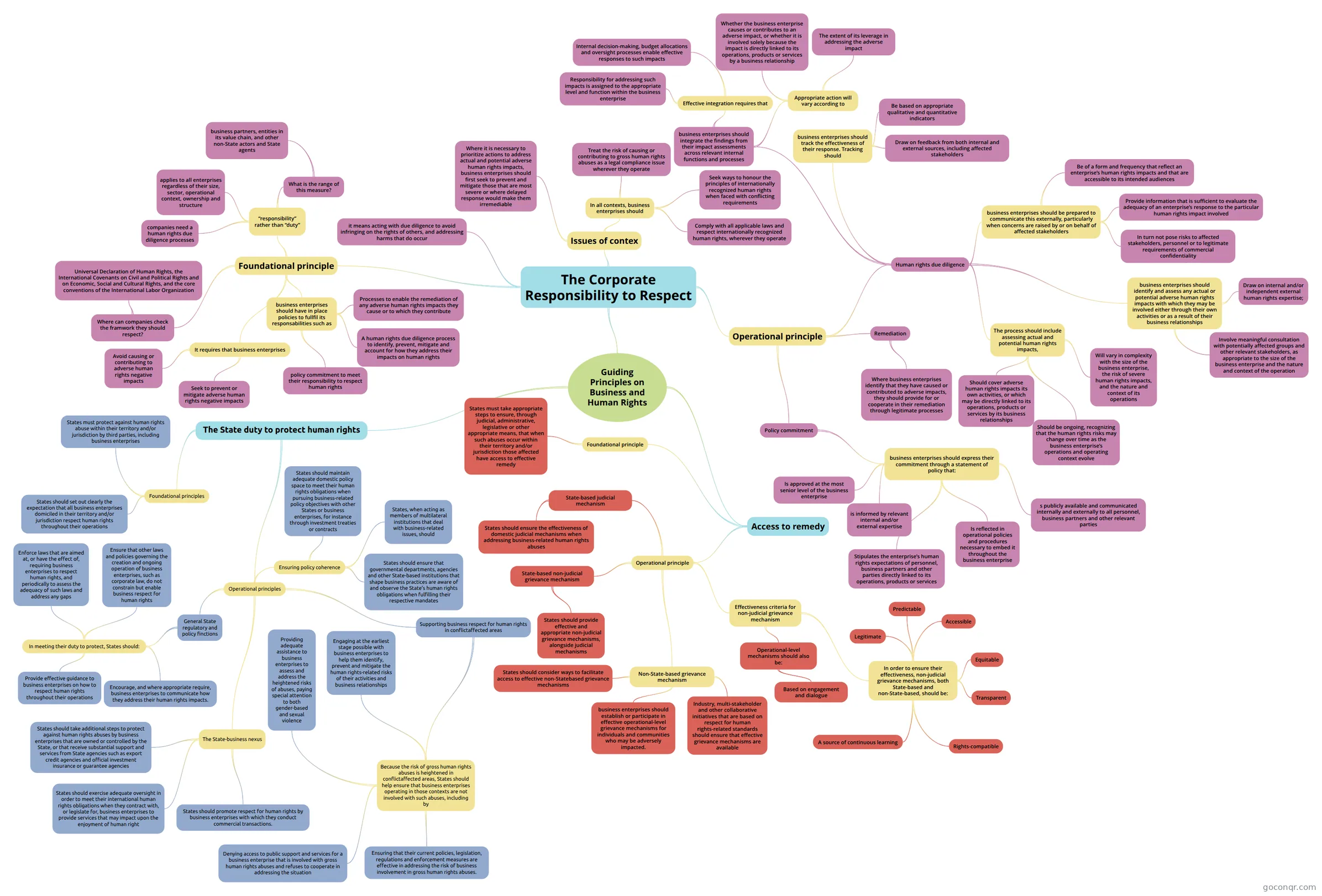
Mind map: the corporate responsibility to respect
Map content
The Corporate Responsibility to Respect
it means acting with due diligence to avoid infringing on the rights of others, and addressing harms that do occur
Foundational principle
- “responsibility” rather than “duty”
- What is the range of this measure?
- business partners, entities in its value chain, and other non-State actors and State agents
- companies need a human rights due diligence processes
- applies to all enterprises regardless of their size, sector, operational context, ownership and structure
- What is the range of this measure?
- Where can companies check the framwork they should respect?
- Universal Declaration of Human Rights, the International Covenants on Civil and Political Rights and on Economic, Social and Cultural Rights, and the core conventions of the International Labor Organization
- It requires that business enterprises
- Avoid causing or contributing to adverse human rights negative impacts
- Seek to prevent or mitigate adverse human rights negative impacts
- business enterprises should have in place policies to fullfil its responsabilities such as
- policy commitment to meet their responsibility to respect human rights
- A human rights due diligence process to identify, prevent, mitigate and account for how they address their impacts on human rights
- Processes to enable the remediation of any adverse human rights impacts they cause or to which they contribute
- “responsibility” rather than “duty”
Operational principle
- Policy commitment
- business enterprises should express their commitment through a statement of policy that:
- Is approved at the most senior level of the business enterprise
- is informed by relevant internal and/or external expertise
- Stipulates the enterprise’s human rights expectations of personnel, business partners and other parties directly linked to its operations, products or services
- s publicly available and communicated internally and externally to all personnel, business partners and other relevant parties
- Is reflected in operational policies and procedures necessary to embed it throughout the business enterprise
- business enterprises should express their commitment through a statement of policy that:
- Human rights due diligence
- The process should include assessing actual and potential human rights impacts,
- Should cover adverse human rights impacts its own activities, or which may be directly linked to its operations, products or services by its business relationships
- Will vary in complexity with the size of the business enterprise, the risk of severe human rights impacts, and the nature and context of its operations
- Should be ongoing, recognizing that the human rights risks may change over time as the business enterprise’s operations and operating context evolve
- business enterprises should identify and assess any actual or potential adverse human rights impacts with which they may be involved either through their own activities or as a result of their business relationships
- Draw on internal and/or independent external human rights expertise;
- Involve meaningful consultation with potentially affected groups and other relevant stakeholders, as appropriate to the size of the business enterprise and the nature and context of the operation
- business enterprises should integrate the findings from their impact assessments across relevant internal functions and processes
- Effective integration requires that
- Responsibility for addressing such impacts is assigned to the appropriate level and function within the business enterprise
- Internal decision-making, budget allocations and oversight processes enable effective responses to such impacts
- Appropriate action will vary according to
- Whether the business enterprise causes or contributes to an adverse impact, or whether it is involved solely because the impact is directly linked to its operations, products or services by a business relationship
- The extent of its leverage in addressing the adverse impact
- Effective integration requires that
- business enterprises should track the effectiveness of their response. Tracking should
- Be based on appropriate qualitative and quantitative indicators
- Draw on feedback from both internal and external sources, including affected stakeholders
- business enterprises should be prepared to communicate this externally, particularly when concerns are raised by or on behalf of affected stakeholders
- Be of a form and frequency that reflect an enterprise’s human rights impacts and that are accessible to its intended audiences
- Provide information that is sufficient to evaluate the adequacy of an enterprise’s response to the particular human rights impact involved
- In turn not pose risks to affected stakeholders, personnel or to legitimate requirements of commercial confidentiality
- The process should include assessing actual and potential human rights impacts,
- Remediation
- Where business enterprises identify that they have caused or contributed to adverse impacts, they should provide for or cooperate in their remediation through legitimate processes
- Policy commitment
Issues of contex
- In all contexts, business enterprises should
- Comply with all applicable laws and respect internationally recognized human rights, wherever they operate
- Seek ways to honour the principles of internationally recognized human rights when faced with conflicting requirements
- Treat the risk of causing or contributing to gross human rights abuses as a legal compliance issue wherever they operate
- Where it is necessary to prioritize actions to address actual and potential adverse human rights impacts, business enterprises should first seek to prevent and mitigate those that are most severe or where delayed response would make them irremediable
- In all contexts, business enterprises should
Guiding Principles on Business and Human Rights
- The State duty to protect human rights
- Foundational principles
- States must protect against human rights abuse within their territory and/or jurisdiction by third parties, including business enterprises
- States should set out clearly the expectation that all business enterprises domiciled in their territory and/or jurisdiction respect human rights throughout their operations
- Operational principles
- General State regulatory and policy finctions
- In meeting their duty to protect, States should:
- Enforce laws that are aimed at, or have the effect of, requiring business enterprises to respect human rights, and periodically to assess the adequacy of such laws and address any gaps
- Ensure that other laws and policies governing the creation and ongoing operation of business enterprises, such as corporate law, do not constrain but enable business respect for human rights
- Provide effective guidance to business enterprises on how to respect human rights throughout their operations
- Encourage, and where appropriate require, business enterprises to communicate how they address their human rights impacts.
- In meeting their duty to protect, States should:
- The State-business nexus
- States should take additional steps to protect against human rights abuses by business enterprises that are owned or controlled by the State, or that receive substantial support and services from State agencies such as export credit agencies and official investment insurance or guarantee agencies
- States should exercise adequate oversight in order to meet their international human rights obligations when they contract with, or legislate for, business enterprises to provide services that may impact upon the enjoyment of human right
- States should promote respect for human rights by business enterprises with which they conduct commercial transactions.
- Supporting business respect for human rights in conflictaffected areas
- Because the risk of gross human rights abuses is heightened in conflictaffected areas, States should help ensure that business enterprises operating in those contexts are not involved with such abuses, including by
- Engaging at the earliest stage possible with business enterprises to help them identify, prevent and mitigate the human rights-related risks of their activities and business relationships
- Providing adequate assistance to business enterprises to assess and address the heightened risks of abuses, paying special attention to both gender-based and sexual violence
- Denying access to public support and services for a business enterprise that is involved with gross human rights abuses and refuses to cooperate in addressing the situation
- Ensuring that their current policies, legislation, regulations and enforcement measures are effective in addressing the risk of business involvement in gross human rights abuses.
- Because the risk of gross human rights abuses is heightened in conflictaffected areas, States should help ensure that business enterprises operating in those contexts are not involved with such abuses, including by
- Ensuring policy coherence
- States should ensure that governmental departments, agencies and other State-based institutions that shape business practices are aware of and observe the State’s human rights obligations when fulfilling their respective mandates
- States should maintain adequate domestic policy space to meet their human rights obligations when pursuing business-related policy objectives with other States or business enterprises, for instance through investment treaties or contracts
- States, when acting as members of multilateral institutions that deal with business-related issues, should
- General State regulatory and policy finctions
- Foundational principles
- Access to remedy
- Foundational principle
- States must take appropriate steps to ensure, through judicial, administrative, legislative or other appropriate means, that when such abuses occur within their territory and/or jurisdiction those affected have access to effective remedy
- Operational principle
- State-based judicial mechanism
- States should ensure the effectiveness of domestic judicial mechanisms when addressing business-related human rights abuses
- State-based non-judicial grievance mechanism
- States should provide effective and appropriate non-judicial grievance mechanisms, alongside judicial mechanisms
- Non-State-based grievance mechanism
- States should consider ways to facilitate access to effective non-Statebased grievance mechanisms
- business enterprises should establish or participate in effective operational-level grievance mechanisms for individuals and communities who may be adversely impacted.
- Industry, multi-stakeholder and other collaborative initiatives that are based on respect for human rights-related standards should ensure that effective grievance mechanisms are available
- Effectiveness criteria for non-judicial grievance mechanism
- In order to ensure their effectiveness, non-judicial grievance mechanisms, both State-based and non-State-based, should be:
- Legitimate
- Accessible
- Predictable
- Equitable
- Transparent
- Rights-compatible
- A source of continuous learning
- Operational-level mechanisms should also be:
- Based on engagement and dialogue
- In order to ensure their effectiveness, non-judicial grievance mechanisms, both State-based and non-State-based, should be:
- State-based judicial mechanism
- Foundational principle
- The State duty to protect human rights
Information
- Description
- Mind Map on The Corporate Responsibility to Respect, created by Deivid Contreras Calderon on 20/02/2017.
- Created by
- Deivid Contreras Calderon
- Views
- 3
- Rating
More on Human Rights and Workplace Ethics