
Mind map
Exam IEEE802.1x / 802.11i
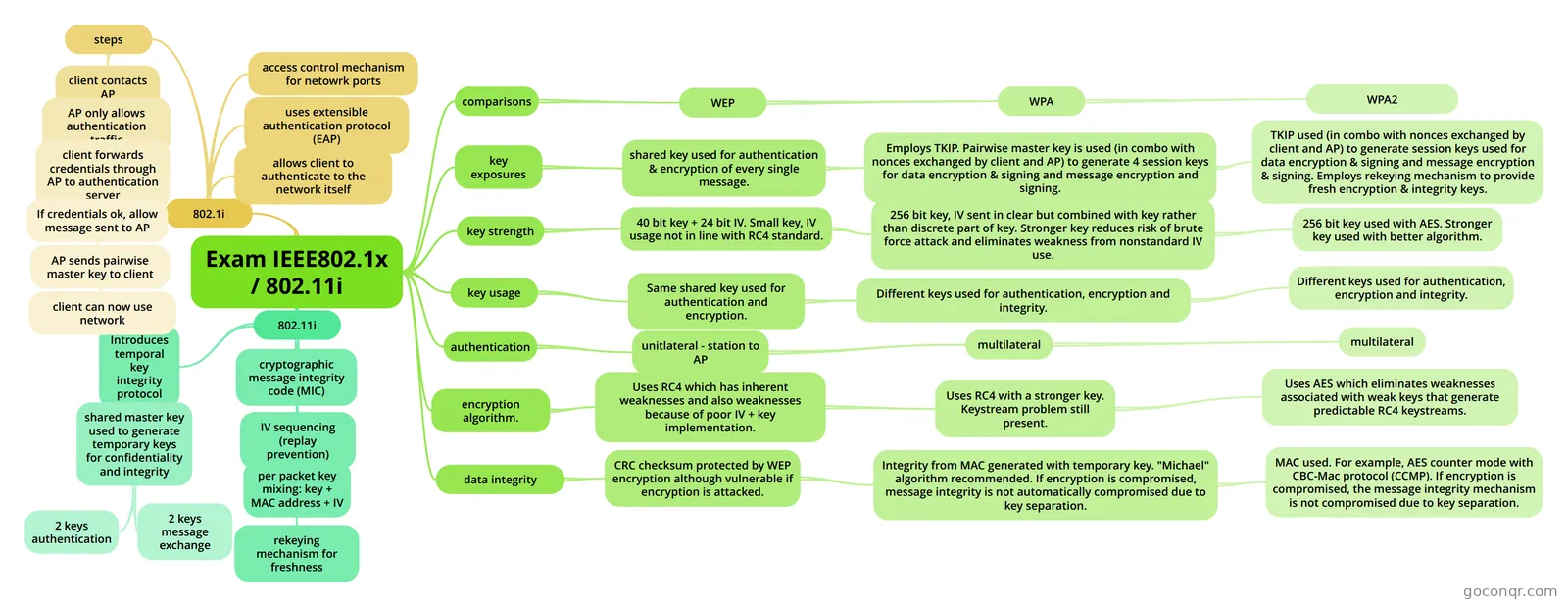
Mind map: IEEE 802.1x and 802.11i
Map content
Exam IEEE802.1x / 802.11i
comparisons
- WEP
- WPA
- WPA2
- WPA
- WEP
key exposures
- shared key used for authentication & encryption of every single message.
- Employs TKIP. Pairwise master key is used (in combo with nonces exchanged by client and AP) to generate 4 session keys for data encryption & signing and message encryption and signing.
- TKIP used (in combo with nonces exchanged by client and AP) to generate session keys used for data encryption & signing and message encryption & signing. Employs rekeying mechanism to provide fresh encryption & integrity keys.
- Employs TKIP. Pairwise master key is used (in combo with nonces exchanged by client and AP) to generate 4 session keys for data encryption & signing and message encryption and signing.
- shared key used for authentication & encryption of every single message.
key strength
- 40 bit key + 24 bit IV. Small key, IV usage not in line with RC4 standard.
- 256 bit key, IV sent in clear but combined with key rather than discrete part of key. Stronger key reduces risk of brute force attack and eliminates weakness from nonstandard IV use.
- 256 bit key used with AES. Stronger key used with better algorithm.
- 256 bit key, IV sent in clear but combined with key rather than discrete part of key. Stronger key reduces risk of brute force attack and eliminates weakness from nonstandard IV use.
- 40 bit key + 24 bit IV. Small key, IV usage not in line with RC4 standard.
key usage
- Same shared key used for authentication and encryption.
- Different keys used for authentication, encryption and integrity.
- Different keys used for authentication, encryption and integrity.
- Different keys used for authentication, encryption and integrity.
- Same shared key used for authentication and encryption.
authentication
- unitlateral - station to AP
- multilateral
- multilateral
- multilateral
- unitlateral - station to AP
encryption algorithm.
- Uses RC4 which has inherent weaknesses and also weaknesses because of poor IV + key implementation.
- Uses RC4 with a stronger key. Keystream problem still present.
- Uses AES which eliminates weaknesses associated with weak keys that generate predictable RC4 keystreams.
- Uses RC4 with a stronger key. Keystream problem still present.
- Uses RC4 which has inherent weaknesses and also weaknesses because of poor IV + key implementation.
data integrity
- CRC checksum protected by WEP encryption although vulnerable if encryption is attacked.
- Integrity from MAC generated with temporary key. "Michael" algorithm recommended. If encryption is compromised, message integrity is not automatically compromised due to key separation.
- MAC used. For example, AES counter mode with CBC-Mac protocol (CCMP). If encryption is compromised, the message integrity mechanism is not compromised due to key separation.
- Integrity from MAC generated with temporary key. "Michael" algorithm recommended. If encryption is compromised, message integrity is not automatically compromised due to key separation.
- CRC checksum protected by WEP encryption although vulnerable if encryption is attacked.
802.11i
- Introduces temporal key integrity protocol
- shared master key used to generate temporary keys for confidentiality and integrity
- 2 keys authentication
- 2 keys message exchange
- shared master key used to generate temporary keys for confidentiality and integrity
- cryptographic message integrity code (MIC)
- IV sequencing (replay prevention)
- per packet key mixing: key + MAC address + IV
- rekeying mechanism for freshness
- Introduces temporal key integrity protocol
802.1i
- uses extensible authentication protocol (EAP)
- access control mechanism for netowrk ports
- allows client to authenticate to the network itself
- steps
- client contacts AP
- AP only allows authentication traffic
- client forwards credentials through AP to authentication server
- If credentials ok, allow message sent to AP
- AP sends pairwise master key to client
- client can now use network
- AP sends pairwise master key to client
- If credentials ok, allow message sent to AP
- client forwards credentials through AP to authentication server
- AP only allows authentication traffic
- client contacts AP
Information
- Description
- Nework Security Mind Map on Exam IEEE802.1x / 802.11i, created by jjanesko on 25/04/2014.
- Created by
- jjanesko
- Views
- 42
- Rating
More on Wi-Fi Security Protocols