
Mind map
9/11, The War on Terror, and Beyond
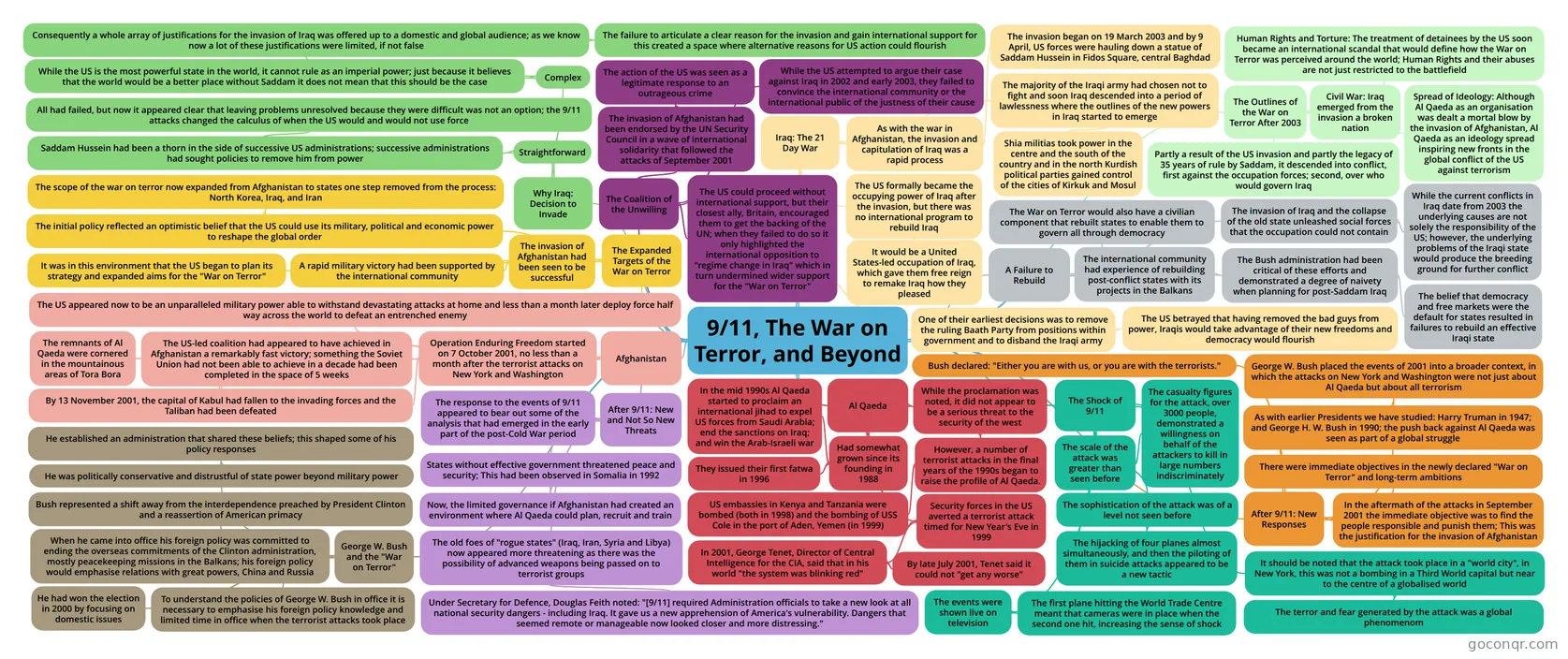
Mind map: 9/11, the War on Terror, and beyond
Map content
9/11, The War on Terror, and Beyond
Al Qaeda
- Had somewhat grown since its founding in 1988
- In the mid 1990s Al Qaeda started to proclaim an international jihad to expel US forces from Saudi Arabia; end the sanctions on Iraq; and win the Arab-Israeli war
- They issued their first fatwa in 1996
- While the proclamation was noted, it did not appear to be a serious threat to the security of the west
- However, a number of terrorist attacks in the final years of the 1990s began to raise the profile of Al Qaeda.
- US embassies in Kenya and Tanzania were bombed (both in 1998) and the bombing of USS Cole in the port of Aden, Yemen (in 1999)
- However, a number of terrorist attacks in the final years of the 1990s began to raise the profile of Al Qaeda.
- Security forces in the US averted a terrorist attack timed for New Year's Eve in 1999
- In 2001, George Tenet, Director of Central Intelligence for the CIA, said that in his world "the system was blinking red"
- By late July 2001, Tenet said it could not "get any worse"
- In 2001, George Tenet, Director of Central Intelligence for the CIA, said that in his world "the system was blinking red"
- Had somewhat grown since its founding in 1988
The Shock of 9/11
- The scale of the attack was greater than seen before
- The casualty figures for the attack, over 3000 people, demonstrated a willingness on behalf of the attackers to kill in large numbers indiscriminately
- The sophistication of the attack was of a level not seen before
- The hijacking of four planes almost simultaneously, and then the piloting of them in suicide attacks appeared to be a new tactic
- The events were shown live on television
- The first plane hitting the World Trade Centre meant that cameras were in place when the second one hit, increasing the sense of shock
- It should be noted that the attack took place in a "world city", in New York, this was not a bombing in a Third World capital but near to the centre of a globalised world
- The terror and fear generated by the attack was a global phenomenom
- The scale of the attack was greater than seen before
After 9/11: New and Not So New Threats
- The response to the events of 9/11 appeared to bear out some of the analysis that had emerged in the early part of the post-Cold War period
- States without effective government threatened peace and security; This had been observed in Somalia in 1992
- Now, the limited governance if Afghanistan had created an environment where Al Qaeda could plan, recruit and train
- The old foes of "rogue states" (Iraq, Iran, Syria and Libya) now appeared more threatening as there was the possibility of advanced weapons being passed on to terrorist groups
- Under Secretary for Defence, Douglas Feith noted: "[9/11] required Administration officials to take a new look at all national security dangers - including Iraq. It gave us a new apprehension of America's vulnerability. Dangers that seemed remote or manageable now looked closer and more distressing."
After 9/11: New Responses
- There were immediate objectives in the newly declared "War on Terror" and long-term ambitions
- In the aftermath of the attacks in September 2001 the immediate objective was to find the people responsible and punish them; This was the justification for the invasion of Afghanistan
- As with earlier Presidents we have studied: Harry Truman in 1947; and George H. W. Bush in 1990; the push back against Al Qaeda was seen as part of a global struggle
- George W. Bush placed the events of 2001 into a broader context, in which the attacks on New York and Washington were not just about Al Qaeda but about all terrorism
- Bush declared: "Either you are with us, or you are with the terrorists."
George W. Bush and the "War on Terror"
- To understand the policies of George W. Bush in office it is necessary to emphasise his foreign policy knowledge and limited time in office when the terrorist attacks took place
- He had won the election in 2000 by focusing on domestic issues
- When he came into office his foreign policy was committed to ending the overseas commitments of the Clinton administration, mostly peacekeeping missions in the Balkans; his foreign policy would emphasise relations with great powers, China and Russia
- Bush represented a shift away from the interdependence preached by President Clinton and a reassertion of American primacy
- He was politically conservative and distrustful of state power beyond military power
- He established an administration that shared these beliefs; this shaped some of his policy responses
Afghanistan
- Operation Enduring Freedom started on 7 October 2001, no less than a month after the terrorist attacks on New York and Washington
- By 13 November 2001, the capital of Kabul had fallen to the invading forces and the Taliban had been defeated
- The remnants of Al Qaeda were cornered in the mountainous areas of Tora Bora
- By 13 November 2001, the capital of Kabul had fallen to the invading forces and the Taliban had been defeated
- The US-led coalition had appeared to have achieved in Afghanistan a remarkably fast victory; something the Soviet Union had not been able to achieve in a decade had been completed in the space of 5 weeks
- The US appeared now to be an unparalleled military power able to withstand devastating attacks at home and less than a month later deploy force half way across the world to defeat an entrenched enemy
- Operation Enduring Freedom started on 7 October 2001, no less than a month after the terrorist attacks on New York and Washington
The Expanded Targets of the War on Terror
- The invasion of Afghanistan had been seen to be successful
- A rapid military victory had been supported by the international community
- It was in this environment that the US began to plan its strategy and expanded aims for the "War on Terror"
- The initial policy reflected an optimistic belief that the US could use its military, political and economic power to reshape the global order
- The scope of the war on terror now expanded from Afghanistan to states one step removed from the process: North Korea, Iraq, and Iran
- The invasion of Afghanistan had been seen to be successful
Why Iraq: Decision to Invade
- Straightforward
- Saddam Hussein had been a thorn in the side of successive US administrations; successive administrations had sought policies to remove him from power
- All had failed, but now it appeared clear that leaving problems unresolved because they were difficult was not an option; the 9/11 attacks changed the calculus of when the US would and would not use force
- Saddam Hussein had been a thorn in the side of successive US administrations; successive administrations had sought policies to remove him from power
- Complex
- While the US is the most powerful state in the world, it cannot rule as an imperial power; just because it believes that the world would be a better place without Saddam it does not mean that this should be the case
- Consequently a whole array of justifications for the invasion of Iraq was offered up to a domestic and global audience; as we know now a lot of these justifications were limited, if not false
- The failure to articulate a clear reason for the invasion and gain international support for this created a space where alternative reasons for US action could flourish
- Straightforward
The Coalition of the Unwilling
- The invasion of Afghanistan had been endorsed by the UN Security Council in a wave of international solidarity that followed the attacks of September 2001
- The action of the US was seen as a legitimate response to an outrageous crime
- While the US attempted to argue their case against Iraq in 2002 and early 2003, they failed to convince the international community or the international public of the justness of their cause
- The US could proceed without international support, but their closest ally, Britain, encouraged them to get the backing of the UN; when they failed to do so it only highlighted the international opposition to "regime change in Iraq" which in turn undermined wider support for the "War on Terror"
- The invasion of Afghanistan had been endorsed by the UN Security Council in a wave of international solidarity that followed the attacks of September 2001
Iraq: The 21 Day War
- As with the war in Afghanistan, the invasion and capitulation of Iraq was a rapid process
- The invasion began on 19 March 2003 and by 9 April, US forces were hauling down a statue of Saddam Hussein in Fidos Square, central Baghdad
- The majority of the Iraqi army had chosen not to fight and soon Iraq descended into a period of lawlessness where the outlines of the new powers in Iraq started to emerge
- Shia militias took power in the centre and the south of the country and in the north Kurdish political parties gained control of the cities of Kirkuk and Mosul
- The US formally became the occupying power of Iraq after the invasion, but there was no international program to rebuild Iraq
- It would be a United States-led occupation of Iraq, which gave them free reign to remake Iraq how they pleased
- One of their earliest decisions was to remove the ruling Baath Party from positions within government and to disband the Iraqi army
- The US betrayed that having removed the bad guys from power, Iraqis would take advantage of their new freedoms and democracy would flourish
- As with the war in Afghanistan, the invasion and capitulation of Iraq was a rapid process
A Failure to Rebuild
- The War on Terror would also have a civilian component that rebuilt states to enable them to govern all through democracy
- The international community had experience of rebuilding post-conflict states with its projects in the Balkans
- The Bush administration had been critical of these efforts and demonstrated a degree of naivety when planning for post-Saddam Iraq
- The belief that democracy and free markets were the default for states resulted in failures to rebuild an effective Iraqi state
- The Bush administration had been critical of these efforts and demonstrated a degree of naivety when planning for post-Saddam Iraq
- The invasion of Iraq and the collapse of the old state unleashed social forces that the occupation could not contain
- While the current conflicts in Iraq date from 2003 the underlying causes are not solely the responsibility of the US; however, the underlying problems of the Iraqi state would produce the breeding ground for further conflict
The Outlines of the War on Terror After 2003
- Human Rights and Torture: The treatment of detainees by the US soon became an international scandal that would define how the War on Terror was perceived around the world; Human Rights and their abuses are not just restricted to the battlefield
- Spread of Ideology: Although Al Qaeda as an organisation was dealt a mortal blow by the invasion of Afghanistan, Al Qaeda as an ideology spread inspiring new fronts in the global conflict of the US against terrorism
- Civil War: Iraq emerged from the invasion a broken nation
- Partly a result of the US invasion and partly the legacy of 35 years of rule by Saddam, it descended into conflict, first against the occupation forces; second, over who would govern Iraq
Information
- Description
- Mind Map on 9/11, The War on Terror, and Beyond, created by Luigi Botrugno on 15/03/2017.
- Created by
- Luigi Botrugno
- Views
- 2
- Rating
More on Terrorism and the War on Terror