
Mind map
T.C.P context
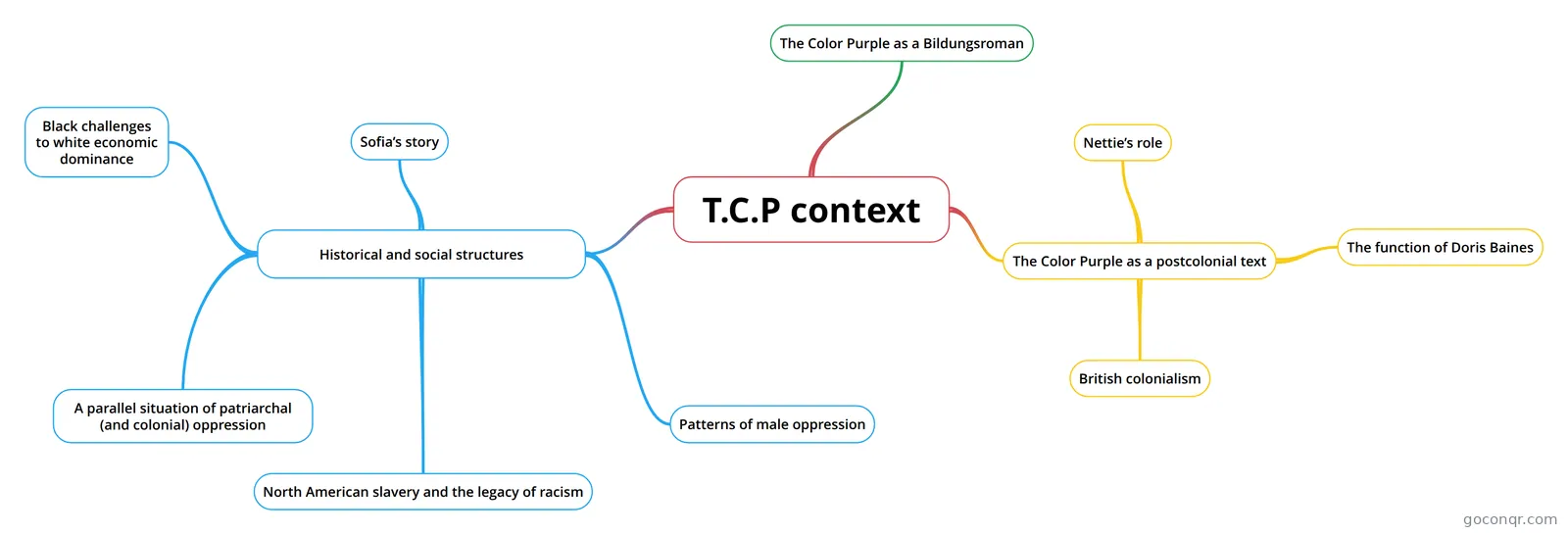
Mind map: The Color Purple context
Map content
T.C.P context
Historical and social structures
- Black challenges to white economic dominance
- A post-slavery culture After the abolition of slavery, the social and economic structure of life for African-Americans in the rural South remained largely unaltered. Although no longer slaves, many black people remained on the land, working as sharecroppers. They grew crops but the land they worked was still owned by their former white slave masters. Following the African-American migration to the Northern states in 1915, the black sharecroppers who stayed in the South became more isolated from white society. Schools, churches and housing were segregated and there were few opportunities for blacks to make a living from anything other than sharecropping. However some entrepreneurial African-Americans were able to establish themselves as businessmen. In The Color Purple, increasing black prosperity signifies the developing sense of pride in personal - and corporate – identity for its black characters.
- Patterns of male oppression
- Many black males, lacking power and control in a white dominated society, turned their frustration and anger on their wives, partners and female family members. In consequence, black women were doubly oppressed; firstly by white men and women because of their perceived inferiority as African-Americans and secondly by their husbands, partners and other black males, because they were convenient victims. The combination of male oppression and physical assault in The Color Purple leads to a loss of female identity and individuality in a number of characters, most obviously Celie. Her self-worth and identity is only recovered by the ministry of a woman, Shug. Walker also addresses various forms of brutal violence, such as domestic incest and rape which reveal the weak internal structures of some African-American families. Fonso’s control of the family’s private resources effectively gives him license to violate his wife and his stepdaughter. Albert’s treatment of Celie reveals a similar lack of respect for women. It is chilling that this model is passed down through the generations. In a patriarchal system older males possess power over younger and make them conform, with brutal control being regarded as a measure of ‘manhood’. That Harpo and Albert are rescued from this pattern is due to Sofia and Shug Avery, who combine ‘masculine’ strength with ‘feminine’ nurture and are quite capable of fighting back.
- A parallel situation of patriarchal (and colonial) oppression
- Working as a missionary in Africa, Nettie finds that the patriarchal system of oppression of the Olinka women is not dissimilar to the situation she left in America. African women are defined only in terms of the value they have for their husbands; girls are denied education and ritual female circumcision and scarring leaves many African women joyless and spiritually dead. As women, Corinne and Nettie encourage female participation in education which is ultimately respected. But their efforts are thwarted by the greater power of white colonialism, whose economic demands mean that no-one beyond the age of seven is educated. Initially, Tashi’s resistance to the colonists means that she retreats back to the physical oppression of female genital mutilation, until the ‘new man’ Adam convinces her that she can have a secure future as an equal by his side
- North American slavery and the legacy of racism
- North America was colonised primarily by European settlers in the seventeenth and eighteenth centuries. The early colonies were run as private business enterprises, producing large amounts of indigo, tobacco, sugar, cotton and other crops that were sold back to England. By 1700, a planter could buy an African slave for life for the same price that he could purchase a white servant for ten years, so there was a massive increase in the importing of slaves from Africa to cultivate major cash crops in the North American colonies. Over the next two centuries, white colonists and their descendants, especially in the rural South, established the institutions and ideas that would come to be known as ‘white supremacy’, an ideology that was based on a belief that black people were ‘subhuman’ and naturally inferior to whites; thus racism was born. Although the American Civil War secured the abolition of slavery, racism itself was not abolished. On the contrary, the ideology was reconstructed to create second-class status for black Americans, dividing the United States into superior and inferior races, according to their origins.
- Sofia’s story
- The story of Sofia explores racial issues in the rural South of the United States and the effects of racism on one character and her friends and family. Sofia is beaten and sentenced to twelve years in jail for attacking the town’s white Mayor after he hits her for impertinence to his wife, Miss Millie.
- Black challenges to white economic dominance
The Color Purple as a postcolonial text
- British colonialism
- The letters written to Celie by her sister Nettie describe the effects of British colonial rule on the members of the African Olinka tribe: Some of the Olinka attempt to resist colonisation directly through resistance groups called mbeles, who move back into the forest away from the colonisers so that they can harass the European plantationsOther villagers choose to maintain their tribal and cultural identities by embracing rituals and customs such as scarification and female genital mutilation. The young woman Tashi, for example, chooses both to demonstrate that Olinka customs are still important, even though the white Europeans have taken away ‘everything else’. Nettie is revolted by the act, calling it a ‘mistake’ (Letter 81).
- The function of Doris Baines
- Nettie’s letters recount the experiences of a white English missionary called Doris Baines, whom she meets on a voyage to England. Miss Baines is an ambiguous character whose decision to become a missionary in Africa seems primarily to have been made in order to escape the constraints of a patriarchal upper-class background and marriage. In Africa, using her family’s wealth, she is able to help local people, building a hospital, school and college. However, she calls Africans ‘the heathen’ and tells Nettie and Samuel that her involvement with ‘her’ tribe is the price she was willing to pay for a peaceful life. Her main reason for staying in Africa was to write novels under her masculine pen name of Jared Hunt. Doris Baines embodies Western colonial arrogance and, despite her altruism, she shows a significant lack of empathy with the African people she claims that she wants to protect, boasting that her wealth enables her to ‘own’ the village where she lives and works.
- Nettie’s role
- Although Walker uses Nettie’s character as a means of criticising the theme of colonialism, Nettie has herself absorbed white cultural values. Her use of English is, for example, very European, unlike Celie’s African-American ‘folk language’ and some of her opinions about the Olinka seem at times to convey a similar patronising attitude to that shown by Doris Baines.
- British colonialism
The Color Purple as a Bildungsroman
- Genre expectations Celie’s personal progress is consistent with an important literary genre known as Bildungsroman, sometimes referred to as ‘coming of age’ novels. The Bildungsroman is a literary genre that began in Germany and spread throughout Europe in the nineteenth century. The form focuses on the psychological and moral growth of the protagonist from youth to adulthood and character change is an important part of this process. The Bildungsroman depicts and criticises aspects of a society that cause the protagonist to suffer in some way. The protagonist is usually male, sensitive and socially inferior and the narrative features some loss or reversal which ultimately changes the course of his life. Charles Dickens’ David Copperfield (1850) and Great Expectations (1861) are classic examples of the genre. Female protagonists, although rare, also feature in novels such as Charlotte Bronte’s Jane Eyre (1847) and George Eliot’s The Mill on the Floss (1860) but there is a significant difference between male and female protagonists in terms of their perceived roles and consequent freedom of choice. Whereas men were encouraged to be independent and were not domestically or morally constrained, the opposite was true for women, who were traditionally expected to remain submissive, dependent and obedient. Tamar Katz’s article in Harold Bloom’s Alice Walker (1988) suggests that The Color Purple is a ‘type of’ Bildungsroman since it not only traces Celie’s psychological growth but also teaches or instructs the reader as they read the collection of letters.
Information
- Description
- AS - Level Englilsh Literature (A2 Prose context) Mind Map on T.C.P context, created by Rebecca Hunter on 20/03/2017.
- Created by
- Rebecca Hunter
- Views
- 6
- Rating