
Mind map
Electric Fields and Electric Potential
Map content
Electric Fields and Electric Potential
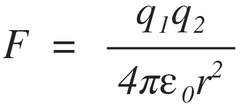
Coulombs law can be used to find the force between two point charges
- If the charges are opposite, the force is attractive and F will be nagative
- The force on Q is always equal and opposite to the force on q
- Further apart charges, weaker force
- The force also depends on the permittivity of the material the charges are in
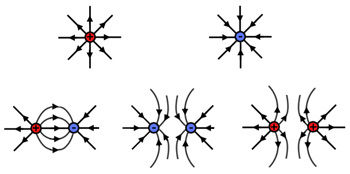
There is an electric field around a charged object
- Can be attractive or repulsive, but are still radial
- Charged spheres can be treated as point charges
- Can be represented by field lines
- Charge is measured in coulombs
- It can be positive or nagative
- Opposite charges attract, like charges repel
- If a charged object is placed in an electric field it will feel a force
- Can be attractive or repulsive, but are still radial
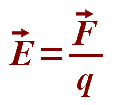
Electric field strength is force per unit charge
- For this equation, you find the force acting on a charge Q which is in an electric field. Q does not cause the electric field.
- E is a vector pointing in the direction that a positive charge would move in
- Newtons per Coulomb
- Depends on where you are in the field
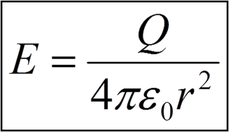
- A point charge has a radial field
- In a radial field, E is inversely proportional to r squared
- When the electric field is generated by a point charge, we redefine Q as the charge causing the field, and q as the charge experiencing the force.
- In a radial field, E depends on the distance R from point charge Q
- Area under a graph of E against r would give the electric potential
- In a radial field, E depends on the distance R from point charge Q
- When the electric field is generated by a point charge, we redefine Q as the charge causing the field, and q as the charge experiencing the force.
Field strength id the same everywhere in a uniform field
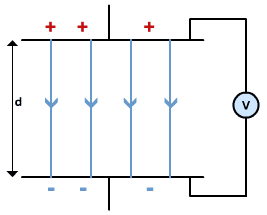
- A uniform field can be produced by connecting two parallel plates to opposite poles of a battery
- Field strength is the same between any two points and is the voltages per unit distance
- Volts per metre
- Charge particles will move through a uniform electric field like projectiles
- A particle of charge Q will experience a constant force given by E=F/Q
- The work done on a particle by this force (W=Fd) increases its kinetic energy and causes it to accelerate at a constant rate in the direction of the force
- If the particle has a velocity perpendicular to the field lines, the horizontal velocity will remain constant
- Curved path
- The work done on a particle by this force (W=Fd) increases its kinetic energy and causes it to accelerate at a constant rate in the direction of the force
- A particle of charge Q will experience a constant force given by E=F/Q
- Field strength is the same between any two points and is the voltages per unit distance
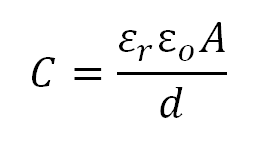
- Parallel plate capacitors generate a uniform electric field
- The capacitance of a capacitor depends on how easy it is to generate an electric field between the plates and on the dimensions of the capacitor
- A uniform field can be produced by connecting two parallel plates to opposite poles of a battery
Electric potential is potential energy per unit charge
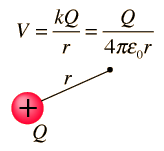
- All points in an electric field have a potential, V
- This is the work done to bring a unit positive charge from infinity to that point in the field. (At infinity, electric potential would be zero)
- The sign of V depends on the charge of Q
- The absolute magnitude of V is is greatest on the surface of the charge
- The sign of V depends on the charge of Q
- This is the work done to bring a unit positive charge from infinity to that point in the field. (At infinity, electric potential would be zero)
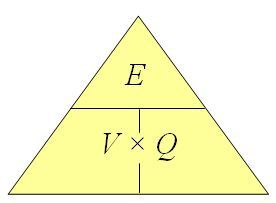
- Electric potential energy is just the electric potential that a unit positive charge would have at a certain point. Therefore you can use electric potential to find electric potential energy
- Electric potential can be used to figure out capacitance, I can't find a picture of the equation but it's capacitance is equal to 4(pi)(Epsilon)r
- All points in an electric field have a potential, V
Comparisons between electric and gravitational fields:
- gravitational field strength, g, is force per unit mass and electric field strength, E, is force per unit positive charge
- The size of an electric force depends on the medium between the charges
- Newtons law of gravitation for the force between two point masses and coulombs law for force between two point charges are inverse square laws
- They have radial fields
- Gravitational potential is potential energy per unit mass, and electric potential is potential energy per unit positive charge. Both are zero at infinity.
- Gravitational forces are always attractive but electric forces can be attractive or repulsive
- Objects can be shielded from electric fields but not gravitational fields
- gravitational field strength, g, is force per unit mass and electric field strength, E, is force per unit positive charge
Images and files in the map
Information
- Description
- Mind Map on Electric Fields and Electric Potential, created by Holly Stokes-Geddes on 27/03/2017.
- Created by
- Holly Stokes-Geddes
- Views
- 0
- Rating