
Mind map
CHINA: CULTURAL REVOLUTION
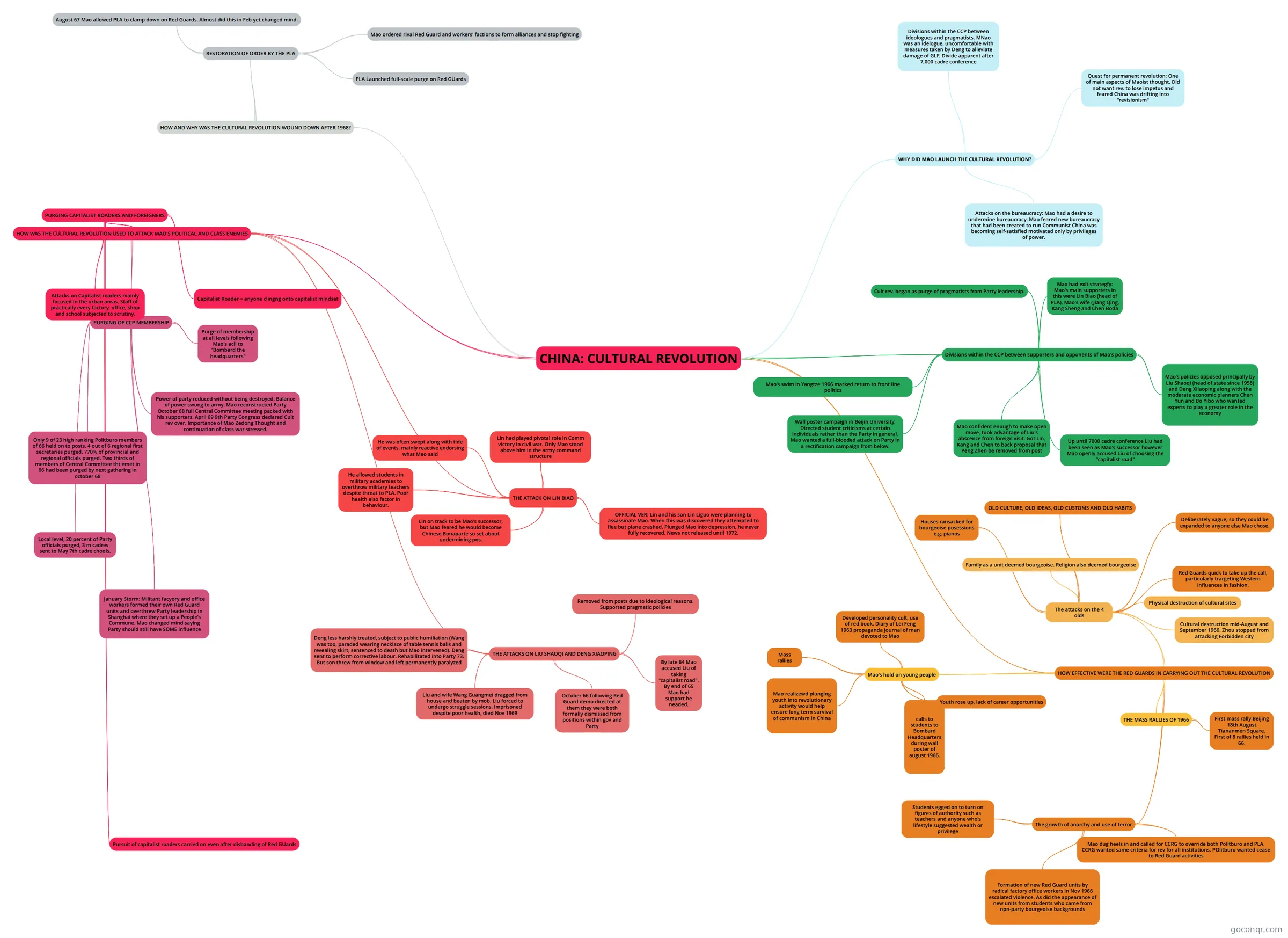
Mind map: China Cultural Revolution
Map content
CHINA: CULTURAL REVOLUTION
WHY DID MAO LAUNCH THE CULTURAL REVOLUTION?
- Divisions within the CCP between ideologues and pragmatists. MNao was an idelogue, uncomfortable with measures taken by Deng to alleviate damage of GLF. Divide apparent after 7,000 cadre conference
- Quest for permanent revolution: One of main aspects of Maoist thought. Did not want rev. to lose impetus and feared China was drifting into "revisionism"
- Attacks on the bureaucracy: Mao had a desire to undermine bureaucracy. Mao feared new bureaucracy that had been created to run Communist China was becoming self-satisfied motivated only by privileges of power.
Divisions within the CCP between supporters and opponents of Mao's policies
- Cult rev. began as purge of pragmatists from Party leadership.
- Mao had exit strategfy: Mao's main supporters in this were Lin Biao (head of PLA), Mao's wife (Jiang Qing, Kang Sheng and Chen Boda
- Mao's policies opposed principally by Liu Shaoqi (head of state since 1958) and Deng Xiiaoping along with the moderate economic planners Chen Yun and Bo Yibo who wanted experts to play a greater role in the economy
- Up until 7000 cadre conference LIu had been seen as Mao's successor however Mao openly accused Liu of choosing the "capitalist road"
- Mao confident enough to make open move, took advantage of Liu's abscence from foreign visit. Got Lin, Kang and Chen to back proposal that Peng Zhen be removed from post
- Wall poster campaign in Beijin University. Directed student criticisms at certain individuals rather than the Party in general. Mao wanted a full-blooded attack on Party in a rectification campaign from below.
- Mao's swim in Yangtze 1966 marked return to front line politics
HOW EFFECTIVE WERE THE RED GUARDS IN CARRYING OUT THE CULTURAL REVOLUTION
- Mao's hold on young people
- Mao realizewd plunging youth into revolutionary activity would help ensure long term survival of communism in China
- Developed personality cult, use of red book. Diary of Lei Feng 1963 propaganda journal of man devoted to Mao
- Mass rallies
- calls to students to Bombard Headquarters during wall poster of august 1966.
- Youth rose up, lack of career opportunities
- THE MASS RALLIES OF 1966
- First mass rally Beijing 18th August Tiananmen Square. First of 8 rallies held in 66.
- The attacks on the 4 olds
- OLD CULTURE, OLD IDEAS, OLD CUSTOMS AND OLD HABITS
- Deliberately vague, so they could be expanded to anyone else Mao chose.
- Red Guards quick to take up the call, particularly trargeting Western influences in fashion,
- Houses ransacked for bourgeoise posessions e.g. pianos
- Family as a unit deemed bourgeoise. Religion also deemed bourgeoise
- Physical destruction of cultural sites
- Cultural destruction mid-August and September 1966. Zhou stopped from attacking Forbidden city
- The growth of anarchy and use of terror
- Students egged on to turn on figures of authority such as teachers and anyone who's lifestyle suggested wealth or privilege
- Formation of new Red Guard units by radical factory office workers in Nov 1966 escalated violence. As did the appearance of new units from students who came from npn-party bourgeoise backgrounds
- Mao dug heels in and called for CCRG to override both Politburo and PLA. CCRG wanted same criteria for rev for all institutions. POlitburo wanted cease to Red Guard activities
- Mao's hold on young people
HOW WAS THE CULTURAL REVOLUTION USED TO ATTACK MAO'S POLITICAL AND CLASS ENEMIES
- THE ATTACKS ON LIU SHAOQI AND DENG XIAOPING
- Removed from posts due to ideological reasons. Supported pragmatic policies
- By late 64 Mao accused Liu of taking "capitalist road". By end of 65 Mao had support he neaded.
- October 66 following Red Guard demo directed at them they were both formally dismissed from positions within gov and Party
- LIu and wife Wang Guangmei dragged from house and beaten by mob. Liu forced to undergo struggle sessions. Imprisoned despite poor health, died Nov 1969
- Deng less harshly treated, subject to public humiliation (Wang was too, paraded wearing necklace of table tennis balls and revealing skirt, sentenced to death but Mao intervened). Deng sent to perform corrective labour. Rehabilitated into Party 73. But son threw from window and left permanently paralyzed
- THE ATTACK ON LIN BIAO
- Lin had played pivotal role in Comm victory in civil war. Only Mao stood above him in the army command structure
- He was often swept along with tide of events, mainly reactive endorsing what Mao said
- He allowed students in military academies to overthrow military teachers despite threat to PLA. Poor health also factor in behaviour.
- Lin on track to be Mao's successor, but Mao feared he would become Chinese Bonaparte so set about undermining pos.
- OFFICIAL VER: Lin and his son Lin Liguo were planning to assassinate Mao. When this was discovered they attempted to flee but plane crashed. Plunged Mao into depression, he never fully recovered. News not released until 1972.
- PURGING OF CCP MEMBERSHIP
- Purge of membership at all levels following Mao's acll to "Bombard the headquarters"
- Only 9 of 23 high ranking Politburo members of 66 held on to posts. 4 out of 6 regional first secretaries purged, 770% of provincial and regional officials purged. Two thirds of members of Central Committee tht emet in 66 had been purged by next gathering in october 68
- Local level, 20 percent of Party officials purged, 3 m cadres sent to May 7th cadre chools.
- January Storm: Militant facyory and office workers formed their own Red Guard units and overthrew Party leadership in Shanghai where they set up a People's Commune. Mao changed mind saying Party should still have SOME influence
- Power of party reduced without being destroyed. Balance of power swung to army. Mao reconstructed Party October 68 full Central Committee meeting packed with his supporters. April 69 9th Party Congress declared Cult rev over. Importance of Mao Zedong Thought and continuation of class war stressed.
- PURGING CAPITALIST ROADERS AND FOREIGNERS
- Capitalist Roader = anyone clingng onto capitalist mindset
- Attacks on Capitalist roaders mainly focused in the urban areas. Staff of practically every factory, office, shop and school subjected to scrutiny.
- Pursuit of capitalist roaders carried on even after disbanding of Red GUards
- THE ATTACKS ON LIU SHAOQI AND DENG XIAOPING
HOW AND WHY WAS THE CULTURAL REVOLUTION WOUND DOWN AFTER 1968?
- RESTORATION OF ORDER BY THE PLA
- August 67 Mao allowed PLA to clamp down on Red Guards. Almost did this in Feb yet changed mind.
- Mao ordered rival Red Guard and workers' factions to form alliances and stop fighting
- PLA Launched full-scale purge on Red GUards
- RESTORATION OF ORDER BY THE PLA
Information
- Description
- Mind Map on CHINA: CULTURAL REVOLUTION, created by Tiana Taitt on 21/04/2017.
- Created by
- Tiana Taitt
- Views
- 0
- History
-
- Created by Will Barnes · Apr 30, 2016
- Copied by Tiana Taitt · Apr 21, 2017
- Rating