
Mind map
The Romantic Age - Introduction and Histrorical background
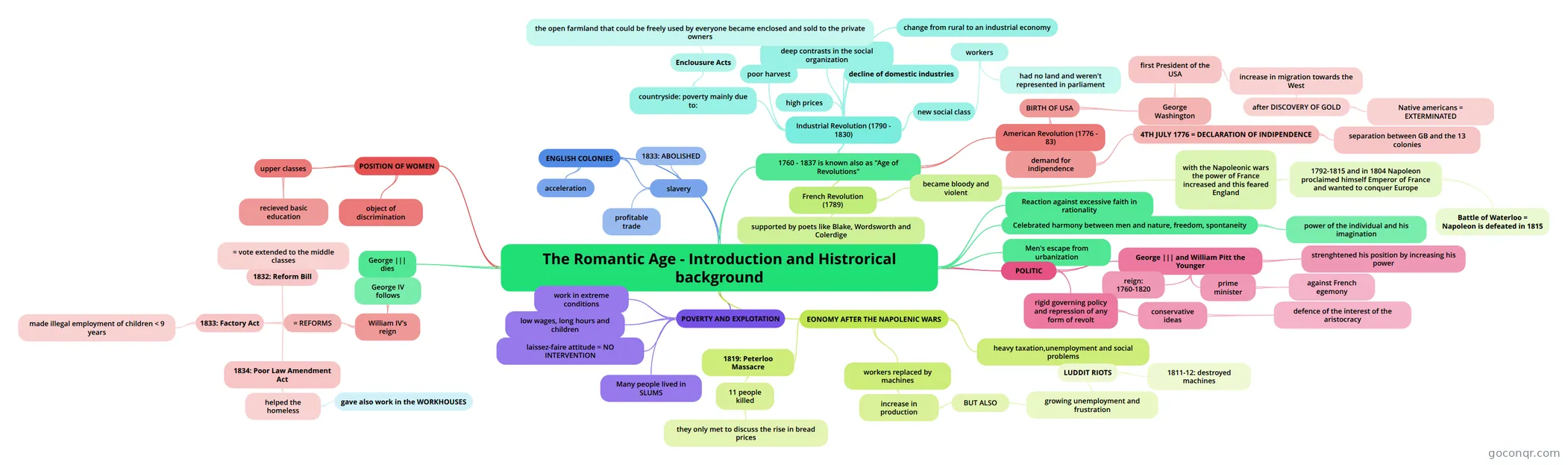
Mind map: The Romantic Age historical background
Map content
The Romantic Age - Introduction and Histrorical background
1760 - 1837 is known also as "Age of Revolutions"
- Industrial Revolution (1790 - 1830)
- change from rural to an industrial economy
- deep contrasts in the social organization
- countryside: poverty mainly due to:
- Enclousure Acts
- the open farmland that could be freely used by everyone became enclosed and sold to the private owners
- Enclousure Acts
- poor harvest
- high prices
- decline of domestic industries
- new social class
- workers
- had no land and weren't represented in parliament
- workers
- American Revolution (1776 - 83)
- demand for indipendence
- 4TH JULY 1776 = DECLARATION OF INDIPENDENCE
- separation between GB and the 13 colonies
- 4TH JULY 1776 = DECLARATION OF INDIPENDENCE
- BIRTH OF USA
- George Washington
- first President of the USA
- increase in migration towards the West
- after DISCOVERY OF GOLD
- Native americans = EXTERMINATED
- after DISCOVERY OF GOLD
- increase in migration towards the West
- first President of the USA
- George Washington
- demand for indipendence
- French Revolution (1789)
- supported by poets like Blake, Wordsworth and Colerdige
- became bloody and violent
- with the Napoleonic wars the power of France increased and this feared England
- 1792-1815 and in 1804 Napoleon proclaimed himself Emperor of France and wanted to conquer Europe
- Battle of Waterloo = Napoleon is defeated in 1815
- 1792-1815 and in 1804 Napoleon proclaimed himself Emperor of France and wanted to conquer Europe
- with the Napoleonic wars the power of France increased and this feared England
- Industrial Revolution (1790 - 1830)
Reaction against excessive faith in rationality
Celebrated harmony between men and nature, freedom, spontaneity
- power of the individual and his imagination
Men's escape from urbanization
POLITIC
- George ||| and William Pitt the Younger
- reign: 1760-1820
- prime minister
- against French egemony
- strenghtened his position by increasing his power
- rigid governing policy and repression of any form of revolt
- conservative ideas
- defence of the interest of the aristocracy
- conservative ideas
- George ||| and William Pitt the Younger
EONOMY AFTER THE NAPOLENIC WARS
- heavy taxation,unemployment and social problems
- workers replaced by machines
- increase in production
- BUT ALSO
- growing unemployment and frustration
- LUDDIT RIOTS
- 1811-12: destroyed machines
- LUDDIT RIOTS
- growing unemployment and frustration
- BUT ALSO
- increase in production
- 1819: Peterloo Massacre
- 11 people killed
- they only met to discuss the rise in bread prices
- 11 people killed
POVERTY AND EXPLOTATION
- work in extreme conditions
- low wages, long hours and children
- laissez-faire attitude = NO INTERVENTION
- Many people lived in SLUMS
George ||| dies
- George IV follows
- William IV's reign
- = REFORMS
- 1832: Reform Bill
- = vote extended to the middle classes
- 1833: Factory Act
- made illegal employment of children < 9 years
- 1834: Poor Law Amendment Act
- helped the homeless
- gave also work in the WORKHOUSES
- helped the homeless
- 1832: Reform Bill
- = REFORMS
- William IV's reign
- George IV follows
POSITION OF WOMEN
- object of discrimination
- upper classes
- recieved basic education
ENGLISH COLONIES
- acceleration
- slavery
- profitable trade
- 1833: ABOLISHED
Information
- Description
- Mind Map on The Romantic Age - Introduction and Histrorical background, created by Polina Strich on 12/05/2014.
- Created by
- Polina Strich
- Views
- 58
- Rating