
Mind map
CUR 535 Data Collection Techniques
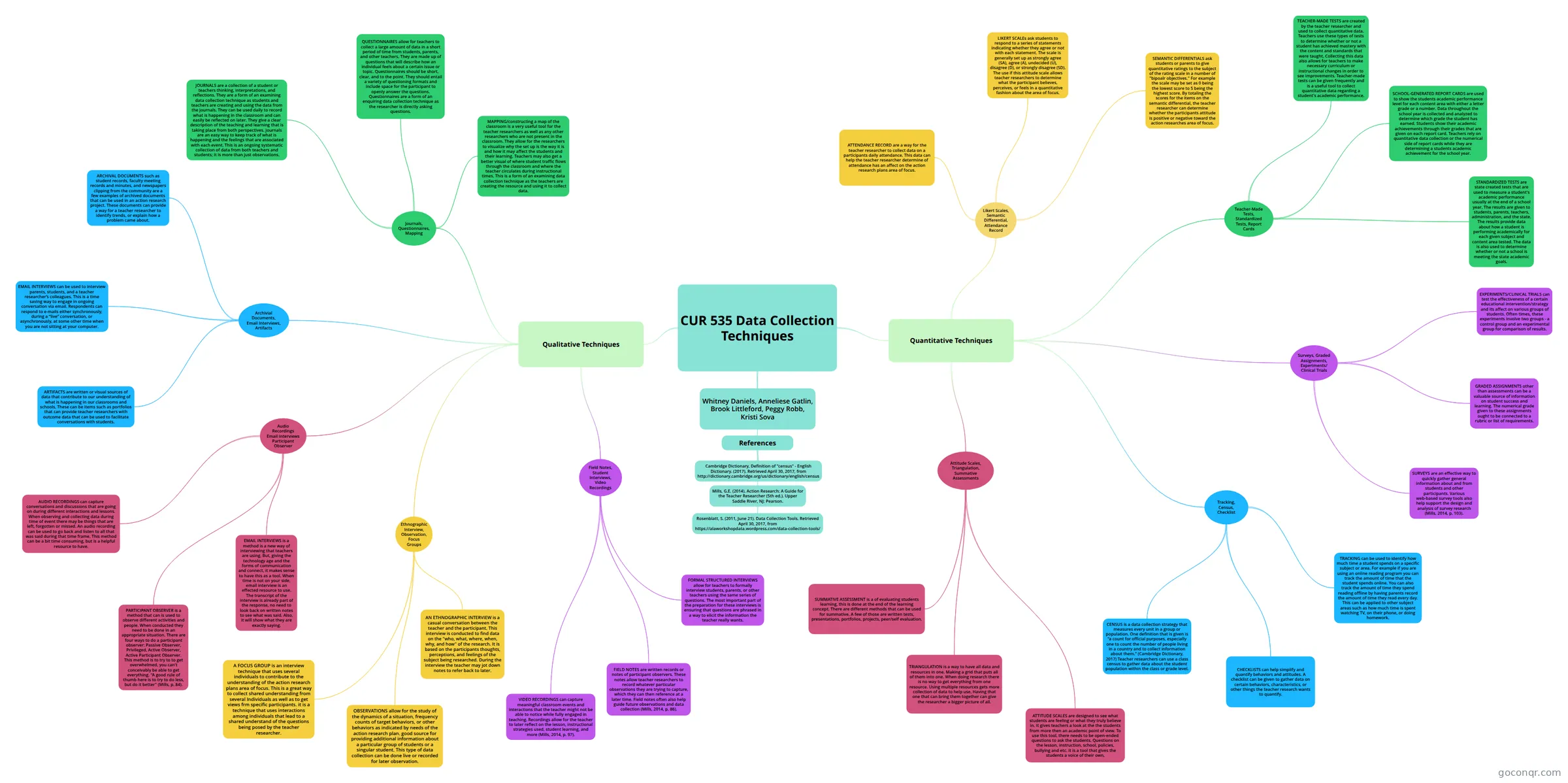
Mind map: CUR 535 data collection techniques
Map content
CUR 535 Data Collection Techniques
Whitney Daniels, Anneliese Gatlin, Brook Littleford, Peggy Robb, Kristi Sova
Qualitative Techniques
- Audio Recordings Email Interviews Participant Observer
- AUDIO RECORDINGS can capture conversations and discussions that are going on during different interactions and lessons. When observing and collecting data during time of event there may be things that are left, forgotten or missed. An audio recording can be used to go back and listen to all that was said during that time frame. This method can be a bit time consuming, but is a helpful resource to have.
- PARTICIPANT OBSERVER is a method that can is used to observe different activities and people. When conducted they need to be done in an appropriate situation. There are four ways to do a participant observer: Passive Observer, Privileged, Active Observer, Active Participant Observer. This method is to try to to get overwhelmed, you can't conceivably be able to get everything. "A good rule of thumb here is to try to do less, but do it better" (Mills, p. 84).
- EMAIL INTERVIEWS is a method is a new way of interviewing that teachers are using. But, giving the technology age and the forms of communication and connect, it makes sense to have this as a tool. When time is not on your side, email interview is an effected resource to use. The transcript of the interview is already part of the response, no need to look back on written notes to see what was said. Also, it will show what they are exactly saying.
- Field Notes, Student Interviews, Video Recordings
- FIELD NOTES are written records or notes of participant observers. These notes allow teacher researchers to record whatever particular observations they are trying to capture, which they can then reference at a later time. Field notes often also help guide future observations and data collection (Mills, 2014, p. 86).
- FORMAL STRUCTURED INTERVIEWS allow for teachers to formally interview students, parents, or other teachers using the same series of questions. The most important part of the preparation for these interviews is ensuring that questions are phrased in a way to elicit the information the teacher really wants.
- VIDEO RECORDINGS can capture meaningful classroom events and interactions that the teacher might not be able to notice while fully engaged in teaching. Recordings allow for the teacher to later reflect on the lesson, instructional strategies used, student learning, and more (Mills, 2014, p. 97).
- Archivial Documents, Email Interviews, Artifacts
- EMAIL INTERVIEWS can be used to interview parents, students, and a teacher researcher’s colleagues. This is a time saving way to engage in ongoing conversation via email. Respondents can respond to e-mails either synchronously, during a “live” conversation, or asynchronously, at some other time when you are not sitting at your computer.
- ARTIFACTS are written or visual sources of data that contribute to our understanding of what is happening in our classrooms and schools. These can be items such as portfolios that can provide teacher researchers with outcome data that can be used to facilitate conversations with students.
- ARCHIVAL DOCUMENTS such as student records, faculty meeting records and minutes, and newspapers clipping from the community are a few examples of archived documents that can be used in an action research project. These documents can provide a way for a teacher researcher to identify trends, or explain how a problem came about.
- Ethnographic Interview, Observation, Focus Groups
- A FOCUS GROUP is an interview technique that uses several individuals to contribute to the understanding of the action research plans area of focus. This is a great way to collect shared understanding from several Individuals as well as to get views frm specific participants. it is a technique that uses interactions among individuals that lead to a shared understand of the questions being posed by the teacher researcher.
- OBSERVATIONS allow for the study of the dynamics of a situation, frequency counts of target behaviors, or other behaviors as indicated by needs of the action research plan. good source for providing additional information about a particular group of students or a singular student. This type of data collection can be done live or recorded for later observation.
- AN ETHNOGRAPHIC INTERVIEW is a casual conversation between the teacher and the participant. This interview is conducted to find data on the "who, what, where, when, why, and how" of the research. It is based on the participants thoughts, perceptions, and feelings of the subject being researched. During the interview the teacher may jot down notes to refer back to later.
- Journals, Questionnaires, Mapping
- JOURNALS are a collection of a student or teachers thinking, interpretations, and reflections. They are a form of an examining data collection technique as students and teachers are creating and using the data from the journals. They can be used daily to record what is happening in the classroom and can easily be reflected on later. They give a clear description of the teaching and learning that is taking place from both perspectives. Journals are an easy way to keep track of what is happening and the feelings that are associated with each event. This is an ongoing systematic collection of data from both teachers and students; it is more than just observations.
- QUESTIONNAIRES allow for teachers to collect a large amount of data in a short period of time from students, parents, and other teachers. They are made up of questions that will describe how an individual feels about a certain issue or topic. Questionnaires should be short, clear, and to the point. They should entail a variety of questioning formats and include space for the participant to openly answer the questions. Questionnaires are a form of an enquiring data collection technique as the researcher is directly asking questions.
- MAPPING/constructing a map of the classroom is a very useful tool for the teacher researchers as well as any other researchers who are not present in the classroom. They allow for the researchers to visualize why the set up is the way it is and how it may affect the students and their learning. Teachers may also get a better visual of where student traffic flows through the classroom and where the teacher circulates during instructional times. This is a form of an examining data collection technique as the teachers are creating the resource and using it to collect data.
- Audio Recordings Email Interviews Participant Observer
Quantitative Techniques
- Attitude Scales, Triangulation, Summative Assessments
- ATTITUDE SCALES are designed to see what students are feeling or what they truly believe in. It gives teachers a look at the the students from more then an academic point of view. To use this tool, there needs to be open-ended questions to ask the students. Questions on the lesson, instruction, school, policies, bullying and etc. It is a tool that gives the students a voice of their own,
- TRIANGULATION is a way to have all data and resources in one. Making a grid that puts all of them into one. When doing research there is no way to get everything from one resource. Using multiple resources gets more collection of data to help use. Having that one that can bring them together can give the researcher a bigger picture of all.
- SUMMATIVE ASSESSMENT is a of evaluating students learning, this is done at the end of the learning concept. There are different methods that can be used for summative. A few of those are written tests, presentations, portfolios, projects, peer/self evaluation.
- Surveys, Graded Assignments, Experiments/ Clinical Trials
- SURVEYS are an effective way to quickly gather general information about and from students and other participants. Various web-based survey tools also help support the design and analysis of survey research (Mills, 2014, p. 103).
- GRADED ASSIGNMENTS other than assessments can be a valuable source of information on student success and learning. The numerical grade given to these assignments ought to be connected to a rubric or list of requirements.
- EXPERIMENTS/CLINICAL TRIALS can test the effectiveness of a certain educational intervention/strategy and its affect on various groups of students. Often times, these experiments involve two groups - a control group and an experimental group for comparison of results.
- Tracking, Census, Checklist
- CHECKLISTS can help simplify and quantify behaviors and attitudes. A checklist can be given to gather data on certain behaviors, characteristics, or other things the teacher research wants to quantify.
- TRACKING can be used to identify how much time a student spends on a specific subject or area. For example if you are using an online reading program you can track the amount of time that the student spends online. You can also track the amount of time they spend reading offline by having parents record the amount of time they read every day. This can be applied to other subject areas such as how much time is spent watching TV, on their phone, or doing homework.
- CENSUS is a data collection strategy that measures every unit in a group or population. One definition that is given is “a count for official purposes, especially one to count the number of people living in a country and to collect information about them.” (Cambridge Dictionary, 2017) Teacher researchers can use a class census to gather data about the student population within the class or grade level.
- Teacher-Made Tests, Standardized Tests, Report Cards
- TEACHER-MADE TESTS are created by the teacher researcher and used to collect quantitative data. Teachers use these types of tests to determine whether or not a student has achieved mastery with the content and standards that were taught. Collecting this data also allows for teachers to make necessary curriculum or instructional changes in order to see improvements. Teacher-made tests can be given frequently and is a useful tool to collect quantitative data regarding a student's academic performance.
- STANDARDIZED TESTS are state created tests that are used to measure a student's academic performance usually at the end of a school year. The results are given to students, parents, teachers, administration, and the state. The results provide data about how a student is performing academically for each given subject and content area tested. The data is also used to determine whether or not a school is meeting the state academic goals.
- SCHOOL-GENERATED REPORT CARDS are used to show the students academic performance level for each content area with either a letter grade or a number. Data throughout the school year is collected and analyzed to determine which grade the student has earned. Students show their academic achievements through their grades that are given on each report card. Teachers rely on quantitative data collection or the numerical side of report cards while they are determining a students academic achievement for the school year.
- Likert Scales, Semantic Differential, Attendance Record
- LIKERT SCALEs ask students to respond to a series of statements indicating whether they agree or not with each statement. The scale is generally set up as strongly agree (SA), agree (A), undecided (U), disagree (D), or strongly disagree (SD). The use if this attitude scale allows teacher researchers to determine what the participant believes, perceives, or feels in a quantitative fashion about the area of focus.
- SEMANTIC DIFFERENTIALS ask students or parents to give quantitative ratings to the subject of the rating scale in a number of "bipoalr objectives." For example the scale may be set as 0 being the lowest score to 5 being the highest score. By totaling the scores for the items on the semantic differential, the teacher researcher can determine whether the participants attitude is positive or negative toward the action researches area of focus.
- ATTENDANCE RECORD are a way for the teacher researcher to collect data on a participants daily attendance. This data can help the teacher researcher determine of attendance has an affect on the action research plans area of focus.
- Attitude Scales, Triangulation, Summative Assessments
References
- Mills, G.E. (2014). Action Research: A Guide for the Teacher Researcher (5th ed.). Upper Saddle River, NJ: Pearson.
- Rosenblatt, S. (2011, June 21). Data Collection Tools. Retrieved April 30, 2017, from https://alaworkshopdata.wordpress.com/data-collection-tools/
- Cambridge Dictionary, Definition of "census" - English Dictionary. (2017). Retrieved April 30, 2017, from http://dictionary.cambridge.org/us/dictionary/english/census
- Mills, G.E. (2014). Action Research: A Guide for the Teacher Researcher (5th ed.). Upper Saddle River, NJ: Pearson.
Information
- Description
- Education Mind Map on CUR 535 Data Collection Techniques, created by Anneliese Gatlin on 25/04/2017.
- Created by
- Anneliese Gatlin
- Views
- 2
- Rating