
Mind map
Revolution Of Language
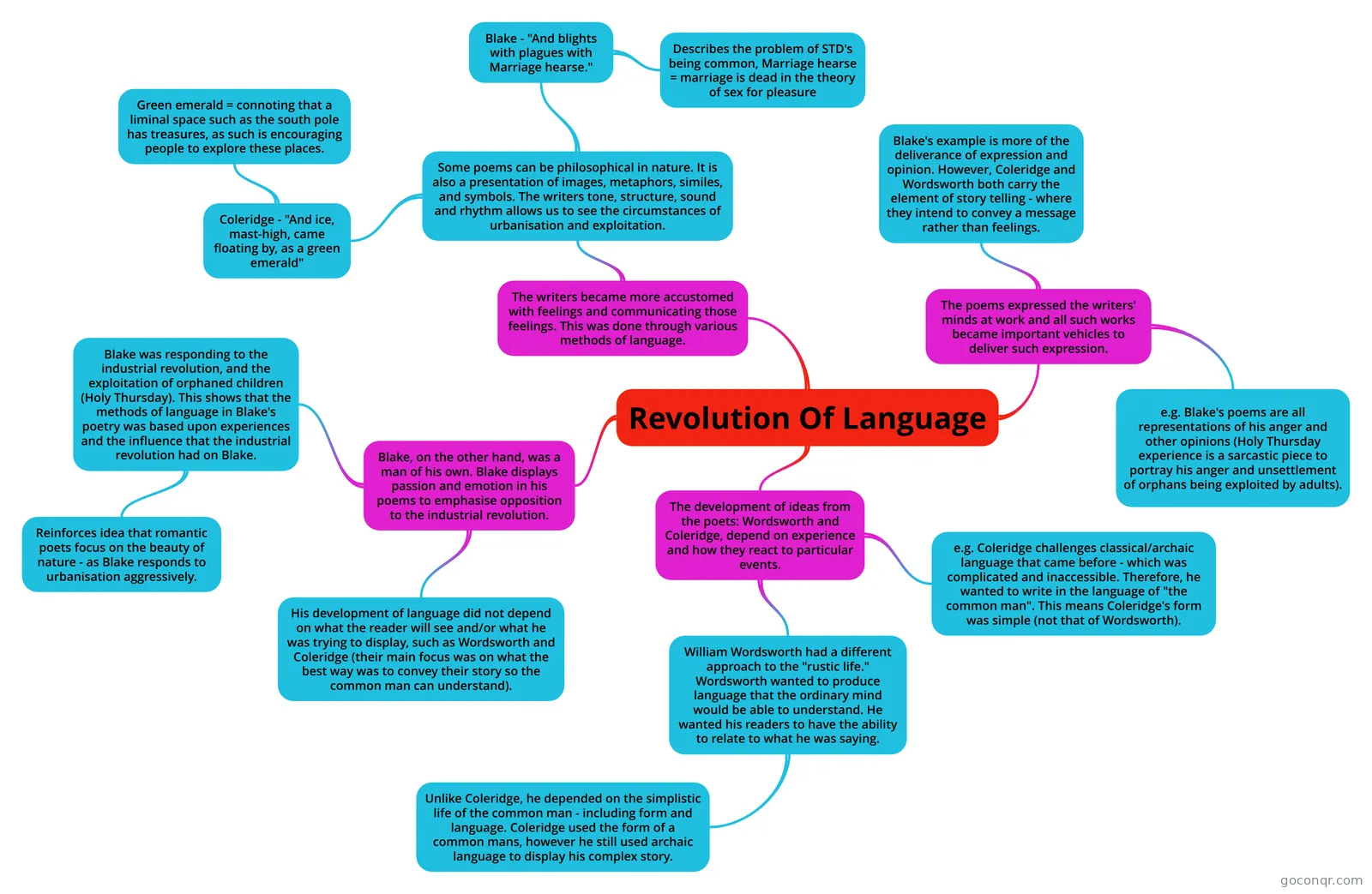
Mind map: Revolution of language
Map content
Revolution Of Language
The development of ideas from the poets: Wordsworth and Coleridge, depend on experience and how they react to particular events.
- e.g. Coleridge challenges classical/archaic language that came before - which was complicated and inaccessible. Therefore, he wanted to write in the language of "the common man". This means Coleridge's form was simple (not that of Wordsworth).
- William Wordsworth had a different approach to the "rustic life." Wordsworth wanted to produce language that the ordinary mind would be able to understand. He wanted his readers to have the ability to relate to what he was saying.
- Unlike Coleridge, he depended on the simplistic life of the common man - including form and language. Coleridge used the form of a common mans, however he still used archaic language to display his complex story.
The writers became more accustomed with feelings and communicating those feelings. This was done through various methods of language.
- Some poems can be philosophical in nature. It is also a presentation of images, metaphors, similes, and symbols. The writers tone, structure, sound and rhythm allows us to see the circumstances of urbanisation and exploitation.
- Coleridge - "And ice, mast-high, came floating by, as a green emerald"
- Green emerald = connoting that a liminal space such as the south pole has treasures, as such is encouraging people to explore these places.
- Blake - "And blights with plagues with Marriage hearse."
- Describes the problem of STD's being common, Marriage hearse = marriage is dead in the theory of sex for pleasure
- Coleridge - "And ice, mast-high, came floating by, as a green emerald"
- Some poems can be philosophical in nature. It is also a presentation of images, metaphors, similes, and symbols. The writers tone, structure, sound and rhythm allows us to see the circumstances of urbanisation and exploitation.
Blake, on the other hand, was a man of his own. Blake displays passion and emotion in his poems to emphasise opposition to the industrial revolution.
- Blake was responding to the industrial revolution, and the exploitation of orphaned children (Holy Thursday). This shows that the methods of language in Blake's poetry was based upon experiences and the influence that the industrial revolution had on Blake.
- Reinforces idea that romantic poets focus on the beauty of nature - as Blake responds to urbanisation aggressively.
- His development of language did not depend on what the reader will see and/or what he was trying to display, such as Wordsworth and Coleridge (their main focus was on what the best way was to convey their story so the common man can understand).
- Blake was responding to the industrial revolution, and the exploitation of orphaned children (Holy Thursday). This shows that the methods of language in Blake's poetry was based upon experiences and the influence that the industrial revolution had on Blake.
The poems expressed the writers' minds at work and all such works became important vehicles to deliver such expression.
- e.g. Blake's poems are all representations of his anger and other opinions (Holy Thursday experience is a sarcastic piece to portray his anger and unsettlement of orphans being exploited by adults).
- Blake's example is more of the deliverance of expression and opinion. However, Coleridge and Wordsworth both carry the element of story telling - where they intend to convey a message rather than feelings.
Information
- Description
- tor baffor eh-lebel Eng-the-leeeend Mind Map on Revolution Of Language, created by Arif Ullah on 27/04/2017.
- Created by
- Arif Ullah
- Views
- 0
- Rating