
Mind map
Vivaldi - Concerto in D minor
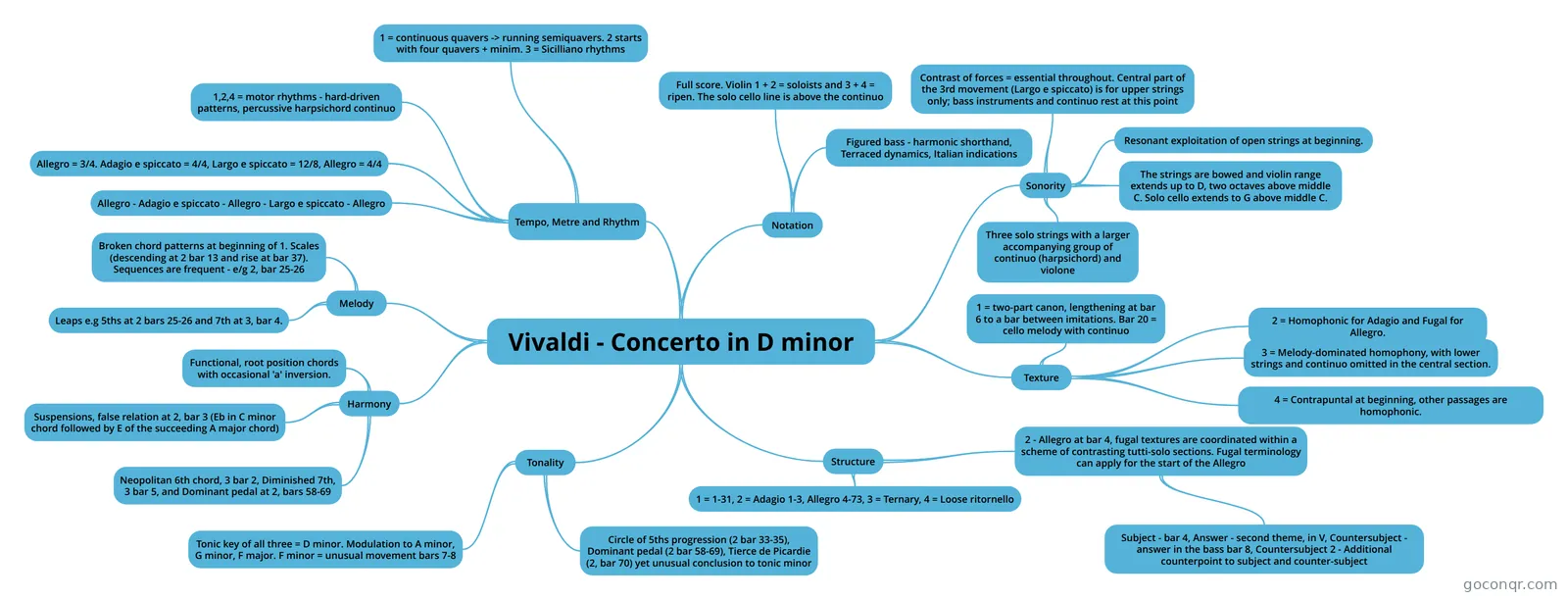
Mind map: Vivaldi Concerto in D minor
Map content
Vivaldi - Concerto in D minor
Sonority
- Three solo strings with a larger accompanying group of continuo (harpsichord) and violone
- The strings are bowed and violin range extends up to D, two octaves above middle C. Solo cello extends to G above middle C.
- Resonant exploitation of open strings at beginning.
- Contrast of forces = essential throughout. Central part of the 3rd movement (Largo e spiccato) is for upper strings only; bass instruments and continuo rest at this point
Notation
- Full score. Violin 1 + 2 = soloists and 3 + 4 = ripen. The solo cello line is above the continuo
- Figured bass - harmonic shorthand, Terraced dynamics, Italian indications
Tempo, Metre and Rhythm
- Allegro - Adagio e spiccato - Allegro - Largo e spiccato - Allegro
- Allegro = 3/4. Adagio e spiccato = 4/4, Largo e spiccato = 12/8, Allegro = 4/4
- 1,2,4 = motor rhythms - hard-driven patterns, percussive harpsichord continuo
- 1 = continuous quavers -> running semiquavers. 2 starts with four quavers + minim. 3 = Sicilliano rhythms
Melody
- Broken chord patterns at beginning of 1. Scales (descending at 2 bar 13 and rise at bar 37). Sequences are frequent - e/g 2, bar 25-26
- Leaps e.g 5ths at 2 bars 25-26 and 7th at 3, bar 4.
Harmony
- Functional, root position chords with occasional 'a' inversion.
- Suspensions, false relation at 2, bar 3 (Eb in C minor chord followed by E of the succeeding A major chord)
- Neopolitan 6th chord, 3 bar 2, Diminished 7th, 3 bar 5, and Dominant pedal at 2, bars 58-69
Tonality
- Tonic key of all three = D minor. Modulation to A minor, G minor, F major. F minor = unusual movement bars 7-8
- Circle of 5ths progression (2 bar 33-35), Dominant pedal (2 bar 58-69), Tierce de Picardie (2, bar 70) yet unusual conclusion to tonic minor
Structure
- 1 = 1-31, 2 = Adagio 1-3, Allegro 4-73, 3 = Ternary, 4 = Loose ritornello
- 2 - Allegro at bar 4, fugal textures are coordinated within a scheme of contrasting tutti-solo sections. Fugal terminology can apply for the start of the Allegro
- Subject - bar 4, Answer - second theme, in V, Countersubject - answer in the bass bar 8, Countersubject 2 - Additional counterpoint to subject and counter-subject
Texture
- 1 = two-part canon, lengthening at bar 6 to a bar between imitations. Bar 20 = cello melody with continuo
- 2 = Homophonic for Adagio and Fugal for Allegro.
- 3 = Melody-dominated homophony, with lower strings and continuo omitted in the central section.
- 4 = Contrapuntal at beginning, other passages are homophonic.
Information
- Description
- Mind Map on Vivaldi - Concerto in D minor, created by Kai Craig on 27/04/2017.
- Created by
- Kai Craig
- Views
- 0
- History
-
- Created by Kai Craig · Apr 25, 2017
- Copied by Kai Craig · Apr 27, 2017
- Rating