
Mind map
Hunter v Moss & McPhail v Doulton
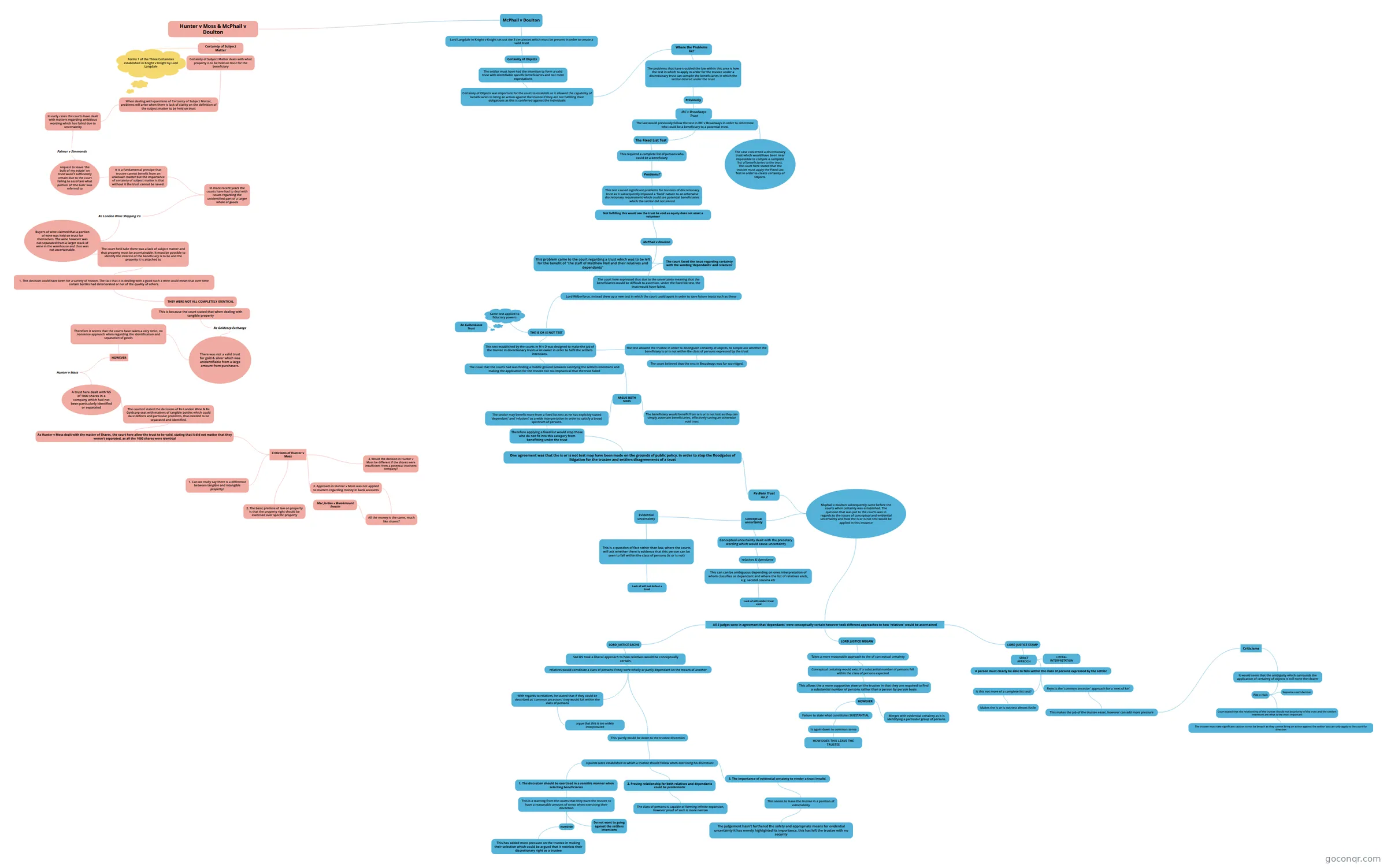
Mind map: Hunter v Moss & McPhail v Doulton
Map content
Hunter v Moss & McPhail v Doulton
McPhail v Doulton
- Lord Langdale in Knight v Knight set out the 3 certainties which must be present in order to create a valid trust
- Certainty of Objects
- The settlor must have had the intention to form a valid trust with identifiable specific beneficiaries and not mere expectations
- Certainty of Objects was important for the court to establish as it allowed the capability of beneficiaries to bring an action against the trustee if they are not fulfilling their obligations as this is conferred against the individuals
- Where the Problems lie?
- The problems that have troubled the law within this area is how the test in which to apply in order for the trustee under a discretionary trust can compile the beneficiaries in which the settlor desired under the trust
- Previously
- IRC v Broadways Trust
- The law would previously follow the test in IRC v Broadways in order to determine who could be a beneficiary to a potential trust.
- The Fixed List Test
- This required a complete list of persons who could be a beneficiary
- Problems?
- This test caused significant problems for trustees of discretionary trust as it subsequently imposed a 'fixed' nature to an otherwise discretionary requirement which could see potential beneficiaries which the settlor did not intend
- Not fulfilling this would see the trust be void as equity does not asset a volunteer
- McPhail v Doulton
- This problem came to the court regarding a trust which was to be left for the benefit of "the staff of Matthew Hall and their relatives and dependants"
- The court faced the issue regarding certainty with the wording 'dependants' and relatives'
- The court here expressed that due to the uncertainty meaning that the beneficiaries would be difficult to assertion, under the fixed list test, the trust would have failed.
- Lord Wilberforce, instead drew up a new test in which the court could aport in order to save future trusts such as these
- THE IS OR IS NOT TEST
- This test established by the courts in M v D was designed to make the job of the trustee in discretionary trusts a lot easier in order to fulfil the settlers intentions.
- The test allowed the trustee in order to distinguish certainty of objects, to simple ask whether the beneficiary is or is not within the class of persons expressed by the trust
- The court believed that the test in Broadways was far too ridged.
- The issue that the courts had was finding a middle ground between satisfying the settlers intentions and making the application for the trustee not too impractical that the trust failed
- ARGUE BOTH SIDES
- The settlor may benefit more from a fixed list test as he has explicitly stated 'dependant' and 'relatives' as a wide interpretation in order to satisfy a broad spectrum of persons.
- Therefore applying a fixed list would stop those who do not fit into this category from benefitting under the trust
- One agreement was that the is or is not test may have been made on the grounds of public policy, in order to stop the floodgates of litigation for the trustee and settlers disagreements of a trust
- Re Bens Trust no.2
- Mcphail v doulton subsequently came before the courts when certainty was established. The question that was put to the courts was in regards to the issues of conceptual and evidential uncertainty and how the is or is not test would be applied in this instance
- Conceptual uncertainty
- Evidential uncertainty
- This is a question of fact rather than law, where the courts will ask whether there is evidence that this person can be seen to fall within the class of persons (is or is not)
- Lack of will not defeat a trust
- This is a question of fact rather than law, where the courts will ask whether there is evidence that this person can be seen to fall within the class of persons (is or is not)
- Conceptual uncertainty dealt with the precotary wording which would cause uncertainty
- 'relatives & dpendants'
- This can can be ambiguous depending on ones interpretation of whom classifies as dependant and where the list of relatives ends, e.g. second cousins etc
- Lack of will render trust void
- This can can be ambiguous depending on ones interpretation of whom classifies as dependant and where the list of relatives ends, e.g. second cousins etc
- 'relatives & dpendants'
- Evidential uncertainty
- All 3 judges were in agreement that 'dependants' were conceptually certain however took different approaches to how 'relatives' would be ascertained
- LORD JUSTICE SACHS
- SACHS took a liberal approach to how relatives would be conceptually certain.
- relatives would constitute a class of persons if they were wholly or partly dependant on the means of another
- With regards to relatives, he stated that if they could be described as 'common ancestors' they would fall within the class of persons
- argue that this is too widely interpretated
- This 'partly would be down to the trustee discretion
- 3 points were established in which a trustee should follow when exercising his discretion:
- 1. The discretion should be exercised in a sensible manner when selecting beneficiaries
- This is a warning from the courts that they want the trustee to have a reasonable amount of sense when exercising their discretion
- HOWEVER
- This has added more pressure on the trustee in making their selection which could be argued that it restricts their discretionary right as a trustee
- Do not want to going against the settlers intentions
- HOWEVER
- This is a warning from the courts that they want the trustee to have a reasonable amount of sense when exercising their discretion
- 2. Proving relationship for both relatives and dependants could be problematic
- The class of persons is capable of forming infinite expansion, however proof of such is more narrow
- 3. The importance of evidential certainty to render a trust invalid.
- This seems to leave the trustee in a position of vulnerability
- The judgement hasn't furthered the safety and appropriate means for evidential uncertainty it has merely highlighted its importance, this has left the trustee with no security
- This seems to leave the trustee in a position of vulnerability
- 1. The discretion should be exercised in a sensible manner when selecting beneficiaries
- 3 points were established in which a trustee should follow when exercising his discretion:
- With regards to relatives, he stated that if they could be described as 'common ancestors' they would fall within the class of persons
- relatives would constitute a class of persons if they were wholly or partly dependant on the means of another
- SACHS took a liberal approach to how relatives would be conceptually certain.
- LORD JUSTICE MEGAW
- Takes a more reasonable approach to the of conceptual certainty
- Conceptual certainty would exist if a substantial number of persons fell within the class of persons expected
- This allows the a more supportive view on the trustee in that they are required to find a substantial number of persons rather than a person by person basis
- HOWEVER
- Failure to state what constitutes SUBSTANTIAL
- Is again down to common sense
- HOW DOES THIS LEAVE THE TRUSTEE
- Is again down to common sense
- Merges with evidential certainty as it is identifying a particular group of persons.
- Failure to state what constitutes SUBSTANTIAL
- HOWEVER
- This allows the a more supportive view on the trustee in that they are required to find a substantial number of persons rather than a person by person basis
- Conceptual certainty would exist if a substantial number of persons fell within the class of persons expected
- Takes a more reasonable approach to the of conceptual certainty
- LORD JUSTICE STAMP
- STRICT APPROCH
- LITERAL INTERPRETATION
- A person must clearly be able to falls within the class of persons expressed by the settlor
- Rejects the 'common ancestor' approach for a 'next of kin'
- This makes the job of the trustee easer, however can add more pressure
- Criticisms
- It would seem that the ambiguity which surrounds the application of certainty of objects is still none the clearer
- Pitt v Holt
- Supreme court decision
- Court stated that the relationship of the trustee should not be priority of the trust and the settlers intentions are what is the most important
- The trustee must take significant caution to not be breach as they cannot bring an action against the settlor but can only apply to the court for direction
- Pitt v Holt
- It would seem that the ambiguity which surrounds the application of certainty of objects is still none the clearer
- Criticisms
- This makes the job of the trustee easer, however can add more pressure
- Is this not more of a complete list test?
- Makes the is or is not test almost futile
- Rejects the 'common ancestor' approach for a 'next of kin'
- STRICT APPROCH
- LORD JUSTICE SACHS
- Conceptual uncertainty
- Mcphail v doulton subsequently came before the courts when certainty was established. The question that was put to the courts was in regards to the issues of conceptual and evidential uncertainty and how the is or is not test would be applied in this instance
- Re Bens Trust no.2
- One agreement was that the is or is not test may have been made on the grounds of public policy, in order to stop the floodgates of litigation for the trustee and settlers disagreements of a trust
- Therefore applying a fixed list would stop those who do not fit into this category from benefitting under the trust
- The beneficiary would benefit from a is or is not test as they can simply assertain beneficiaries, effectively saving an otherwise void trust
- The settlor may benefit more from a fixed list test as he has explicitly stated 'dependant' and 'relatives' as a wide interpretation in order to satisfy a broad spectrum of persons.
- ARGUE BOTH SIDES
- The test allowed the trustee in order to distinguish certainty of objects, to simple ask whether the beneficiary is or is not within the class of persons expressed by the trust
- Same test applied to fiduciary powers
- Re Gulbenkiens Trust
- This test established by the courts in M v D was designed to make the job of the trustee in discretionary trusts a lot easier in order to fulfil the settlers intentions.
- THE IS OR IS NOT TEST
- Lord Wilberforce, instead drew up a new test in which the court could aport in order to save future trusts such as these
- The court here expressed that due to the uncertainty meaning that the beneficiaries would be difficult to assertion, under the fixed list test, the trust would have failed.
- The court faced the issue regarding certainty with the wording 'dependants' and relatives'
- This problem came to the court regarding a trust which was to be left for the benefit of "the staff of Matthew Hall and their relatives and dependants"
- McPhail v Doulton
- Not fulfilling this would see the trust be void as equity does not asset a volunteer
- This test caused significant problems for trustees of discretionary trust as it subsequently imposed a 'fixed' nature to an otherwise discretionary requirement which could see potential beneficiaries which the settlor did not intend
- Problems?
- This required a complete list of persons who could be a beneficiary
- The case concerned a discretionary trust which would have been near impossible to compile a complete list of beneficiaries to the trust. The court here stated that the trustee must apply the Fixed List Test in order to create certainty of Objects.
- The Fixed List Test
- The law would previously follow the test in IRC v Broadways in order to determine who could be a beneficiary to a potential trust.
- IRC v Broadways Trust
- Previously
- The problems that have troubled the law within this area is how the test in which to apply in order for the trustee under a discretionary trust can compile the beneficiaries in which the settlor desired under the trust
- Where the Problems lie?
- Certainty of Objects was important for the court to establish as it allowed the capability of beneficiaries to bring an action against the trustee if they are not fulfilling their obligations as this is conferred against the individuals
- The settlor must have had the intention to form a valid trust with identifiable specific beneficiaries and not mere expectations
- Certainty of Objects
- Lord Langdale in Knight v Knight set out the 3 certainties which must be present in order to create a valid trust
Certainty of Subject Matter
- Certainty of Subject Matter deals with what property is to be held on trust for the beneficiary
- When dealing with questions of Certainty of Subject Matter, problems will arise when there is lack of clarity on the definition of the subject matter to be held on trust
- In early cases the courts have dealt with matters regarding ambitious wording which has failed due to uncertainity
- Palmer v Simmonds
- request to leave 'the bulk of my estate' on trust wasn't sufficiently certain due to the court failing to ascertain what portion of 'the bulk' was referred to
- It is a fundamental principe that trustee cannot benefit from an unknown matter but the importance of certainty of subject matter is that without it the trust cannot be saved.
- In more recent years the courts have had to deal with issues regarding the unidentified part of a larger whole of goods
- Re London Wine Shipping Co
- Buyers of wine claimed that a portion of wine was held on trust for themselves. The wine however was not separated from a larger stock of wine in the warehouse and thus was not ascertainable.
- The court held take there was a lack of subject matter and that property must be ascertainable. It must be possible to identify the interest of the beneficiary is to be and the property it is attached to
- 1. This decision could have been for a variety of reason. The fact that it is dealing with a good such a wine could mean that over time certain bottles had deteriorated or not of the quality of others.
- THEY WERE NOT ALL COMPLETELY IDENTICAL
- This is because the court stated that when dealing with tangible property
- Re Goldcorp Exchange
- There was not a valid trust for gold & silver which was unidentifiable from a large amount from purchasers.
- Therefore it seems that the courts have taken a very strict, no nonsense approach when regarding the identification and separation of goods
- HOWEVER
- Hunter v Moss
- A trust here dealt with %5 of 1000 shares in a company which had not been particularly identified or separated
- The courted stated the decisions of Re London Wine & Re Goldcorp seat with matters of tangible bottles which could dace defects and particular problems, thus needed to be separated and identified.
- As Hunter v Moss dealt with the matter of Shares, the court here allow the trust to be valid, stating that it did not matter that they weren't separated, as all the 1000 shares were identical
- Criticisms of Hunter v Moss
- 1. Can we really say there is a difference between tangible and intangible property?
- 2. The basic premise of law on property is that the property right should be exercised over specific property
- 3. Approach in Hunter v Moss was not applied to matters regarding money in bank accounts
- All the money is the same, much like shares?
- Mac Jordan v Brookmount Erostin
- All the money is the same, much like shares?
- 4. Would the decision in Hunter v Moss be different if the shares were insufficient from a potential insolvent company?
- Criticisms of Hunter v Moss
- As Hunter v Moss dealt with the matter of Shares, the court here allow the trust to be valid, stating that it did not matter that they weren't separated, as all the 1000 shares were identical
- The courted stated the decisions of Re London Wine & Re Goldcorp seat with matters of tangible bottles which could dace defects and particular problems, thus needed to be separated and identified.
- A trust here dealt with %5 of 1000 shares in a company which had not been particularly identified or separated
- Hunter v Moss
- HOWEVER
- Therefore it seems that the courts have taken a very strict, no nonsense approach when regarding the identification and separation of goods
- There was not a valid trust for gold & silver which was unidentifiable from a large amount from purchasers.
- Re Goldcorp Exchange
- This is because the court stated that when dealing with tangible property
- THEY WERE NOT ALL COMPLETELY IDENTICAL
- 1. This decision could have been for a variety of reason. The fact that it is dealing with a good such a wine could mean that over time certain bottles had deteriorated or not of the quality of others.
- The court held take there was a lack of subject matter and that property must be ascertainable. It must be possible to identify the interest of the beneficiary is to be and the property it is attached to
- Buyers of wine claimed that a portion of wine was held on trust for themselves. The wine however was not separated from a larger stock of wine in the warehouse and thus was not ascertainable.
- Re London Wine Shipping Co
- In more recent years the courts have had to deal with issues regarding the unidentified part of a larger whole of goods
- It is a fundamental principe that trustee cannot benefit from an unknown matter but the importance of certainty of subject matter is that without it the trust cannot be saved.
- request to leave 'the bulk of my estate' on trust wasn't sufficiently certain due to the court failing to ascertain what portion of 'the bulk' was referred to
- Palmer v Simmonds
- In early cases the courts have dealt with matters regarding ambitious wording which has failed due to uncertainity
- When dealing with questions of Certainty of Subject Matter, problems will arise when there is lack of clarity on the definition of the subject matter to be held on trust
- Forms 1 of the Three Certainties established in Knight v Knight by Lord Langdale
- Certainty of Subject Matter deals with what property is to be held on trust for the beneficiary
Information
- Description
- Mind Map on Hunter v Moss & McPhail v Doulton, created by Jamie Roberts on 09/05/2017.
- Created by
- Jamie Roberts
- Views
- 0
- Rating