
Mind map
American Expressionism and Orson Welles
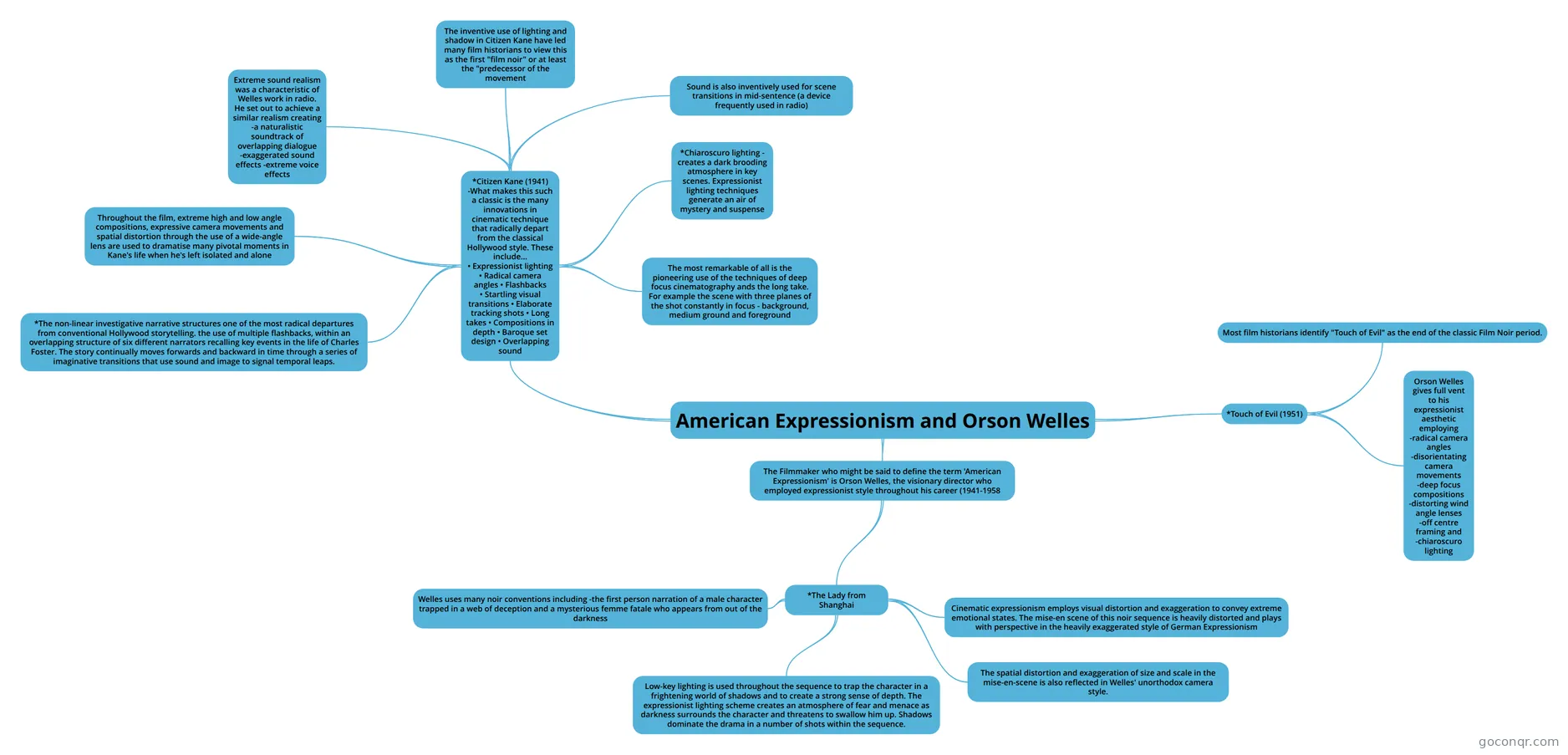
Mind map: American Expressionism and Orson Welles
Map content
American Expressionism and Orson Welles
The Filmmaker who might be said to define the term 'American Expressionism' is Orson Welles, the visionary director who employed expressionist style throughout his career (1941-1958
- *The Lady from Shanghai
- Welles uses many noir conventions including -the first person narration of a male character trapped in a web of deception and a mysterious femme fatale who appears from out of the darkness
- Cinematic expressionism employs visual distortion and exaggeration to convey extreme emotional states. The mise-en scene of this noir sequence is heavily distorted and plays with perspective in the heavily exaggerated style of German Expressionism
- The spatial distortion and exaggeration of size and scale in the mise-en-scene is also reflected in Welles' unorthodox camera style.
- Low-key lighting is used throughout the sequence to trap the character in a frightening world of shadows and to create a strong sense of depth. The expressionist lighting scheme creates an atmosphere of fear and menace as darkness surrounds the character and threatens to swallow him up. Shadows dominate the drama in a number of shots within the sequence.
- *The Lady from Shanghai
*Citizen Kane (1941) -What makes this such a classic is the many innovations in cinematic technique that radically depart from the classical Hollywood style. These include… • Expressionist lighting • Radical camera angles • Flashbacks • Startling visual transitions • Elaborate tracking shots • Long takes • Compositions in depth • Baroque set design • Overlapping sound
- The inventive use of lighting and shadow in Citizen Kane have led many film historians to view this as the first "film noir" or at least the "predecessor of the movement
- *Chiaroscuro lighting - creates a dark brooding atmosphere in key scenes. Expressionist lighting techniques generate an air of mystery and suspense
- Throughout the film, extreme high and low angle compositions, expressive camera movements and spatial distortion through the use of a wide-angle lens are used to dramatise many pivotal moments in Kane's life when he's left isolated and alone
- *The non-linear investigative narrative structures one of the most radical departures from conventional Hollywood storytelling. the use of multiple flashbacks, within an overlapping structure of six different narrators recalling key events in the life of Charles Foster. The story continually moves forwards and backward in time through a series of imaginative transitions that use sound and image to signal temporal leaps.
- The most remarkable of all is the pioneering use of the techniques of deep focus cinematography ands the long take. For example the scene with three planes of the shot constantly in focus - background, medium ground and foreground
- Extreme sound realism was a characteristic of Welles work in radio. He set out to achieve a similar realism creating -a naturalistic soundtrack of overlapping dialogue -exaggerated sound effects -extreme voice effects
- Sound is also inventively used for scene transitions in mid-sentence (a device frequently used in radio)
*Touch of Evil (1951)
- Most film historians identify "Touch of Evil" as the end of the classic Film Noir period.
- Orson Welles gives full vent to his expressionist aesthetic employing -radical camera angles -disorientating camera movements -deep focus compositions -distorting wind angle lenses -off centre framing and -chiaroscuro lighting
Information
- Description
- AS level MIA (Factfiles) Mind Map on American Expressionism and Orson Welles, created by Marcus Hayes on 10/05/2017.
- Created by
- Marcus Hayes
- Views
- 13
- Rating
More on Film History and the Film Industry