
Mind map
8.2 Cell Respiration
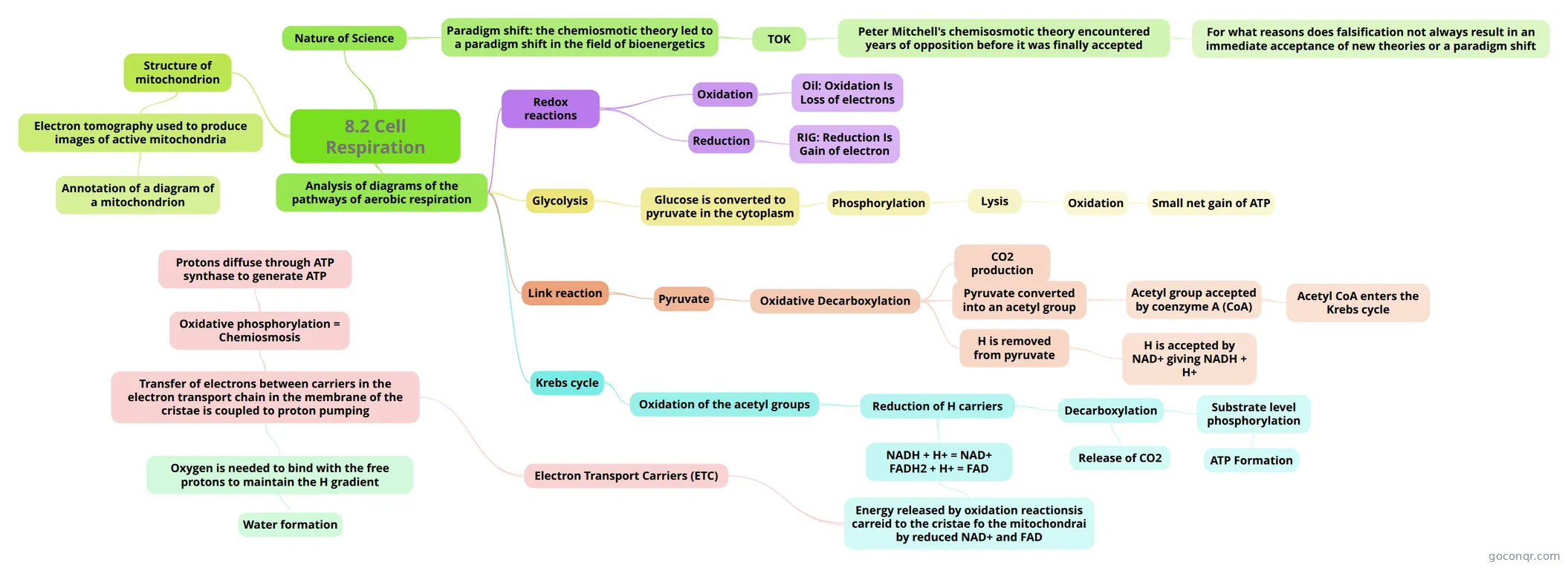
Mind map: 8.2 Cell respiration
Map content
8.2 Cell Respiration
Nature of Science
- Paradigm shift: the chemiosmotic theory led to a paradigm shift in the field of bioenergetics
- TOK
- Peter Mitchell's chemisosmotic theory encountered years of opposition before it was finally accepted
- For what reasons does falsification not always result in an immediate acceptance of new theories or a paradigm shift
- Peter Mitchell's chemisosmotic theory encountered years of opposition before it was finally accepted
- TOK
- Paradigm shift: the chemiosmotic theory led to a paradigm shift in the field of bioenergetics
Structure of mitochondrion
- Electron tomography used to produce images of active mitochondria
- Annotation of a diagram of a mitochondrion
- Electron tomography used to produce images of active mitochondria
Analysis of diagrams of the pathways of aerobic respiration
- Redox reactions
- Oxidation
- Oil: Oxidation Is Loss of electrons
- Reduction
- RIG: Reduction Is Gain of electron
- Oxidation
- Glycolysis
- Glucose is converted to pyruvate in the cytoplasm
- Phosphorylation
- Lysis
- Oxidation
- Small net gain of ATP
- Oxidation
- Lysis
- Phosphorylation
- Glucose is converted to pyruvate in the cytoplasm
- Link reaction
- Pyruvate
- Oxidative Decarboxylation
- H is removed from pyruvate
- H is accepted by NAD+ giving NADH + H+
- CO2 production
- Pyruvate converted into an acetyl group
- Acetyl group accepted by coenzyme A (CoA)
- Acetyl CoA enters the Krebs cycle
- Acetyl group accepted by coenzyme A (CoA)
- H is removed from pyruvate
- Oxidative Decarboxylation
- Pyruvate
- Krebs cycle
- Oxidation of the acetyl groups
- Reduction of H carriers
- Decarboxylation
- Substrate level phosphorylation
- ATP Formation
- Release of CO2
- Substrate level phosphorylation
- NADH + H+ = NAD+ FADH2 + H+ = FAD
- Energy released by oxidation reactionsis carreid to the cristae fo the mitochondrai by reduced NAD+ and FAD
- Electron Transport Carriers (ETC)
- Transfer of electrons between carriers in the electron transport chain in the membrane of the cristae is coupled to proton pumping
- Oxidative phosphorylation = Chemiosmosis
- Protons diffuse through ATP synthase to generate ATP
- Oxygen is needed to bind with the free protons to maintain the H gradient
- Water formation
- Oxidative phosphorylation = Chemiosmosis
- Transfer of electrons between carriers in the electron transport chain in the membrane of the cristae is coupled to proton pumping
- Electron Transport Carriers (ETC)
- Energy released by oxidation reactionsis carreid to the cristae fo the mitochondrai by reduced NAD+ and FAD
- Decarboxylation
- Reduction of H carriers
- Oxidation of the acetyl groups
- Redox reactions
Information
- Description
- DP IB Biology (08 Metabolism, Cell Respiration, and Photosynthesis) Mind Map on 8.2 Cell Respiration, created by Steve Harton on 19/05/2014.
- Created by
- Steve Harton
- Views
- 601
- Tags
- Rating