
Mind map
Electric and Magnetic Fields
Map content
Electric and Magnetic Fields
Electric Fields
- Electric Fields Basics
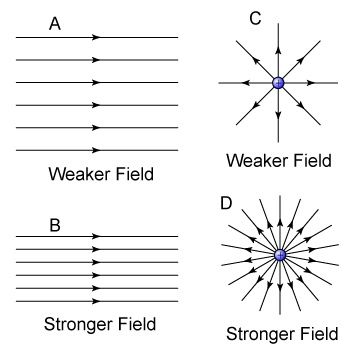
- An electric field is a region of space that will cause a charged particle to experience a non contact force
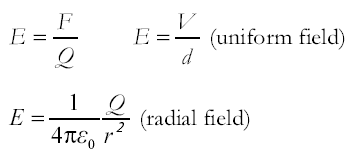
- Electric field strength (E), measured in (N/M) using the Force (N) a charged particle with charge (q) will experience in the field
- We can represent electric fields using electrical field lines
- Field Line diagrams show us the direction of force a POSITIVELY charged particle will feel. The closer together the field lines are, the stronger it is.
- An electric field is a region of space that will cause a charged particle to experience a non contact force
- Electric Potential
- Electric potential is the amount of energy an ion will get per unit of charge depending on its position within the electric field
- The Electric Potential of a charged particle inside an electric field depends on its position within the electric field.
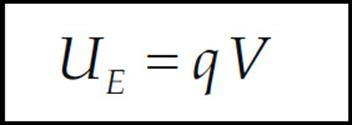
- We can use the idea of Electric potential (E) to calculte the amount of kinetic energy (E) a charged particle (Q) will gain by moving through an electric field and a potential difference (V)
- In the equation on the left, U has been used instead of E to represent energy, but they mean the same thing
- Electric potential is the amount of energy an ion will get per unit of charge depending on its position within the electric field
- Types of Electric Field
- Uniform Electric Fields
- Uniform Electric Fields are electric fields which have parallel field lines equally spaced throughout. This means that there is a constant field strength throughout
- We can set up a uniform electric field by having 2 identical metal plates connected to each terminal of a battery.
- We can calculate the field strength of a Uniform Electric Field (E) if we know the distance between the 2 plates (D) and the potential difference applied across them (V)
- Radial Electric Fields
- Radial Electric fields are the region around a positively charged sphere
- We can calculate the strength of an electric field (E) at any given distance (r) from the point source using the charge of the point source (q) and the constant for the permivitty of free space
- Uniform Electric Fields
- Coulombs Law
- The force of attraction between a proton and an electron can be thought of as an electron feeling a force from the proton's magnetic field
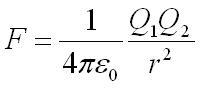
- We can use coulombs law to calculate the force of attraction between 2 charged particles (Q), given the distance between them (r)
- Electric Fields Basics
Capacitors
- Capacitor Basics
- Capacitors are devices that store electrical charge. They are made by having 2 metal plates separated by an air gap.
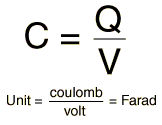
- The amount of charge a capacitor can store per volt is the capacitance (C) measured in Farads (F). It can be calculated using the potential difference across the capacitor when fully charged, and the charge stored (Q)
- Charging and Discharging Capacitors
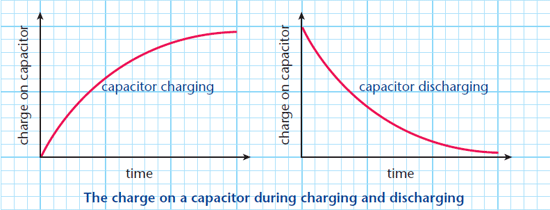
- When a power supply is connected to a capacitor, positive and negative charge build up on opposite plates. This creates a potential difference. This creates a uniform electric field between the plates.
- Charging of a capacitor
- The charging and discharge of a capacitor happens exponentially (starts off quick, then slows down.)
- If a capacitor is disconnected from a cell and then used connected to a resistor, it'll discharge. This is because the electrons will move over to the positive side of the capacitor and by discharging through a resistor.
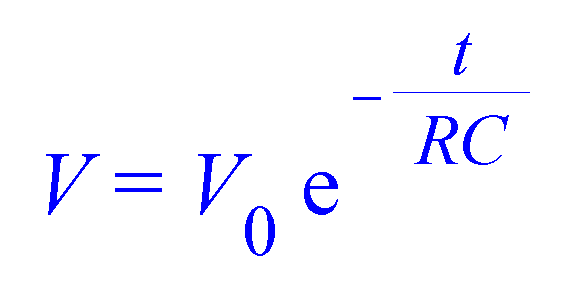
- We can calculate the new voltage (V) after a given amount of time discharging (t) given that we know the initial voltage (Vo) and the time constant of the capacitor (RC)
- The equations for the charge and discharge of a capacitor all follow the same pattern to show the changes in charge, current and voltage
- The time constant is the time a capacitor will take to discharge down to 37%.
- If we know the capacitance of the capacitor (C), and the resistance of the resistor (R) that it is discharging through, we are able to calculate the time constant of the capacitor
- T=RC
- If we know the capacitance of the capacitor (C), and the resistance of the resistor (R) that it is discharging through, we are able to calculate the time constant of the capacitor
- When a power supply is connected to a capacitor, positive and negative charge build up on opposite plates. This creates a potential difference. This creates a uniform electric field between the plates.
- Energy stored in a capacitor
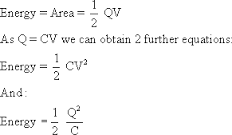
- A charged capacitor is a store of electrical potential energy. When the capacitor discharges, electric potential energy is transferred into other forms.
- When calculating electric potential energy, our value is halved. This is because work is done when charging a capacitor, this leads to some energy being dissipated.
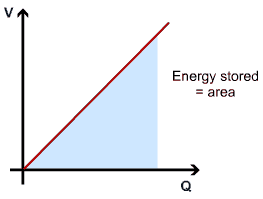
- This leads to the energy stored being the area under a Voltage (V) against Charge (Q) graph.
- This leads to the energy stored being the area under a Voltage (V) against Charge (Q) graph.
- Capacitor Basics
Magnetic Fields
- Magnetic Field Basics
- A region of space that will cause a magnetic pole to feel a force is called a magnetic field
- Magnetic Field lines are represented in the same way as electric field lines. They show the direction the NORTH pole of a magnet will feel a force
- The strength of a magnetic field is called the magnetic flux density (B) measured in Tesla (T)
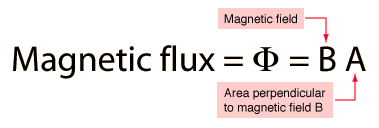
- We can use the magnetic flux density (B) to find the amount of flux (phi) measured in weber (Wb) through a given area (A). This gives the effect of the magnetic field in that area.
- A region of space that will cause a magnetic pole to feel a force is called a magnetic field
- Flux Linkage
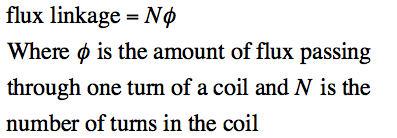
- Flux linkage is the amount of magnetic flux interacting with a coil of wire.
- The interaction between a magnetic field and a charged particle, or a conductor allows motors to operate. This allows an Emf to be induced.
- Usually, i magnetic flux is put through a coil of wire, since a single coil wont be effective. The magnetic field will interact with each turn in the coil. The effect of this will be multiplied by how every many coils there are (n)
- The interaction between a magnetic field and a charged particle, or a conductor allows motors to operate. This allows an Emf to be induced.
- Flux linkage is the amount of magnetic flux interacting with a coil of wire.
- The Motor Effect
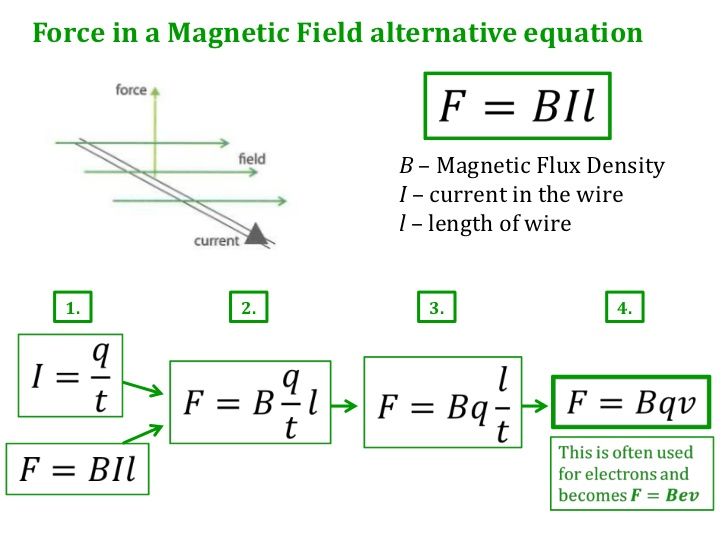
- Placing a wire in a magnetic field and passing a current through it causes it to experience a force.
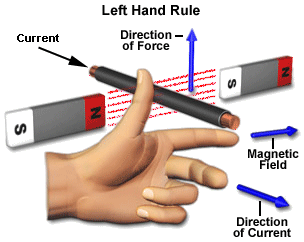
- We can predict the direction of the force that the wire will feel given the direction of current and magnetic field lines using Flemming's left hand rule
- Placing a wire in a magnetic field and passing a current through it causes it to experience a force.
- Magnetic Forces
- We can calculate the Force (F) acting on a wire of a given length (L) in a magnetic field density (B) and a current flowing through it (I)
- The equation tells us that we can make a motor more powerful by: Increasing the current through it. Increasing the number of turns on the wire. Increasing the magnetic field within the motor.
- If a charged particle is moving freely inside a magnetic field, it will follow a circular path
- We can calculate the Force (F) acting on a wire of a given length (L) in a magnetic field density (B) and a current flowing through it (I)
- Electromagnetic Induction
- If we move a magnet near a wire, the electrons in the wire will feel a force that will make them flow through the wire
- This is an emf being generated. If this wire is in a complete circuit, the electrons will move, forming a complete current
- If we reverse the polarity of the magnet, the direction of the emf induced will the opposite
- This is an emf being generated. If this wire is in a complete circuit, the electrons will move, forming a complete current
- Faraday's Law tells us that the induced emf is proportional to the rate of change in flux linkage in the wire.
- If we move a magnet near a wire, the electrons in the wire will feel a force that will make them flow through the wire
- Lenz's Law
- If you drop a non magnetic metal, as well as a magnetic metal down a copper tube, the magnetic metal will fall slower than the non magnetic one.
- This is strange since copper is not a magnetic metal, meaning it should not interact with the magnetic metal
- These observations come as a result of Lenz's Law
- As the metal falls through the copper tube, an emf is induced. This is because we can consider the copper tube as a set of alot of coils. The current will create an EM field in the opposite direction to the falling metal. This is due to the conservation of energy. This force slows it down, explaining the phenomena.
- These observations come as a result of Lenz's Law
- This is strange since copper is not a magnetic metal, meaning it should not interact with the magnetic metal
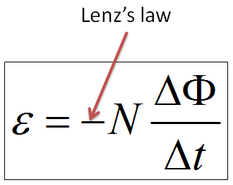
- We can use Lenz's law to calculate induced Emfs. The emf induced is the rate of change of flux linkage.
- Faraday's law tells us the induced emf is proportional to the rate of change in flux linkage
- A negative sign comes from Lenz's law to show the force is in the opposite direction
- If you drop a non magnetic metal, as well as a magnetic metal down a copper tube, the magnetic metal will fall slower than the non magnetic one.
- Magnetic Field Basics
Images and files in the map
Information
- Description
- A level Physics Mind Map on Electric and Magnetic Fields, created by Husein Adamjee on 31/05/2017.
- Created by
- Husein Adamjee
- Views
- 0
- History
-
- Created by Husein Adamjee · May 23, 2017
- Copied by Husein Adamjee · May 31, 2017
- Rating