
Mind map
Oral Surgery in Children
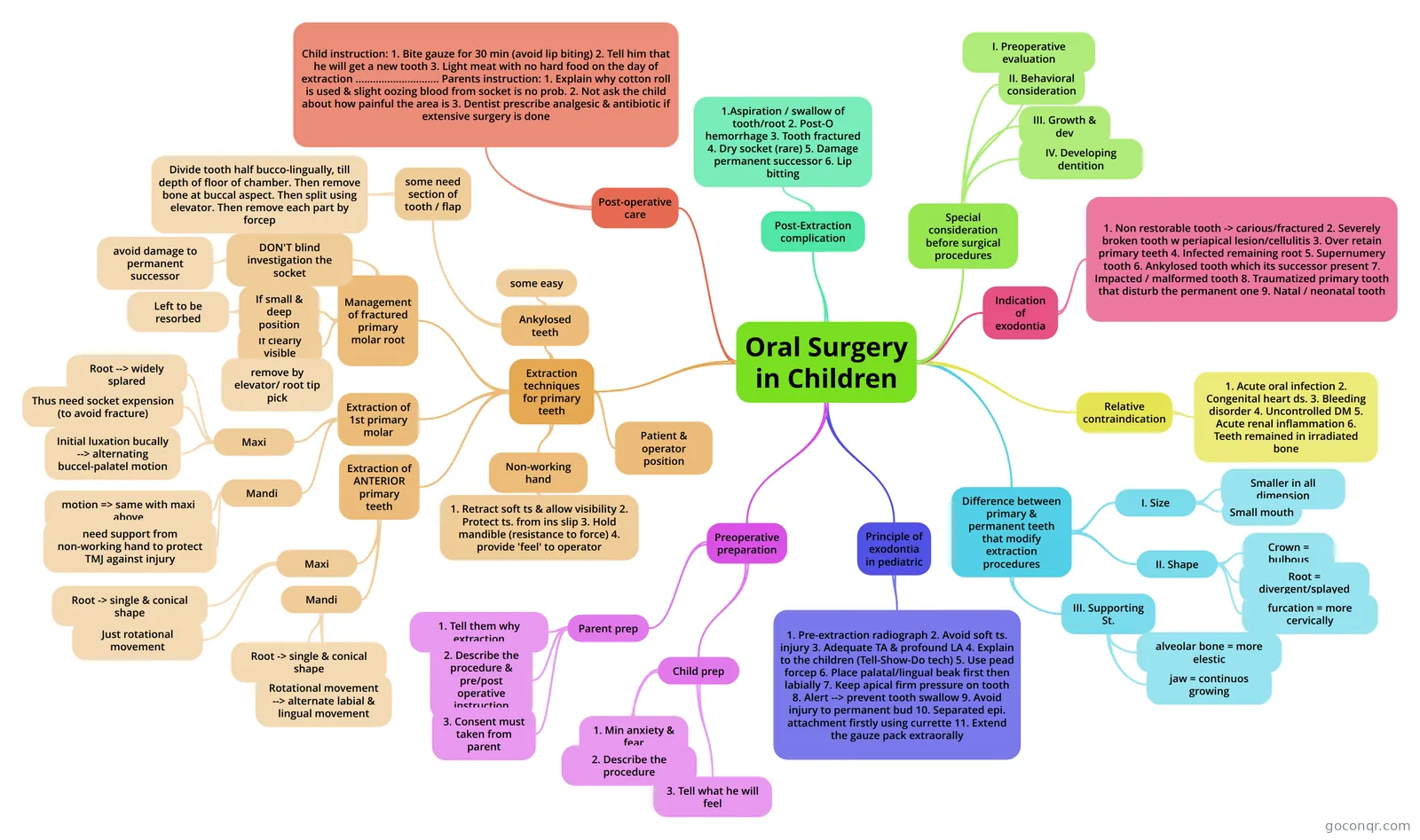
Mind map: oral surgery in children
Map content
Oral Surgery in Children
Special consideration before surgical procedures
- I. Preoperative evaluation
- II. Behavioral consideration
- III. Growth & dev
- IV. Developing dentition
Indication of exodontia
- 1. Non restorable tooth -> carious/fractured 2. Severely broken tooth w periapical lesion/cellulitis 3. Over retain primary teeth 4. Infected remaining root 5. Supernumery tooth 6. Ankylosed tooth which its successor present 7. Impacted / malformed tooth 8. Traumatized primary tooth that disturb the permanent one 9. Natal / neonatal tooth
Relative contraindication
- 1. Acute oral infection 2. Congenital heart ds. 3. Bleeding disorder 4. Uncontrolled DM 5. Acute renal inflammation 6. Teeth remained in irradiated bone
Difference between primary & permanent teeth that modify extraction procedures
- I. Size
- Smaller in all dimension
- Small mouth
- II. Shape
- Crown = bulbous
- Root = divergent/splayed
- furcation = more cervically
- III. Supporting St.
- alveolar bone = more elestic
- jaw = continuos growing
- I. Size
Preoperative preparation
- Parent prep
- 1. Tell them why extraction
- 2. Describe the procedure & pre/post operative instruction
- 3. Consent must taken from parent
- Child prep
- 1. Min anxiety & fear
- 2. Describe the procedure
- 3. Tell what he will feel
- Parent prep
Extraction techniques for primary teeth
- Patient & operator position
- Non-working hand
- 1. Retract soft ts & allow visibility 2. Protect ts. from ins slip 3. Hold mandible (resistance to force) 4. provide 'feel' to operator
- Extraction of ANTERIOR primary teeth
- Maxi
- Root -> single & conical shape
- Just rotational movement
- Mandi
- Root -> single & conical shape
- Rotational movement --> alternate labial & lingual movement
- Maxi
- Extraction of 1st primary molar
- Maxi
- Root --> widely splared
- Thus need socket expension (to avoid fracture)
- Initial luxation bucally --> alternating buccel-palatel motion
- Mandi
- motion => same with maxi above
- need support from non-working hand to protect TMJ against injury
- Maxi
- Management of fractured primary molar root
- If clearly visible
- remove by elevator/ root tip pick
- If small & deep position
- Left to be resorbed
- DON'T blind investigation the socket
- avoid damage to permanent successor
- If clearly visible
- Ankylosed teeth
- some easy
- some need section of tooth / flap
- Divide tooth half bucco-lingually, till depth of floor of chamber. Then remove bone at buccal aspect. Then split using elevator. Then remove each part by forcep
Post-operative care
- Child instruction: 1. Bite gauze for 30 min (avoid lip biting) 2. Tell him that he will get a new tooth 3. Light meat with no hard food on the day of extraction ............................. Parents instruction: 1. Explain why cotton roll is used & slight oozing blood from socket is no prob. 2. Not ask the child about how painful the area is 3. Dentist prescribe analgesic & antibiotic if extensive surgery is done
Principle of exodontia in pediatric
- 1. Pre-extraction radiograph 2. Avoid soft ts. injury 3. Adequate TA & profound LA 4. Explain to the children (Tell-Show-Do tech) 5. Use pead forcep 6. Place palatal/lingual beak first then labially 7. Keep apical firm pressure on tooth 8. Alert --> prevent tooth swallow 9. Avoid injury to permanent bud 10. Separated epi. attachment firstly using currette 11. Extend the gauze pack extraorally
Post-Extraction complication
- 1.Aspiration / swallow of tooth/root 2. Post-O hemorrhage 3. Tooth fractured 4. Dry socket (rare) 5. Damage permanent successor 6. Lip bitting
Information
- Description
- PEDODONTICS Mind Map on Oral Surgery in Children, created by pengiran92 on 05/28/2014.
- Created by
- pengiran92
- Views
- 28
- Rating