
Mind map
Clinical Research and Pre-Clinical Development
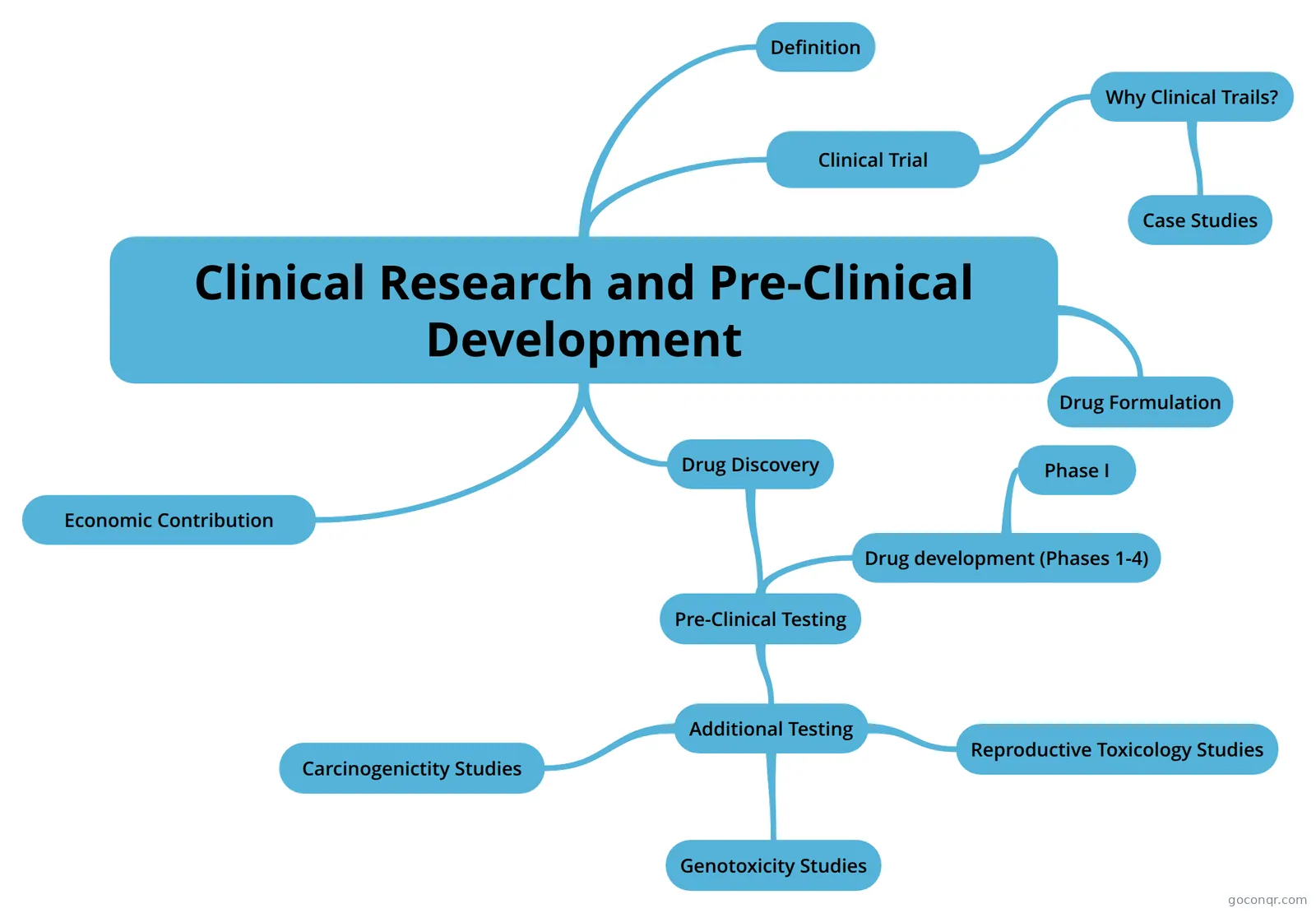
Mind map: Clinical research and pre-clinical development
Map content
Clinical Research and Pre-Clinical Development
Definition
- Definition: The involvement of a particular person or a group of people, or the uses of material from humans, such as their behaviour or samples of their tissue.
- It is a branch of healthcare science in which the safety and effectiveness (efficacy) is determined.
- -It includes: -Medications -Devices -Diagnostic Materials -Treatment regimes intended for human use
- It's aim is to be used for: -Prevention -Treatment -Diagnosis -Relieving Symptoms of a Disease (Palliative Care)
Clinical Trial
- Definition. Source: ICH GCP Section 1.12 https://www.ich.org/fileadmin/Public_Web_Site/ICH_Products/Guidelines/Efficacy/E6/E6_R1_Guideline.pdf -Any investigation in human subjects intended to discover or verify the clinical, pharmacological -and/or other pharmacodynamic effects of an investigationalproduct(s), -and/or to identify any adverse reactions to an investigational product(s),-and/or to study absorption, distribution, metabolism, and excretion of an investigational product(s) with the object of ascertaining its safety -and/or efficacy. Theterms clinical trial and clinical study are synonymous.
- In a clinical trial: -Participants recieve specific interventions according to the reasearch plan/ protocol created by the investigators -It may compare a new medical approach to the Gold Standard, a Placebo or there might be no intervention -There is the uncertainty of the IP in whether beneficial/harmful/no different from the avaliable alternatives
- Why Clinical Trails?
- In short, it is aimed to answer the question of safety, efficacy to the Gold Standard and any side effects that may arise from the treatment in the hope of improving health and the quality of life for patients.
- Case Studies
- WWII Nazi Doctors and the Nuremburg Code ICH GCP Thalidomide Declaration of Helsinki TeGenero/Northwick Park Clinical Trial Biotrial/Rennes Clinical Trial Tuskegee Henrietta Lacks
Economic Contribution
- -UK Life Sciences are contributing about 30.7bn to the economy in 2015, providing an estimated tax contribution of £8.6bn to the exchequer -Each Life Sciences job supports 2.5 jobs elsewhere in the UK economy, meaning the sector supports a total of 482,000 jobs -Jobs are distributed throughout the UK, with every region containing a UK head office of a Life Sciences firm -Major clusters of Life Sciences activity can be found in East Anglia, Wales, and the South East of England.
Drug Discovery
- Innovation has become central to drug discovery in the UK and collaboration in almost all organisation becoming ubiquitous (Increased collaborative drug discovery). Work in partnership with a range of partners including: -Biotech Firms Acedeme Drug discovery centres (or catapults) The role of research charities in drug discovery seems to be growing
- It takes an average of 12 years to discover, develop and test a new medicine. It is not a straightforward process and many project fail for a number of reasons, such as unexpected side effects or the unforeseen ineffectiveness of the drug
- It takes about £1.15 Billion for the research and development of a new molecular entity (2016).
- The knowledge of how the body works and understanding of human genetics has lead to the new insights into treating diseases Finding the lead compound may be a step into drug developement
- Pre-Clinical Testing
- Development: through rigorous testing, if the studied compound pass the test set by scientist and chemist, it becomes a drug candidate and moves into the Development phase -It would then be put through pre-clinical/in vivo testing which would include testing on animals to find out the effect on a whioel organism
- Types of Study: -Single Acute Study: Looks at potential Adverse Events of single doses provide information regarding (A) possible dose levels for the 1st application in man (B) indications of possible effects that can be expected with overdosing
- -Repeated Dose Toxicity: looks at the toxicity effects of repeated doses over a period of up to 24 hours. (A)Data would help in determining the doses and length of the Phase 1 studies conducted in humans (B)Mammalian types are tested (C)Categorised as acute, sub-acute and chronic. (Define)
- -Acute Studies: Study by rising dose until signs of toxicity is apparent. It is usualy done in 2/more mammalian species covering 2 different routes of administration -Sub-Acute Studies: Study given to animals for 4-6 weeks in doses below the level which causes rapid poisoning in order to determine toxic drug metabolites build up over time-Chronic Studies: last for up to 2 years and in the EU there is a requirement of 2 mammalian species being used, with one being non-rodent
- Toxicity study: Toxicokinetics: describe the relationship between systemic exposure in ainmals and toxicity, following an extrapoation to exposure to humans. It is an intergral component of non-clinical toxicity studies.
- Additional Testing
- See http://www.ich.org/fileadmin/Public_Web_Site/ICH_Products/Guidelines/Safety/S1A/Step4/S1A_Guideline.pdf ICH S1A Carcinogenicity Studies (Animals) -Obj. To I.D if the study drug was potentially carcinogenic in animals and access the relevant risk in humans -Initiated based on lab results, animal toxicology studies and data in clinical trials The intention of the IP is to be administered regularly over a long period of time (min. 6 months) or very frequently in an intermittent manner so that the total exposure was similar. I.e. in chronic and recurring condition like depression or anxiety
- Carcinogenicity studies must be completed before marketing approval. However, completed rodent carcinogenicity studies are not needed in advance of the conduct of large scale clinical trials, unless there is a special concern for the patient population. For pharmaceuticals developed to treat certain serious diseases, carcinogenicity testing need not be conducted before market approval although these studies should be conducted post-approval. (A) This speeds the availability of pharmaceuticals for lifethreatening or severely debilitating diseases, especially where no satisfactory alternative therapy exists. In instances where the life-expectancy in the indicated population is short (i.e., less than 2 - 3 years) no long-term carcinogenicity studies may be required. (A) For example, oncolytic agents intended for treatment of advanced systemic disease do not generally need carcinogenicity studies. In cases where the therapeutic agent for cancer is generally successful and life is significantly prolonged there may be later concerns regarding secondary cancers. (B) When such pharmaceuticals are intended for adjuvant therapy in tumour free patients or for prolonged use in noncancer indications, carcinogenicity studies are usually needed.
- Species used: Rodents, in which they are dosed daily for 2 years and monitored closely. There is the assessment of their organs for any histological evidence of tumours. The process is length and thus expensive and early planning is required.
- The industry aims to REPLACE, REDUCE and REFINE the use of animals in research
- Carcinogenictity Studies
- For pharmaceuticals developed to treat certain serious diseases, carcinogenicity testing need not be conducted before market approval although these studies should be conducted post-approval. This speeds the availability of pharmaceuticals for lifethreatening or severely debilitating diseases, especially where no satisfactory alternative therapy exists. In instances where the life-expectancy in the indicated population is short (i.e., less than 2 - 3 years) no long-term carcinogenicity studies may be required. For example, oncolytic agents intended for treatment of advanced systemic disease do not generally need carcinogenicity studies. In cases where the therapeutic agent for cancer is generally successful and life is significantly prolonged there may be later concerns regarding secondary cancers. When such pharmaceuticals are intended for adjuvant therapy in tumour free patients or for prolonged use in noncancer indications, carcinogenicity studies are usually needed.
- For pharmaceuticals developed to treat certain serious diseases, carcinogenicity testing need not be conducted before market approval although these studies should be conducted post-approval. This speeds the availability of pharmaceuticals for lifethreatening or severely debilitating diseases, especially where no satisfactory alternative therapy exists. In instances where the life-expectancy in the indicated population is short (i.e., less than 2 - 3 years) no long-term carcinogenicity studies may be required. For example, oncolytic agents intended for treatment of advanced systemic disease do not generally need carcinogenicity studies. In cases where the therapeutic agent for cancer is generally successful and life is significantly prolonged there may be later concerns regarding secondary cancers. When such pharmaceuticals are intended for adjuvant therapy in tumour free patients or for prolonged use in noncancer indications, carcinogenicity studies are usually needed.
- Species used: Rodents, in which they are dosed daily for 2 years and monitored closely. There is the assessment of their organs for any histological evidence of tumours. The process is length and thus expensive and early planning is required.
- Genotoxicity Studies
- https://www.youtube.com/watch?v=I-u-OqIEXzE (From 12:06)http://www.genetics-gsa.org/education/pdf/GSA_DeStasio_Ames_Student_Resources.pdfObj. To check the likelihood of the drug compound causing genetic mutations which may lead to cancer. The Ames Test is used as the Gold Standard for the 1st type of genetic testing in bacterial cells (In Vivo and In Vitro) The relative growth of Histidine Negative bacterium Salmonella tymphimurium on a medium lacking Histidine exposed to the chemical determines the carcinogenic factor of the IP.
- Strand breaks, mutations and chromosomal aberrations also would be considered
- Reproductive Toxicology Studies
- RTS studies detect any effect on mammalian reproduction (done in animals) Segment 1: -effect on fertility and early embryonic development -effect on fertility in males and females, and the range of effects (reduced reproductive capability- complete sterility)
- Seg. 2: -Detection of embryo-foetal development -Evaluation of the influence of the drug surviving to term
- Seg 3. -Pre- and Post- natal development, including maternal function - Teratogenicity= adverse effects on the developing embryo and foetus that will have irreersible consequences on the physical integruty of the offspring (congenital defects)
- Drug development (Phases 1-4)
- Phase I
- Single Ascending Dose Multiple Ascending Dose
- Phase I
Drug Formulation
- The main aim for drug developers is to ensure the formulation of the drug remains potent and sterile, as well as safe right up to administration. Parameters to consider: - The formulation alone - Storage - Shipment - Heat - Light - Over time
- Tablets: -The active drug constitutes of about 5-10% of the drug - Excipients make 90% (Dilutents lubricants and etc), which is also tested to ensure its interaction is not harmful -Its potency must not be comprimised and must be sterile and non toxic.
- Injectables: Determination of storage (Liquid/Lyophilised(freeze dried)) -Temperature -Requirement of solution -Delivery of the drug (tropical countries-cold chain )
Information
- Description
- Mind Map on Clinical Research and Pre-Clinical Development, created by Princess C on 10/07/2017.
- Created by
- Princess C
- Views
- 9
- Rating
More on Clinical Trial Design and Phases