
Notes
Cement Industry - created from Mind Map
Content of the notes (1)
Page 1
Constitution of OPC
OPC (Ordinary Portland Cement): is defined as being the product obtained by pulverizing clinker consisting essentially of calcium silicates, to which no addition has been made after calcination other than water and gypsum
Manufacture of OPC
Cement can be produced by "Wet process" or "Dry process" but recently Dry process is commonly used for economic purposed.
In certain cases when clay raw material are extremely plastic their high water content make it uneconomial to dry them in that case a semi-dry process can be used, such as "lepol process"
Wet process: Add water to raw mix before introducing to firing kiln.
Dry process: No addition of water.
Hydration of Cement
Properties of Portland Cement
Types of Portland Cement
Raw Materials
Are essentially clay and limestone \(CaCO_3\) with regulating doses of silica and a source of iron (usually oxides).
Precaution: the total percent of alkali oxides\(Na_2O , K_2O\) shouldn't exceed 2%, This limit the maxmium alkali in the product cement to 0.6%
For alkali Oxides:
\(2 \% {Raw material} \rightarrow 0.6 \% Product\)
Oxides analysis of a raw material (raw mix):
Oxide %
\(CaO\) 42
\(SiO_2\) 14.2
LOI 35.1
\(Al_2O_3\) 3.6
\(Fe_2O_3\) 2
\(MgO\) 1.8
\(K_2O)\) 0.63
\(Na_2O\) 0.22
\(TiO_2\) 0.17
\(Mn_2O_3\) 0.1
\(P_2O_5\) 0.06
LOI: loss on ignition is losing compounds due to combustion, in cement is due to the loss of carbon dioxide from the limestone and chemical water from the clay.
Clinker Components
The reactions occurring in Rotary kiln used for firing raw mix produce four main compounds:
\(Alite\) \(C_3S\) Tri-Calcium Silicate \(3CaO.SiO_2\)
\(Belite\) \(C_2S\) Di-Calcium Silicate \(2CaO.SiO_2\)
\(Aluminate\) \(C_3A\) Tri-calcium Aluminate \(3CaO.Al_2O_3\)
\(Ferrite\) \(C_4AF\) Tetra-Calcium Alumino Ferrite \(4CaO.Al_2O_3.Fe_2O_3\)
\(C_3S:\) Is responsible for early strength of cement.
\(C_2S:\) Is responsible for acquired strength after long time period.
\(C_3A:\) Is responsible for initial setting and heat evolution upon adding water.
\(C_4AF:\) Plays a minor role similar to \(C_3A\).
Typical Oxides levels in cement (clinker):
Oxide
\(CaO\) 60-67%
\(SiO_2\) 17-25%
\(Al_2O_3\) 3-8%
\(Fe_2O_3\) 0.5-6%
\(MgO\) 0.1-4%
Alkali 0.2-1.2%
\(SO_3\) 1-3%
\(SO_3\) is present as gypsum added to clinker to retard setting.
Whenever the percent oxides are known, it is possible to estimate the clinker composition from "Bogue Formula"
\(\%C_3S = 4.07CaO - 7.6SiO_2 - 6.72Al_2O_3 - 1.43Fe_2O_3\)
\(\%C_2S = -3.07CaO + 8.6SiO_2 + 5.07Al_2O_3 + 2.08Fe_2O_3\)
\(\%C_3A = 2.65Al_2O_3 - 1.69Fe_2O_3\)
\(\%C_4AF = 3.04 Fe_2O_3\)
For example clinker would consists of about:
\(C_3S: 60\%\)
\(C_2S:18\%\)
\(C_3A: 13\%\)
\(C_4AF: 9\%\)
Cement Indices
In order cement fulfills its function properly, the clinker composition should have certain indices:
1. The Silicon Ratio (SR):
\(S.I = \frac{SiO_2}{Al_2O_3 + Fe_2O_3}\)
In clinker range should be \(1.8 - 3.6\)
2. The Lime Saturation Factor (LSF)
\(LSF = \frac{CaO}{2.8SiO_2 + 1.18Al_2O_3 + 0.65Fe_2O_3}\)
It measures the lime content of clinker with respect to other oxides , it range \(0.7 - 1\), if it exceeds \(1\) the final product (cement) will contain free \(CaO\) which cause trouble in use.
Clay
Limestone
Silica
Source of iron
Alite
Belite
Aluminate)
Ferrite)
Silica Ratio
Lime Saturation Factor
Wet Process
The raw materials are separately "crushed then mixed and ground" in ball mills, the slurry containing 35-40% water then go to a "Correcting Tank" where sample are taken for analysis, then go to "Silo" and send to "rotary Kiln" where reaction take place to finally form small nodules of diameter (\(10^\omicron - 10^1 mm\) (clinker), hot clinker leaves the kiln at high temperature 1400 °C and rapidly cooled by cold air and then mixed with gypsum and grounded in ball mill, then restored in silo before Packaging.
Wet Kiln:
is very long (200 m in length) sine part of the kiln is devoted for dehydration of the slurry , also they have a high specific heat of consumption \(\approx 6000{KJ/Kg} {clinker}\)
Productivity of wet kilns can't exceed \(3000tpd\)
Heat economy: hot air from the clinker cooler (600-800 °C ) after dedusting in a filter can be added to the rotary kiln as a secondary air for combustion.
Flue gases from the kiln enrain a large amount of a dust that can be collected in electrostatic precipitator and recycled to the kiln.
Crusher: jaw crusher(single or double), Gyratory crusher
Dry Process
The raw material "Crushed then grinded" the "Dried" either by using hot flue gases from the kiln or hot air(probably from cooler)then delivered to "Raw mix silo" which designed to have continous air stirring to avoid any segregation, then transfer to a heat exchanger system known as "Suspended preheaters" consists of several vertical "Cyclones" where hot flue gases leaving kiln (1100°C) flow in counter-current aganist the raw mix, the latter reach temperature (850°C) at kiln entrance and (350°C) for the cooled gases, this cause partial calcination of limestone and clay and decrease the specific heat consumption of the process, then clinker is formed on the kiln and then cooled by cold air in a cooler (the hot air from cooler used as secondary air for combustion to the kiln after De-dusting in filter) then gypsum is added to cooled clinker and grounded in "Ball mill" then stored in "Silo" ready for Packaging.
Dry Process steps:
1. Crushing and Grinding
2. Drier
3. Raw mix silo
4. Suspended preheater
5. Rotary kiln
6. Cooler
7. Adding Gypsum and Grinding
8. Restoring in Silo
9. Packaging
Cyclone preheaters:
recently up to six cyclones have been used reducing the specific heat consumption to less than \(2000 KJ/Kg Clinker\) and the exit gases temperature down to 300°C
The productivity of Kiln increases to \(10,000 tpd\) clinker as preheating exists, so the length of the kiln could be \(100 m\) (short kiln)
35% of the limestone calcinated in preheater cyclones.
Total Pre-Calcination:
External furnace can be added beneath the lowest cyclone in which cheap fuel can be burnt to give hot flue gases, this cause almost total calcination \(90-95\%\) of raw mix
Rotary Kiln:
Reactions and phase transformation occuring in the kiln:
Temp °C
80 - 120°C Loss physical water (Endo)
400 - 800°C Loss of chemical water (Endo)
>500°C Structural change in silicates(Exo)600-900°C Dissocaition of calcium carbonate (Endo)
>900°C Formation of Belite,Aluminate,Ferrite (Exo)
>1250°C Beginning of melting (Endo)
>1250°C Formation of Alite( Exo)
>1300°C Further melting and Clinker formation (Exo)
Design of Kiln
Length \(\approx 100 m\)
\(D:L = 1:11\)
It is inclined
Rotation \(1 - 4 rpm\) (girth gear)
The kiln is internally lined with refreactory bricks, on the cold end fire clay refractories are used while on the hot end magnesite bricks are used due to clinker nature and there is an insulation layer.
To avoid escaping of gases from the kiln, we apply vacuum, so the kiln is operate under slightly negative pressure, this may cause air to be sucked into the kiln if special precautions aren't taken, this called false, this decrease the temperature inside the kiln, that is why seals are placed at banding and at the gear to avoid such phenomena.
Power required to drive rotary kiln depends on rotation speed, kiln weight and charge weight
Typical residance time \(20 - 60 min\)
\(Power 20 - 300 hp (>100 hp)\)
Circulation phenomena:
If the clay ore used in production is rich in alkalis, these will be mainly
present in the form of chlorides. If liquid fuel oil is used for combustion,
sulphur oxides will be released in flue gases. These will convert part of these
chlorides to sulphates. Alkali salts are extremely volatile at the high
temperatures prevailing inside the kiln. They tend to condense inside the
cyclone preheaters and are recirculated to the kiln with the incoming raw
mix, causing what is known as the alkali cycle.
If their amount is
appreciable they may clog cyclone openings as they condense causing
disruption of operation. Such phenomenon is particularly observed when
clay quarries lie in maritime regions.
To overcome this Phenomena:
1. Use raw materials that aren't rich in alkalis
2. Use a sulphur free fuel(like N.G.)
3. Install an alkali by pass system (not economic), by purging part of gases at temperature of vaporization (900 - 1000°C) the stream is rapidly cooled by air and entrained condensed dust collected by means of electrostatic precipitator, this dust contains large amount of alkali salts \(> 6%\) % and it can't be back to kiln, so we can dumped it in the desert.
Clinker coolers:
As clinker leaves the rotary kiln, it has to be rapidly cooled. The main
reason for rapid cooling is that \(C_2S\) is present in clinker in the variety \(\beta C_2S\).
If left to cool slowly, this will transform to the allotropic \(\gamma C_2S\) form. This transition is accompanied with a large volume change causing shuttering of
clinker nodules, a phenomenon known as dusting of cement.
There are several types of clinker coolers, the three main types are
discussed in what follows:
1. Rotary Cooler: This is the oldest type of coolers and its disadvantage is the clinker leaves at high temperature \(\approx 150°C\)
2. Planetary Cooler: This type of coolers can be used for large capacities, and has been particularly used with wet process kilns.Its main advantage is that it does not require a special drive as it rotates with the kiln. However, its design is intricate and the cooled clinker leaves at a relatively high temperature.
3. The Grate Cooler: This type has become the most widespread used in theproduction of cement by the dry process with total precalcination.It is divided into two sections, first one air out at \(1000°C\) maybe used as secondary air for combustion, second section air leaves at \(450°C\) used in dry raw materials, air leaving must be dedusted may in electrocstatic precipitator.
Gas Cleaning:
Flue gases from the kiln or from an eventual by-pass system are commonly cleaned using electrostatic precipitators (EP). These can rid the gases from particles as fine as 0.01 μm. They rely on the following principle:
If a high voltage is set up between two conductors, then the atoms of
ambient gas will be ionized. If this latter contains dust particles, then they will be charged and can subsequently be collected by earthed electrodes.
In cement industry, the commonly used type consists of vertical wires placed between collecting plates. High intensity current is made to flow through these wires and the charged dust particles are collected at the plates.
These are regularly shaken or hammered to get rid of adhering particles. The
retention time of gases into the precipitator is a few seconds, and the applied
voltage is in the range \(10^5 V\). Collection efficiencies as high as 99.9% are
not uncommon. This is necessary to abide by standard norms of dust
concentrations in the cleaned gas stream (\(<50 mg/Nm^3\)). The collection
efficiency increases with a decrease in gas temperature and an increase in its
humidity.
One common problem encountered is the fact that CO can combine with air to form an explosive mixture if its concentration in the flue gas stream exceeds 1%. That is why, it is necessary to install a rigid control system that cuts off power whenever the CO level becomes critical.
Some trends in Cement Industry
1. Decrease \(CO_2\) Emission:
Surround the factory with green area (trees).
2. Sending flue gases in water cooling towers: Don't discharge hot flue gases to the atmosphere, If they are not used to dry raw materials, then they may be
cooled in a water sprayed tower. Besides some dust separation thereof,
increased humidity will result in a better separation efficiency in the electrostatic precipitator.
3. Blending part of the by-pass dust with product cement: Part of the by-pass dust can be blended with cement without altering its
properties. A main condition is that the chlorid
should not exceed 0.1%. This way, depending on the chloride content of clay
raw material, up to half the by-pass load can be used, resulting in improved economical and ecological aspects.
4. Using vertical roller mill (VRM) for grinding:
A vertical grinding mill (VRM) consists of a rotating grinding table on
which several rollers (up to 6) grind the raw material. A special system allows for the partly ground material to be entrained by a stream of air to a separator. In this latter, coarse particles move towards the periphery of the cone and fell onto the table to be ground once more . Fine particles are entrained by the air stream to an outlet opening.
Over the last three decades, VRM has increasingly replaced
conventional ball mills in grinding raw materials. A main advantage is that
classification does not require a separate unit, but readily occurs in the mill.
Its use in clinker grinding is less frequent. The decision to use either VRM
or ball mills mainly depends on economical considerations.
VRM has been conventionally used to grind raw materials offering the
possibility to use one such equipment instead of a series of tube mills.
Another advantage over conventional tube mills is the lower ground floor
space it occupies. However, cement manufacturers have been reluctant to
use VRM for clinker grinding because of the flaky nature of ground product.
Recently, this shortcoming has been overcome by introducing vertical mills (OK mills) with a curved grinding table profile that produces ground clinker
particles in shapes close to spherical.
5. The use of alternative fuels:
Classical fuels used in cement kilns are coal, fuel oil, diesel oil and N.G.
In the last two decades, combustible waste materials (waste derived fuels,
WDF) have been used as alternate fuels in cement kilns. Their use represents
two main advantages: Safely disposing of more or less hazardous waste and
decreasing fuel consumption. The use of any waste derived fuel is limited by
the presence of undesirable elements such as \(S\) or \(Cl\)
Cyclone Preheater
Rotary Kiln
Grate Cooler
Electrostatic precipitator
Decreasing CO2 emissions
Send flue gases to cooling towers
Blending part of the by-pass dust with product cement:
VRM
The use of alternate fuels
Mechanism of Hydration
As water is added to cement, a paste is formed that develops consistency
and strength. This is due to the formation of hydrates out of the main clinker
constituents.
First: \(C_3A\) hydrates forming cubic hexahydrate crystals. The
reaction is very rapid and full hydration takes place in a few hours.
\[C_3A + 6H_2O \rightarrow C_3A.6H_2O (hexahydrate)\]
Second:\(C_4AF\) hydrate to give \(C_3A.6H_2O\) and calcium ferrite hydrate.
Then, \(C_3S\) and \(C_2S\) follow at lower rates, although the rate at which the
latter hydrates is much lower than the former. Both yield a hydrate having
the formula: \(C_3S_2.3H_2O\).
Third: Reaction takes about 7 days to totally hydrate
\[2C_3S + 6H_2O \rightarrow C_3S_2.3H_2O + 3Ca(OH)_2\]
Fourth: Reaction takes about several months
\[2C_2S + 4H_2O \rightarrow C_3S_2.3H_2O + Ca(OH)_2\]
While \(C_3A\) hydrates in a few hours, \(C_3S\) will take about seven days to
totally hydrate. \(C_2S\), on the other hand, will not complete its hydration
before several months. The rate at which these reactions occur follows the order:
\[C_3A > C_4AF > C_3S > C_2S\]
If any free lime or magnesia is present, then the corresponding hydroxides will be formed.
Hydration is also accompanied by exothermic heat release, being mainly due to the hydration of \(C_3A\).
Role of Gypsum
If ground clinker is directly treated with water, then \(C_3A\) present will readily react and setting will occur in a few minutes before any proper molding can be done, a phenomenon known as \(Flash\) \(Setting\). If gypsum is
added in a few percentages \(\approx 5\%\), then \(C_3A\) will selectively react with
\(CaSO_4\)to form calcium sulpho-aluminate, otherwise known as \(Ettringite\):
\(C_3A.3CaSO_4.32H_2O\). This gives enough time for \(C_3S\) to begin hydration.
If too much gypsum is added, then setting will be seriously delayed. On the other hand, if clinker is not cold enough, then, on grinding with gypsum, it may convert to the hemihydrate through the reaction:\[CaSO_4.2H_2O \rightarrow CaSO_4.\frac{1}{2}H_2O + \frac{3}{2}H_2O\]On adding water, the hemihydrate will rapidly set to the original dehydrate and an apparently hard mass will be obtained, a phenomenon known as \(False\) \(Setting\).That is why it is common to water spray the clinker ball mills on their outer surface to prevent overheating of gypsum.
A recent trend consists in heating gypsum to a relatively high temperature \(\approx 200°C\) to convert it to the inert anhydrite \(CaSO_4\) before grinding with clinker. Whether it is more convenient to use this technique or to cool the mills is an economic matter.
So, we can cool the clinker or heat the gypsum to prevent formation of hemi-hydrate.
Development of Strength
Although \(C_3A\) is the first compound to hydrate, the crystals formed
are weak and do not influence the strength of the paste. On the other hand,
\(C_3S_2.3H_2O\) crystals are the main contributors to strength. Since \(C_3S\) is faster
to hydrate than \(C_2S\) it is considered to be the compound that is mainly
responsible for strength development or hardening. As \(C_2S\) is much slower
to hydrate it will not seriously contribute to strength before a few months.
Flash Setting
False Setting
Ettringite
Chemical Composition
This is generally related to the type of cement. However, there are
certain general requirements: The Loss on ignition should not exceed 5%,
the percent of solids insoluble in \(HCl\) should not exceed \(5\%\), the sulphate
and chloride content should not exceed \(3.5\%\) and \(0.1\%\) respectively.
Heat of Hydration
Although not standard, this test is of particular importance if the cement
is to be of low heat release type. It should not exceed \(270\) \(J/g\). after 7 days.
Fineness
Fineness or particle size of cement affect the hydration rate and thus the rate of strength gain, the smaller the particle size the greater surface area to volume ratio, the more area for water-cement interaction per unit volume, leads to rapid hardening of cement (good), the specific surface area is determined by \(Blaine.Test\), which maked use of the pressure drop accompanying the flow of air through porous cement bed, the specific surface of OPC usually exceeds \(2500\) \(g/cm^2\) and increased to more than \(3500\) \(g/cm^2\) in case of rapid hardening.
Soundness
Soundness (Constancy of volume):
If free \(CaO\) or free \(MgO\) is present in the final product, then they will
hydrate producing the corresponding hydroxides. This process is
accompanied with an increase in volume that may cause cracks to develop in
the hardened mass. A test, known as the \(Le.Chatelier.fork\) test is sometimes
used to assess the possibility of excessive volume expansion. In this test, a
cement mortar containing cement and sand, in the ratio 1 : 3, is mixed with
water to form a paste. This is confined in a ring of standard dimensions to
which are fixed two flat slabs of standard length. The paste is left for 24
hours in water then boiled for one hour and the clearance between the tips of
the slabs measured. An expansion of more than 10 mm denotes the presence
of excess free lime.
Strength
Standard compressive strength tests are usually performed on 2" cubes
filled with cement mortar after 1 day, 3 days, 7 days and possibly after 28 days. This last test is of particular importance although it is not usually performed for lack of time. Cement pastes reach 70 to 80% of its final
strength after 28 days. OPC mortars should have a compressive strength of
at least \(32.5\) \(MPa\) after 28 days.
Setting and Hardening
By setting is meant the acquirement by a cement paste of a solid – like consistency, while hardening means the ability of set cement to with-stand external stresses.
An important parameter that has to be determined first is the \(water.of.consistency\). This is the amount of water needed to form a workable plastic
mass. It is determined using a standard apparatus known as the Vicat needle.
Water of consistency is calculated as the amount of water to be added
to 100 g. of cement in a cement paste so that the needle penetrates 10 mm in
a freshly prepared paste.
\(Initial.setting\) is the time taken for the needle to penetrate 5 mm in a standard paste, while \(final.setting\) is reached when the needle just leaves an impression on the surface of the hard paste, while the circular edge representing the tip of the rod does not. Initial setting time should not exceed 45 min., while final setting should occur in less than 10 hrs.
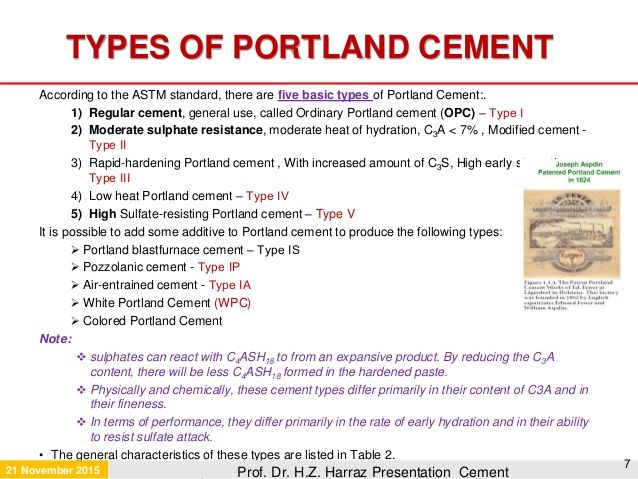
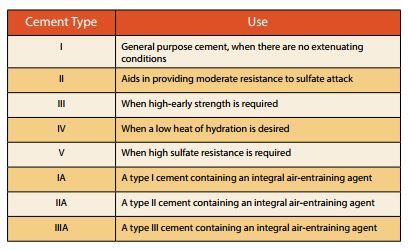
Type I
Type II
Type III
Type IV
Type V
White
Information
- Description
- Other Subjects Note on Cement Industry - created from Mind Map, created by Abdou Mohamed on 13/12/2017.
- Created by
- Abdou Mohamed · Dec 2017
- Updated
- Feb 5, 2018
- Views
- 0
- History
-
- Created by Abdou Mohamed · Dec 13, 2017
- Copied to Note by Abdou Mohamed · Dec 13, 2017
- Rating