
Notes
Classification and vector spaces
Content of the notes (11)
Page 1
Sentiment analysis :
say you have 1000 product reviews :
go through the product review and classify how much % is good and how much is bad?
In the first week, you'll learn how to represent text as a vector and build a classifier that will classify whether a sample text is a positive sentiment or a negative one. You will use logistic regression for that
In the second week, you'll use the Naive Bayes classifier on the same problem. I
In the third week, you'll learn about vector space models. You'll learn how to represent text documents like tweets, articles, queries, or any object that contains of text as a vector. This is important in information retrieval, in indexing, in relevancy ranking, and also in information filtering.
Finally, in week 4, you will build your first simple machine translation system and you'll make use of locality sensitive hashing to improve the performance of nearest neighbor search.
Page 2
hSupervised ML : input variable X: Output variable : Y
Sentiment analysis of tweet :
Input is the tweet : "I am happy learning the NLP"
Output variable Y : Positive -1; Negative - 0;
so we can use the Logistic regression;
process :
how do you do that?
you have input : X
then you define prediction function : made of parameters : theta
prediction output : Y-cap;
Cost = Y predicted - Y actual;
then update your parameters :
so that the cost is minimized
this process of updating the theta parameters in the prediction function to minimize cost is called "Training"
Page 3
How to extract feature from a Tweet?
First you build a vocabulary of all unique words from all tweets : call it V
I am happy learning NLP
I hate History
V =[ I , am , happy, learning, NLP, hate, History]
then : for a particular tweet say,
Ex.,
I am happy learning NLP
feature represtnation goes like this :
for every word in vocabulary assign 1; for every word in vocabulary not in tweet assign 0
[1 1 1 1 1 0 0 0]
so logistic regression : will be n+1 model ???, where n is size of vocabulary
Page 4
create a corpus of 4 tweets : both positive and negative tweets
create a vocabulary out of 4 tweets
now take positive tweets:
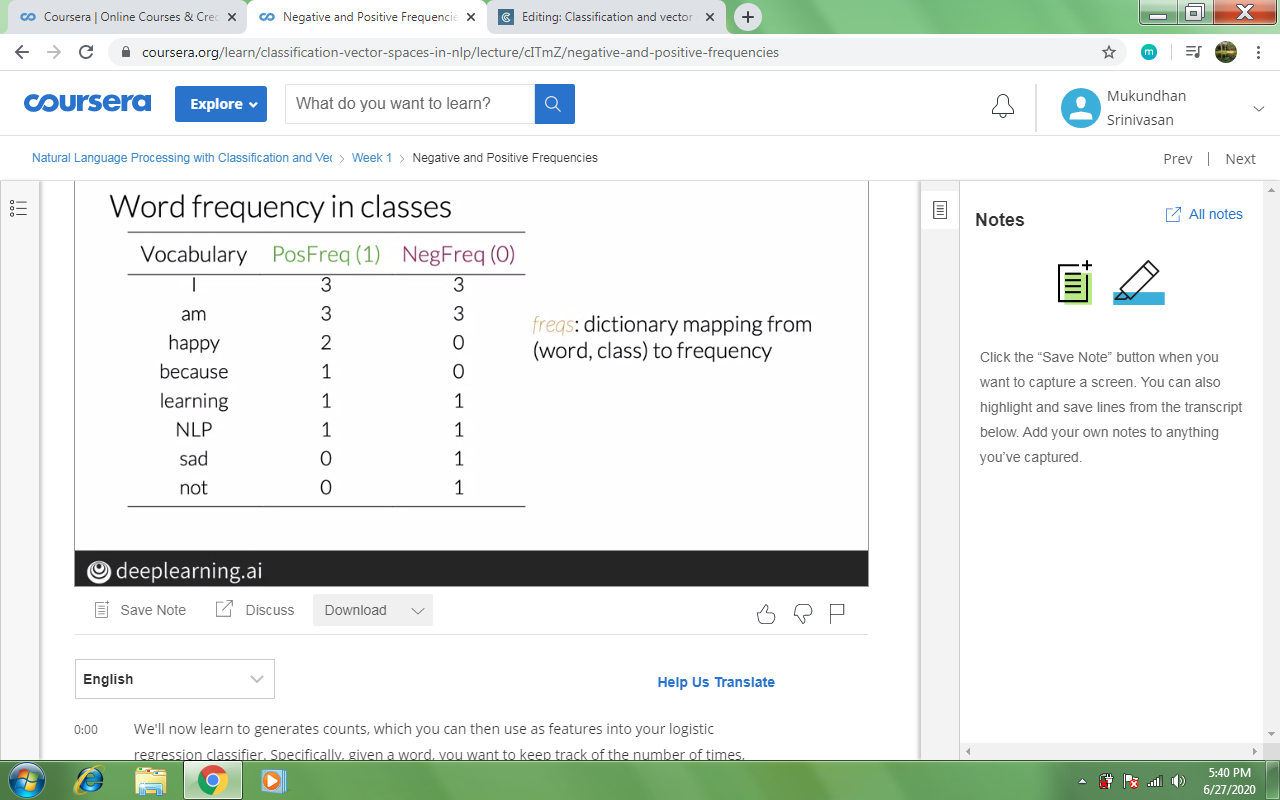
and count the frequency of each word in vocabulary:
similarly
take negative tweets :
and count the frequency of each word in vocabulary:
see example below :
Page 5
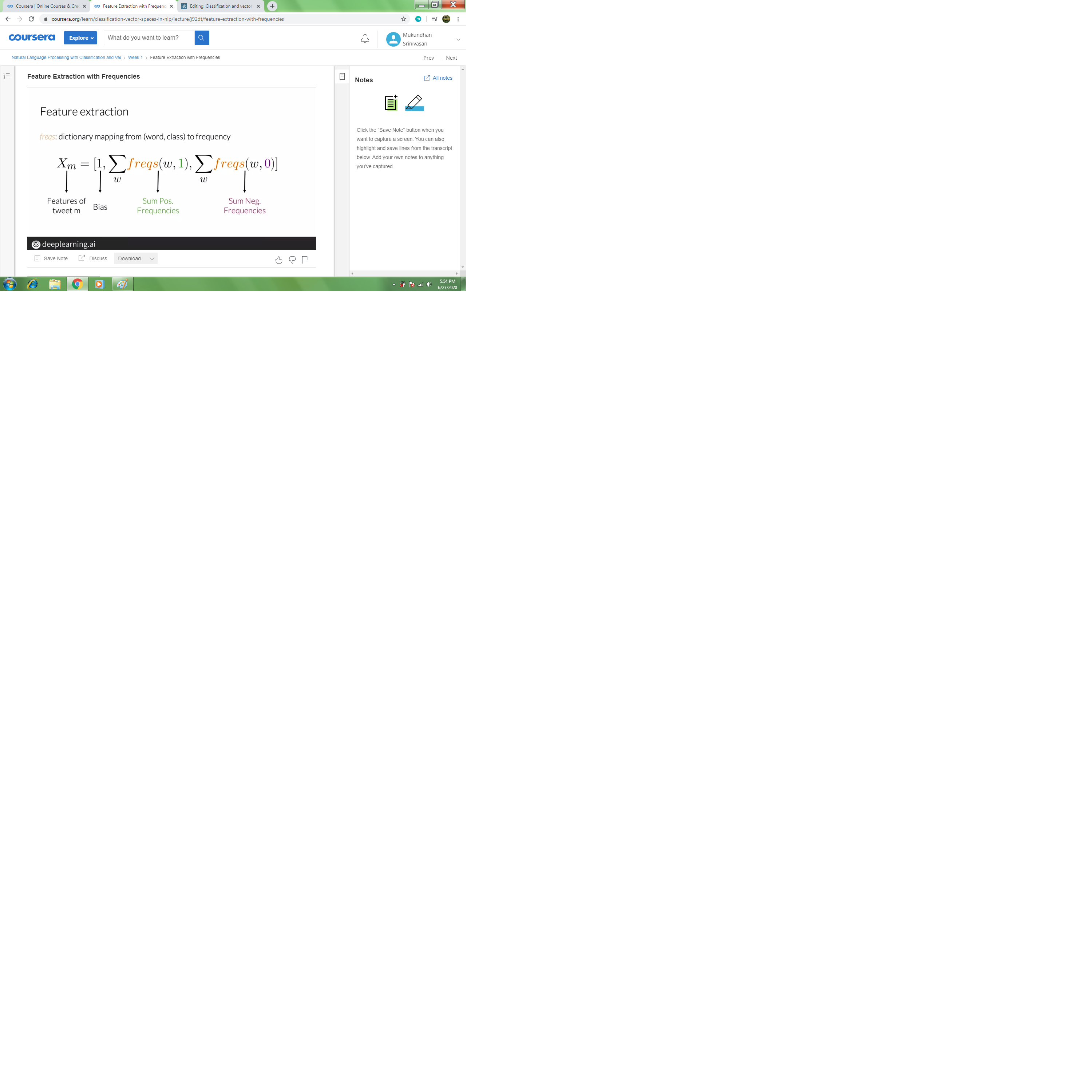
Feature extraction:
you need to represent a tweet as vector of 3 :
for a particular tweet :
I am sad i am not learning NLO
[1 , count of positive frequency for each word, count of negative frequency for each word]
Answer : [1,8,11]
Page 6
Preprocessing:
one of the thing you need to do with text is to : preprocess:
consists of following steps:
removing words like and , is, or,
removing punctuations
lower case:
removing special characters
stemming :
ex., tuning GREAT AI Models!!!
stemming : tuning => tun which can be related to tune,tuning, tuned
GREAT => great
AI => ai
tun great ai models
Page 7
Algorithm to build X matrix:
build vocabulary:
create frequency dictionary mapping
take tweet:
I am happy learning NLP @deeplearning
|
preprocess
|
[happy,learn,nlp]
|
X vector => [1,sum of number of positive tweets, sum of number of negative tweets]
=> [1,4,2]
so for 'm' number of tweets => you will have matrix of size : m x 3 :
[1 X1(1) X1(2) , 1 X2(1) X2(2) , ..... 1 Xm(1) Xm(2)]
So Algorithm is :
#build frequencies dictionary
freqs = build_freqs (tweets, labels)
X = np,zeroes((m,3)) ; initialize matrix m
for i= 1 to m :
process every tweet to fill matrix X
X[i,:] = extract_features
Page 8
Next is to use extracted features X in Logistic Regression:
X => Function (of Theta) => Output Y -cap = > Cost = Output Y - Label Y => update theta to minimize cost
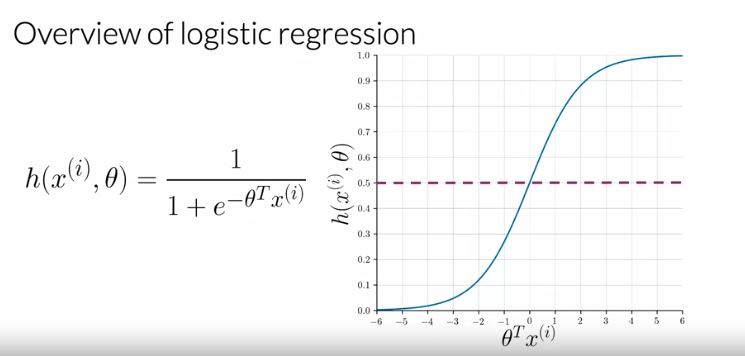
in logistics regression : Function F -> Sigmoid function:
F : h (xi) , theta) = 1/(1 + exp( -Theta transpose * x(i))
so you train theta , using training data to reduce cost function
Page 9
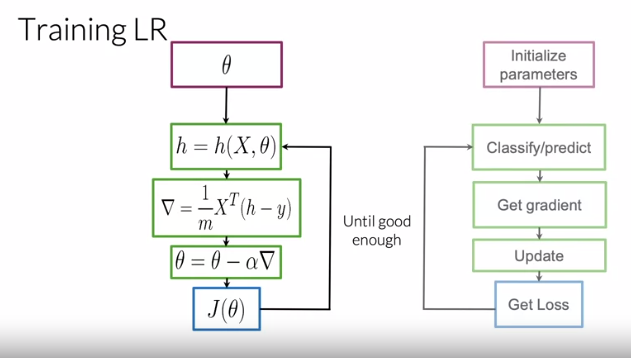
Initialize Theta parameters :
use logistic function :
find Y-cap:
Get gradient:
Update Theta
Get loss
Iterate
Page 10
testing logistic regression:
get X val and Y val and Theta : for training tweets
then
use sigmoid function on Xval
pred = h(Xval, Theta) > = 0.5 ;
so, pred = 1; if h < 0.5
pred =1 ; if h>=0.5
now do that for m tweets;
compare : prediction to Y val;
if both are equal : create a new vector => 1 ; you predicted right for the tweet
if prediction not equal to Y => vector value = 0 you predicted wrong for
so for m tweets => [1 0 1 1 0] ;
acciracy = sum of 1s / m = 3/4 = 60%
Page 11
Information
- Description
- Natural Language Processing Note on Classification and vector spaces, created by Mukundhan Srinivasan on 27/06/2020.
- Created by
- Mukundhan Srinivasan
- Views
- 2
- Rating