
Notes
Naive Bayes
Content of the notes (7)
Page 1
Probabilities :
say total of 20 tweets
A => positive tweet : 12 tweets
B => contains word happy;
P(A) = 12/20 = .6
P(B) = 4/20 = .2
probability that : tweet is positive and contain word happy: say 3 tweets :
P(AnB) = 3/20 = .15
Page 2
Conditional probability:
Probability of event A given B happened: P(A|B)
= P(AnB)/P(B)
Probability of event B given A happened: P(B|A)
= P(AnB)/P(A)
Bayes Rule:
P(A|B) = P(B|A) *P(A) / P(B);
Suppose that in your dataset, 25% of the positive tweets contain the word ‘happy’. You also know that a total of 13% of the tweets in your dataset contain the word 'happy', and that 40% of the total number of tweets are positive. You observe the tweet: ''happy to learn NLP'. What is the probability that this tweet is positive?
P(happy) = .13
P(happy|positive) = .25
P(positive) = .4
P(positive |happy) = P(happy|positive) * P(positive)/P(happy)
= .25*.4 /.13 = .1/.13 = .77
Page 3
Naive Bayes :
Supervised Machine Learning: ?
it is called Naive , hehehe, because features you are using for classification are independent : which may not be the case
Naive -Bayes Steps:
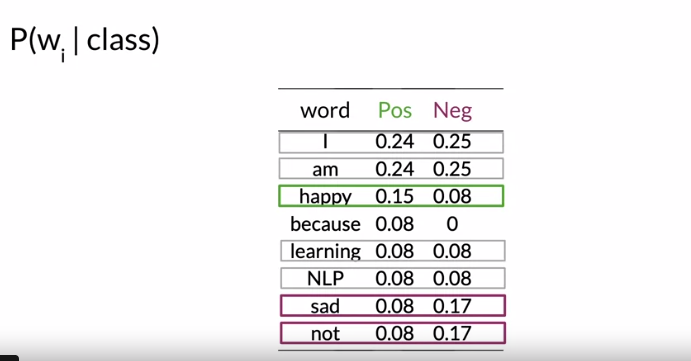
Do the work frequency map for postive and negative tweets
sum the positive words and negative words
divide the frequency by the sum : you get the probabaility ; and if you sum all postive word probability you get 1
similarly for negative tweets
now look at word and see which of them have equal prbability in postive and negative : ex., learnign they do not add to the sentiment
look at word happy : it has more probability of being postive rather than sad
look at word because : it has negative probability zero :
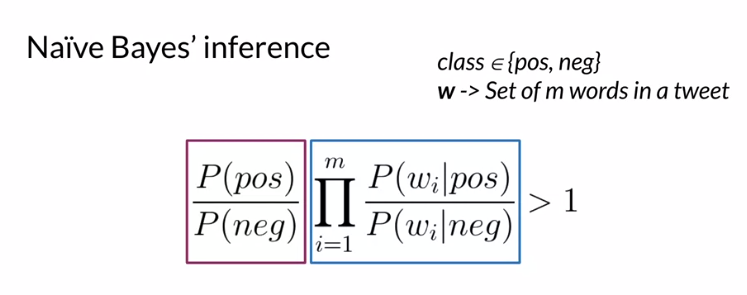
next we use something called : naive-bayes inference condition rule for binary classifciation - see picture below
whats that man? oh man ? throwing jargons man ....hehehehehe
it is this : it is this : it is this:
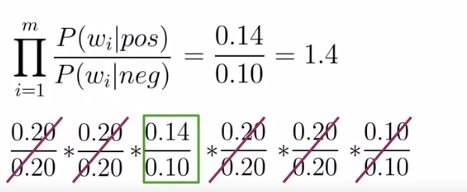
given a new tweet : for example : I am happy today I am learning
for each word in tweet : compute p(word|positivie) / p(word|negative) ;
multiply all of them:
if outcome > 1, its more likely positive tweet
in our example, it is 1.
Page 4
problem with Naive-Bayes method : one of the words because : has zero probability;
so what can you do is :
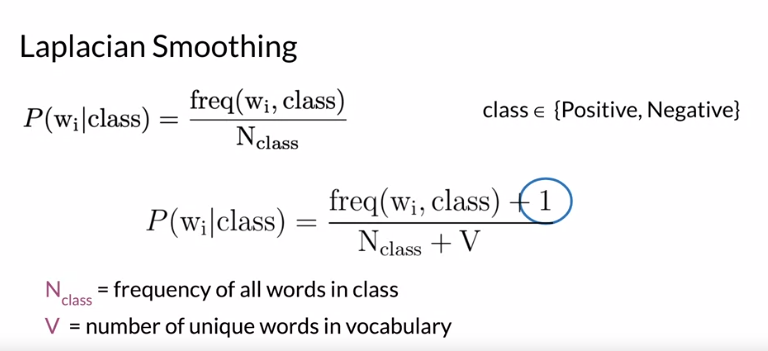
use laplacian smoothing :
oh man another jargon here :
ok fine and take care and do well and take care and do well ;
what is thing thingy called laplacian smoothing :
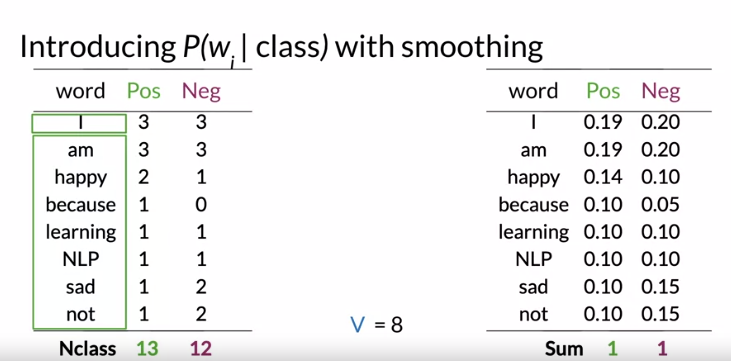
see below : pics;
because of the laplacian smoothing , the word because : probability is now non zero!
Page 5
earlier we saw that : Naive Bayes inference on how to asses positive vs negative tweets:
a: get the conditional probability of word in current tweet being positive
b : get the conditional probability of word in current tweet being negative
divide a/b;
multiply all probabilities :
and then : you have to multiply : P(pos) tweets/P (negative tweets)
Page 6
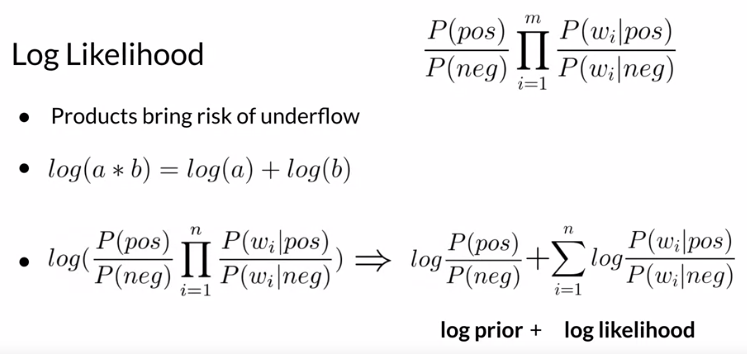
Now the issues : when Vocabulary is huge : the probability numbers can be very small ;
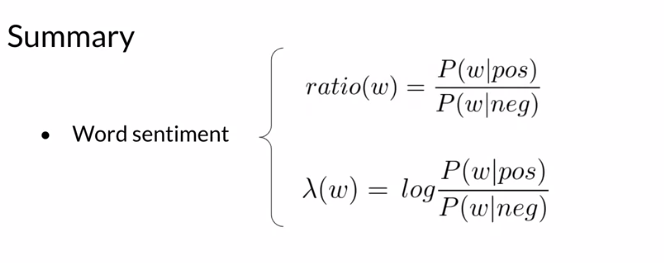
to deal with this we use log likelihood :
and we call this lambda:
compute lambda for each word :
and sum it up ;
and then add log P(pos)/P(neg)
Page 7
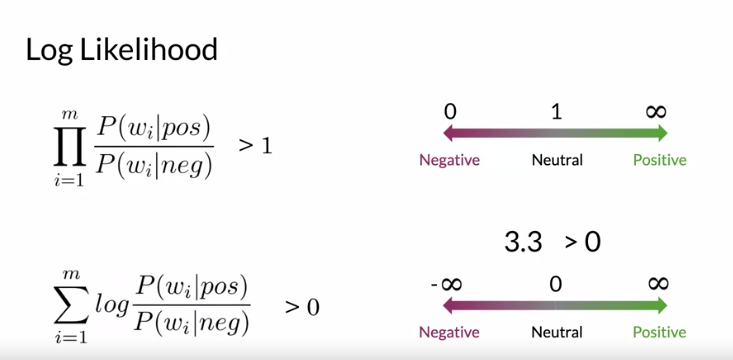
in likelihood : Neutral has scale 1 : anything positive : is positive sentiment
negative sentiment !!!
in log likelihood : neutral is Log 1 = 0;
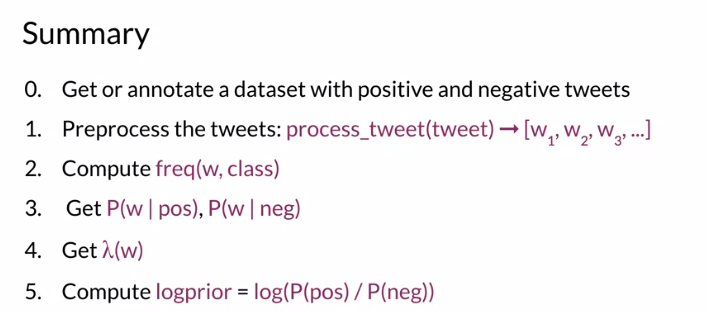
look at picture fro the algorithm for implementing : Naive Bayes algorithm:
Information
- Description
- Natural Language Processing Note on Naive Bayes, created by Mukundhan Srinivasan on 05/07/2020.
- Created by
- Mukundhan Srinivasan
- Views
- 1
- Rating