
Description


|
Created by Chloe Wood
over 4 years ago
|
|
Page 1
Surface-Area to Volume Ratio: Surface-Area to Volume ratio is a main factor that affect the movement of substances. The rate of diffusion, osmosis and active transport is higher in cells with a larger surface area to volume ratio as there is more room for the reaction to occur.
Plant Transport Systems and Transpiration: The Xylem and Phloem are the transport vessels of the plant. Phloem: Phloem transports food. Made of columns of living cells that have perforated end-plates to allow substances to flow through. They have no nucleus, meaning that they cannot survive on their own and have a companion cell. These cells carry out the living functions for both cells. Phloem vessels transport food substances e.g. sugars both up and down the stem to growing and storage tissue. This movement is known as translocation. Xylem: Xylem takes water up. Made up of dead cells joined end to end with no end walls between them and a hole down the middle called the lumen. The thick side walls are made of cellulose which makes it strong and stiff, giving the plant support. The cell walls are also strengthened. They carry minerals and water from the roots up the shoot to the leaves in transpiration.
Page 2
Transpiration: Transpiration = the loss of water from the plant. Caused by the evaporation and diffusion of water from a plant’s surface. Most transpiration happens at the leaves. Evaporation and diffusion creates a slight shortage of water in the leaf and so more water is drawn up from the rest of the plant through the xylem vessels to replace it. Meaning that more water is drawn up from the roots and there’s a constant transpiration stream of water through the plant. Positives of transpiration: The constant stream of water from the ground helps to keep the plant cool. Provides the plant with a constant supply of water for photosynthesis. The water creates turgor pressure in the plant cells which help to support the plant. Minerals needed by the plant can be brought in from the soil with the water. Transpiration Rate is affected by three main things: An increase in light intensity - the brighter the light, the greater the transpiration rate. Bright light increases the rate of photosynthesis causing the stomata to open and let carbon dioxide in. Stomata begin to close as it gets darker because photosynthesis can’t happen in the dark. When the stomata are closed, water can’t escape and transpiration does not happen. An increase in temperature - the warmer it is, the faster transpiration happens. When it’s warm, the water particles have more energy to evaporate and diffuse out of the stomata and so transpiration occurs. An increase in air movement - if there is lots of wind around a leaf, transpiration happens faster. If the air is very still, the water vapour surrounds the leaf, not moving away. This means there is a high concentration of water particles outside the leaf as well as inside it, so diffusion doesn’t happen as quickly. If it is windy, the water vapour is swept away, maintaining a low concentration of water in the air outside of the lead. Diffusion then happens quickly from an area of higher concentration to an area of lower concentration.
Page 3
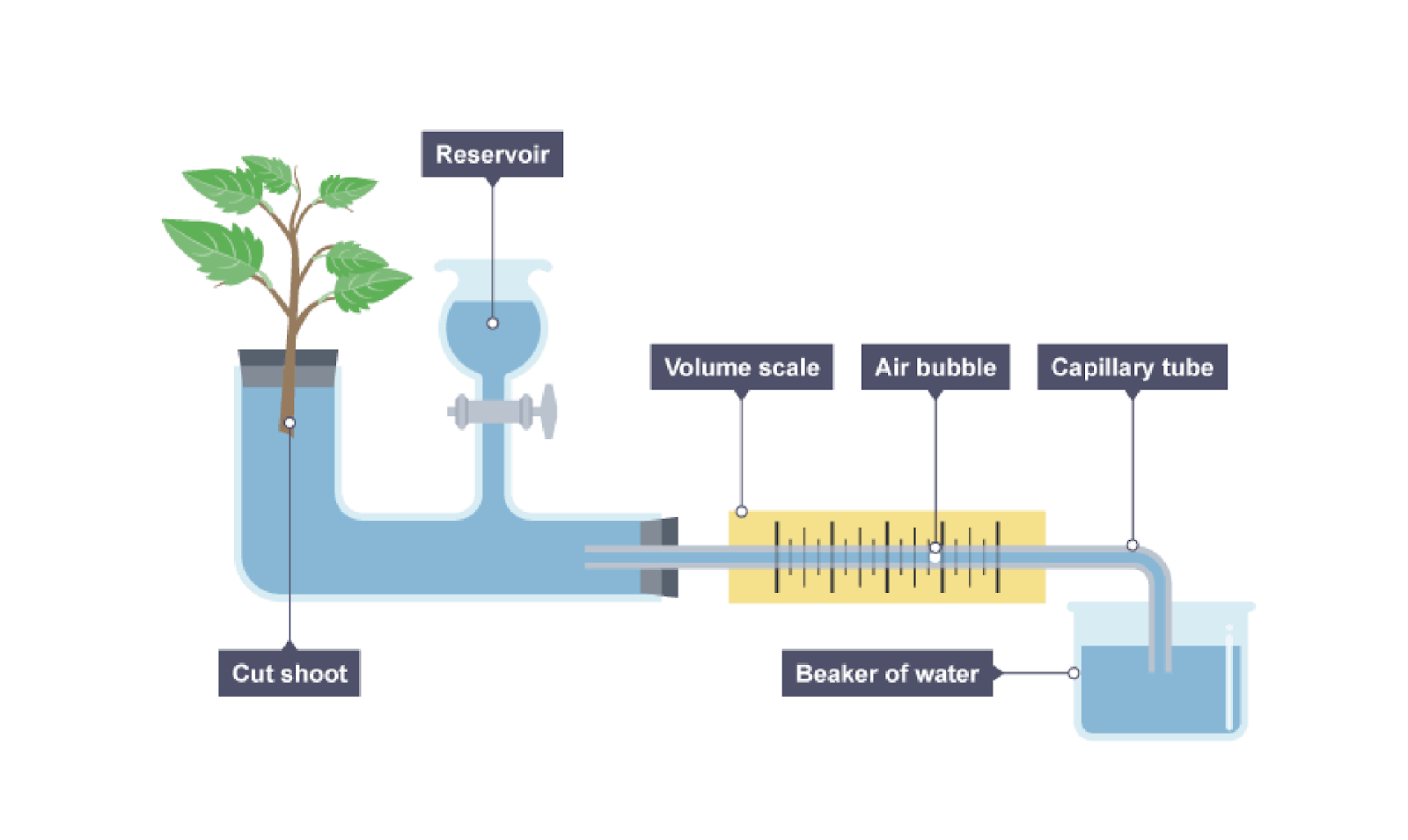
Investigating Transpiration: A potometer can used to estimate transpiration rate. It is a piece of apparatus that measures water uptake by a plant. Cut a shoot underwater to prevent air from entering the xylem. Cut it at a slant to increase the surface area available for water uptake. Assemble the potometer in water and insert the shoot underwater so no air can enter. Remove the apparatus from the water but keep the end of the capillary tube submerged in a beaker of water. Check that the apparatus is watertight and airtight. Dry the leaves, allow time for the shoot to acclimatise and then shut the tap. Remove the end of the capillary tube from the beaker of water until one air bubble has formed, then put the end of the tube back into the water. Record the starting position of the air bubble. Start a stopwatch and record the distance moved by the bubble per unit time. Calculating the speed of air bubble movement gives an estimate of the transpiration rate: distance moved/time taken. Keep the conditions constant throughout the experiment e.g. temperature. How can you see how environmental conditions affect transpiration rate? You can use a potometer to estimate how different factors affect the transpiration rate. The set up is your control. You can vary an environmental condition, run the experiment again and compare the results to the control to see how the change affected the transpiration rate. Light intensity - use a lamp to increase the intensity of the light that hits the plant. This should increase the transpiration rate. To decrease the light intensity, put the potometer in a cupboard which should decrease the transpiration rate. Temperature - increase or decrease the temperature by putting the potometer in a room that’s warmer or colder than where you did the control experiment. An increase in temperature should increase the transpiration rate. Air movement - use a fan to increase the air movement around the plant, this should increase the transpiration rate.
Page 4
Stem Cells: Stem cells can differentiate into different types of cells. Stem cells are undifferentiated cells. Depending on what instructions they are given, they can divide by mitosis to become new cells which then differentiate. Embryonic stem cells are found in early human embryos and have the potential to turn into any kind of cell at all. This means that stem cells are important for the growth and development of humans. Adults also have stem cells in bone marrow. These aren’t as adaptable as embryonic stem cells as they can’t turn into any type of cell, only certain ones from the tissue that they originally came from. In animals, human stem cells are used to replace damaged cells e.g. to make new skin or blood cells. Plant Stem Cells: In plants, the only cell that can divide by mitosis are found in plant tissues called meristems which is found in the areas of a plant that are growing e.g. roots. They produce unspecialised cells that are able to divide and form any cell type in the plant, like embryonic stem cells. However, these cells can divide to generate any type of cell for as long as the plant lives. The unspecialised cells can become specialised and form tissues like xylem and phloem.
Page 5
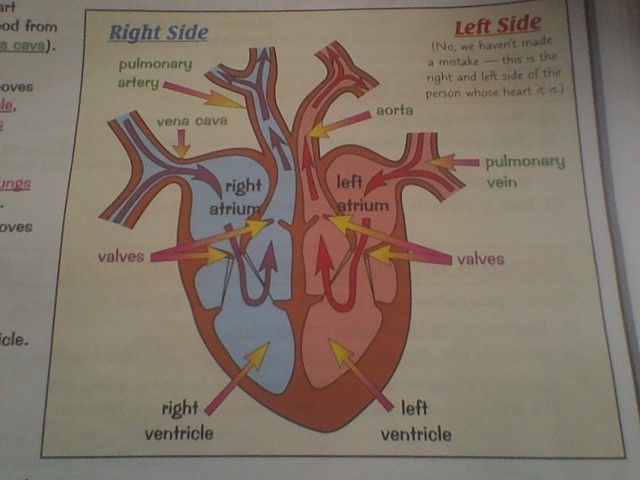
Structure of the Heart: The heart has valves to make sure that blood flows in the right direction. When the ventricles contract, the valves to the atria close and the valves to the blood vessels open. This prevents back flow. This is how the heart uses its four chambers (right and left atria and ventricles) to pump blood around: Blood flows into the two atria from the vena cava and the pulmonary vein. The atria contract, pushing the blood into the ventricles. The ventricles contract, forcing the blood into the pulmonary artery and the aorta and out of the heart. The blood then flows to the organs through arteries and returns through veins. The atria fill again and the whole cycle starts over. Blood is supplied to the heart by two coronary arteries which branch from the base of the aorta.
Page 6
The Blood Vessels: There are three main types of blood vessels: Arteries - these carry blood away from the heart. Capillaries - these are involved in the exchange of materials at the tissues. Veins - these carry blood to the heart. Arteries: The heart pumps blood out at high pressure so the artery walls are strong and elastic. The walls are thick and contain layers of muscle to make them strong and elastic fibres to allow them to stretch and spring back. Capillaries: Capillaries are really small. They carry the blood very close to every cell in the body to exchange substances with them. They have permeable walls so substances can diffuse in and out. They supply food and oxygen but take away waste like carbon dioxide. Their walls are usually only one cell thick, increasing the rate of diffusion by decreasing the distance over which it occurs. Veins: The blood is at lower pressure in the veins so the walls don’t need to be as thick as artery walls. They have a bigger lumen than arteries to help the blood flow despite the lower blood pressure. They also have valves to help keep the blood flowing in the right direction.
Want to create your own Notes for free with GoConqr? Learn more.