
Notes
Glacial Processes
Content of the notes (3)
Page 1
Glacial Erosion
Glaciers break down rock through freeze-thaw action.
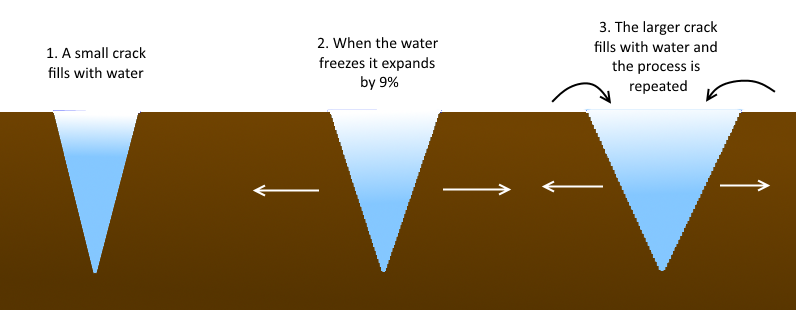
This follows the same process as freeze-thaw weathering:
Small cracks in the rock surface fill with water from precipitation or melted ice
As temperatures drop, the ice on the surface is the first to freeze over
When the rest of the ice freezes, it expands, putting pressure on the rock and causing the crack to become bigger
This process is repeated as the larger cracks fill with water and freeze
Plucking often accompanies this process when glaciers are involved.
As a glacier move through a valley, pressure is put on the valley sides and bottom.
The friction from this creates heat, causing the edge of the glacier to melt.
Meltwater fills cracks in the rock surface and freezes.
As the glacier continues to move, it drags this ice with it, pulling away some of the rock.
As the rock is carried by the glacier, it can scrape away at the side of the valley and erode it.
This process is called abrasion.
Very large boulders being carried by the glacier can do more damage than smaller ones.
Page 2
Transportation
Glaciers transport supraglacial and englacial debris.
Supraglacial debris is carried on the surface of the glacier.
Englacial debris is carried in the main body of the glacier.
The front of a glacier is called its snout. This acts as a bulldozer.
Glaciers move due to gravity.
Due to friction, glacier ice usually moves on a film of meltwater.

Page 3
Deposition
During summer months, higher temperatures cause glaciers underneath the snow line (where snow falls) to melt.
When this occurs, meltwater will usually pour out of the glacier's snout, creating meltwater rivers.
These rivers carry huge amounts of sediment called glacial outwash.
This sediment undergoes further erosion by attrition, reducing the particle size.
Despite the melting of the glacier, the snout does not usually retreat.
The sediment in the glacier acts as if on an escalator, constantly moving down.
Meltwater deposits the fine sediment when it loses energy.
This fine sediment is called glacial till.
Information
- Description
- User has deleted their subject information Note on Glacial Processes, created by Deleted user on 23/06/2017.
- Created by
- Deleted user · Jun 2017
- Updated
- Jun 23, 2017
- Views
- 35
- History
-
- Created by Antonia Blankenberg · Jun 22, 2017
- Copied by Antonia Blankenberg · Jun 23, 2017
- Rating