
Notes
Fertilisers

Content of the notes (2)
Page 1
Use of fertilisers
Without the production of ammonia for use in fertilisers, we would not be able to feed the world's population.
Fertilisers increase crop yield by:
Replacing essential elements used by a previous crop, especially nitrogen, phosphorus and potassium.
Providing extra essential elements
More nitrogen gets incorporated into plant protein, leading to more growth.
However, overuse of nitrogenous fertilisers can harm the environment.
Lakes and rivers can suffer from eutrophication.
Page 2
Production of fertilisers
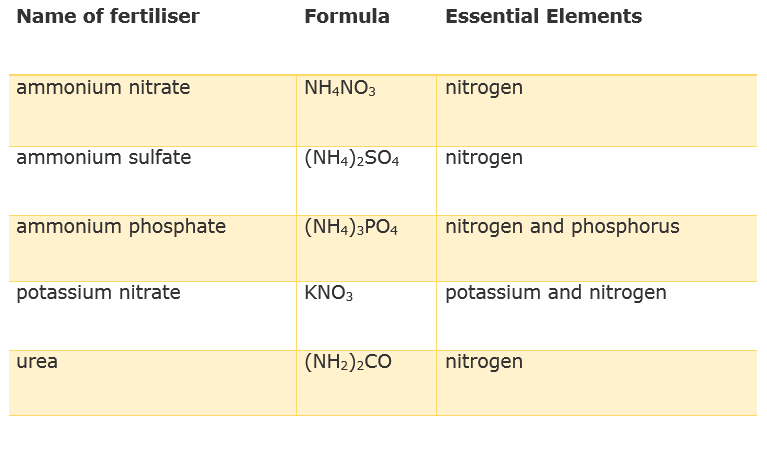
Ammonia is used to produce fertilisers by reacting it with either sulfuric or nitric acid to produce ammonium sulfate or nitrate respectively.
The name of a fertiliser can indicate what elements are involved in its production. (See table below)
Preparation of fertiliser in the lab - Reaction of an acid with an alkali
A quantity of alkali is placed in a beaker and a solution of acid is run in until the solution is neutral.
This can be measured with a pH meter or by removing samples for testing with universal indicator.
The neutral solution of salt is evaporated until crystals form.
These are filtered out, washed and dried in a warm oven.
Industrial preparation of fertiliser:
Ammonia is manufactured by the Haber process
Sulfuric acid is manufactured by the contact process
Ammonia is treated with sulfuric acid to form the fertiliser
The process happens on a much larger scale
Information
- Description
- User has deleted their subject information Note on Fertilisers, created by Deleted user on 26/07/2017.
- Created by
- Deleted user
- Views
- 31
- History
-
- Created by Niamh Ryan · Jul 20, 2017
- Copied by Niamh Ryan · Jul 26, 2017
- Rating