
Notes
Titrations and Solutions
Content of the notes (6)
Page 1
Standard Solutions and Primary Standards
Standard solution: A solution whose concentration is accurately known.
A standard solution is prepared by dissolving an accurately weighed mass of a primary standard into water.
Primary standard: A substance used to make a standard solution by weighing
Primary standards should:
Be solids with high molar masses
Be available in a high degree of purity
Be chemically stable
Not absorb water from the air
Be soluble in water
React rapidly and completely with other substances when used in titrations
Page 2
Making a standard solution
It is important that you know the steps involved in preparing an accurate standard solution.
An example of a primary standard frequently used in acid-base titrations is sulfamic acid.
Preliminary Calculations:
You need to be able to calculate approximately how much primary standard you will need. This can be done using the formula \[n= c \times V\] \[m=n \times M\] These calculations let you know how much mass you will need for the volume of solution you are preparing.
Method:
Add roughly the amount of mass that you have calculated you need to the weighing bottle, noting accurately how much is actually used. (Mass 1)
Transfer as much of the acid as possible to a clean beaker and weigh the weighing bottle again. (Mass 2)
Add deionised water to the beaker and stir until all of the acid has dissolved.
Wash traces of the solution from the rod into the beaker using the wash bottle.
Place a funnel in the neck of the volumetric flask and transfer the solution from the beaker to the volumetric flask.
Rinse the inside of the beaker several times with the wash bottle and transfer the rinsings to the flask.
Add deionised water to the flask and make up exactly to the graduation mark. Make sure the lowest part of the liquid, known as the meniscus, is aligned with the graduation mark.
Stopper the flask and invert it several times.
Further Calculations:
\( \text{Mass 2} - \text{Mass 1} = \text{Mass of sulfamic acid added to beaker}=m\)
\[\frac{m}{M \times V}= c \]
This method allows you to obtain a solution of very accurately known concentration. This solution can be titrated against other solutions so that their concentrations can also be accurately known.

Page 3
Carrying out Titrations
Method outline:
Rinse conical flask with deionised water and place it on the white tile.
Rinse the pipette with deionised water. Rinse it with some of the alkali solution and then use a pipette filler to transfer \(25cm^3\) of solution to the conical flask. Add a few drops of indicator.
Rinse the burette with deionised water and then with the acid solution - make sure to also rinse the area beneath the tap.
Use a funnel to fill the burette up to the zero mark. Remove the funnel and adjust the amount of solution until the bottom of the meniscus, viewed at eye level, sits exactly on top of the zero mark. Place burette in retort stand
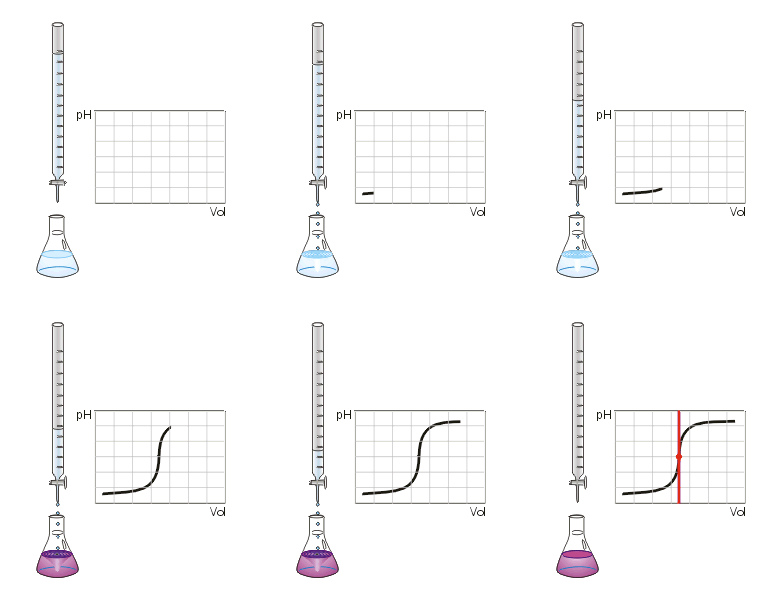
Add acid steadily at first, and then dropwise when you are approaching the equivalence point you have calculated. Swirl the conical flask all the time to ensure that the solution is fully mixed and there is no unreacted acid on the walls of the conical flask.
When the indicator just changes colour, stop adding acid. Ensure the tap is fully close and record the titre - the position of the bottom of the meniscus.
Rinse the conical flask with deionised water and repeat the above steps again until you obtain concordant titres.
Titration techniques:
Use a white tile - Makes the colour change easier to see
Add about 3 drops of indicator - Many indicators are acids/bases themselves and so adding touch much of them could change the pH of the solution in the conical flask
Fill the burette so that the space between the tap and the tip is full of solution - This prevents air bubbles from forming below the tap which would affect the accuracy of the burette measurement
Tip of burette inside neck of conical flask - Prevents any solution from burette going onto outside of conical flask
Record burette reading to the nearest half of a small division, using a light background to see the meniscus - Increases accuracy
Add sulfamic acid solution steadily at first and then drop by drop, swirling the conical flask all the time - Decreases the chance of overshooting the end point Swirling ensures continuous mixing of the two solutions
Stop adding solution just after colour change - Increases accuracy
Repeat to obtain concordant results - Increases accuracy
Rinsing pipette, burette and conical flask (Described below) - Makes sure we know the exact amounts of each substance being placed in each of the containers, preventing errors from being introduced
Page 4
Preparing the apparatus
Rinsing the apparatus:
Pipette and burette: Rinse with deionised water and the solution to be used
Conical flask: Rinse with deionised water only
Rinsing with water ensures that there are no contaminants in the apparatus that could affect the titration.
Rinsing with the solution to be used makes sure all of the water is removed after the first rinsing. If some water were left behind, it would dilute the solution placed in the pipette and burette which could decrease the accuracy of concentration calculations.
If the conical flask were to be rinsed with the sodium hydroxide solution, there would be an unknown extra amount of substance being titrated, which would introduce an error.
Choosing an indicator:
For some titrations, any indicator can be used while others will not be compatible with certain indicators.
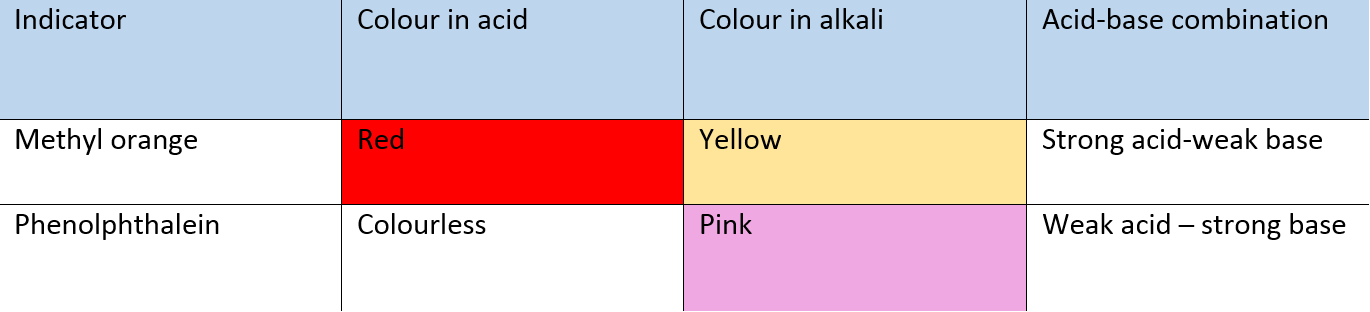
Two common indicators include methyl orange and phenolphthalein (Don't spell this wrong!). Both can be used in strong acid-strong base titrations. However, when one of either the acid or base is weak and the other is strong, a specific indicator is needed.
Page 5
Titration Calculations
1. Calculating the average titre
When calculating the average titre for use in your calculations, only use ones that are concordant, i.e. that agree within 0.20 \(cm^3\).
The first titration usually isn't concordant - its very easy to overshoot the endpoint when you don't know what you're aiming for.
2. Calculating concentration
An important formula that will enable you to solve all titration problems is: \[\frac{M_1 \times V_1}{n_1} =\frac{M_2 \times V_2}{n_2}\] where \(M\) is the molar concentration and \(n\) is the coefficient in the equation. The subscripts refer to substances 1 and 2.
You will know \(V_1\) and \(V_2\) - one is the amount that you put in the conical flask, the other is the average titre. \(n_1\) and \(n_2\) are known from the equation. \(M_1\) should be accurately known because we have prepared a standard solution. Therefore, the only variable that remains to be found is \(M_2\).
Example 1:
Sulfamic acid and sodium hydroxide react together according to the following equation: \[NaOH(aq) + NH_2SO_3H(aq) \rightarrow NH_2SO_3Na(aq) +H_2O(l)\] The coefficients on both the sodium hydroxide and the sulfamic acid are one - therefore, both \(n_1\) and \(n_2\) will be one.
The following are the results obtained:
Volume of sodium hydroxide used: 25.0\(cm^3\)
Average titre: 22.65\(cm^3\)
Concentration of sulfamic acid solution: 0.0985 \(mol \text{ }dm^{-3}\)
Subbing into the formula gives \[\frac{M_1 \times V_1}{n_1} =\frac{M_2 \times V_2}{n_2}\]
\[\frac{0.0985 \times 22.65}{1} =\frac{M_2 \times 25.0}{1}\]
\[\frac{0.0985 \times 22.65}{25.0} = M_2\]
\[0.0892 mol \text{ }dm^{-3} = M_2\]
In this case, you don't need to worry too much about your units, as long as you are consistent. Both of the volume measurements are in \(cm^3\) - this is consistent. The concentration given is in \(mol \text{ }dm^{-3}\) so the answer will be in \(mol \text{ }dm^{-3}\).
Page 6
Example 2
Example 2:
A student reacts potassium hydroxide and sulfuric acid. The following results are obtained:
Volume of potassium hydroxide: \(25.0cm^3\)
Volume of sulfuric acid: \(19.83 cm^3\)
Concentration of sulfuric acid: \( 0.0618 mol \text{ }dm^{-3}\)
What is the concentration of the potassium hydroxide in \(g \text{ }dm^{-3}\)?
Answer:
Potassium hydroxide and sulfuric acid react according to the following equation:\[2KOH + H_2SO_4 \rightarrow K_2SO_4 + 2H_20\]
Subbing into the formula gives \[\frac{M_1 \times V_1}{n_1} =\frac{M_2 \times V_2}{n_2}\]
\[\frac{0.0618 \times 19.83}{1} =\frac{M_2 \times 25.0}{2}\]
\[\frac{0.0618 \times 19.83 \times 2}{25.0} = M_2\]
\[0.098 mol \text{ }dm^{-3} =M_2\]
The concentration given in the question was in terms of \(mol \text{ }dm^{-3} \), so the answer for the calculations must also be in terms of \(mol \text{ }dm^{-3}\). To convert to \(g \text{ }dm^{-3}\), multiply the calculated concentration by the molecular mass of potassium hydroxide.
\[0.098 \times 56.11 = 5.5 g \text{ }dm^{-3} =M_2\]
This comes from the formula \[Moles = \frac{Mass}{\text{Molecular mass}}\] \[ \implies Mass = Moles \times \text{Molecular mass}\]
Information
- Description
- User has deleted their subject information Note on Titrations and Solutions, created by Deleted user on 14/08/2017.
- Created by
- Deleted user
- Views
- 56
- History
-
- Created by Niamh Ryan · Aug 8, 2017
- Copied by Niamh Ryan · Aug 14, 2017
- Rating