
Notes
Physics - Energy and Motion
Content of the notes (5)
Page 1
Changes in energy stores
Conservation of energy
Energy and work
Gravitational Potential Energy stores
Kinetic energy and elastic energy stores
Energy dissipation
Vectors and scalars
Forces between objects
Resultant forces
Speed and distance - time graphs
Velocity and acceleration
More about velocity - time graphs
Analysing motion graphs
The parallelogram of forces
Resolution of forces
Equations needed for this test:
weight = mass x gravitational field strength W = mg
force applied to a spring = spring constant x extension F = ke
Acceleration = change in velocity / time taken a = change in v / t
Momentum = mass x velocity p = mv
GPE = mass x GFS X STRENGTH X HEIGHT Ep = mgh
Power = work done / time P = W/ t
Efficiency = useful power output / total power output
Density = mass / volume P = m / V
Work done = force x distance W = Fs
distance travelled = speed x time s = vt
resultant force = mass x acceleration F = ma
kinetic energy = 0.5 x mass x (speed)squared Ek = 1/2 mv(squared)
power = energy transferred / time P = E / t
Efficiency = useful output energy transfer / total input energy transfer
Page 2
Changes in energy stores
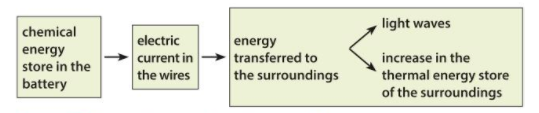
Chemical energy includes fuels, foods or chemicals found in batteries - energy is transferred during chemical reactions.
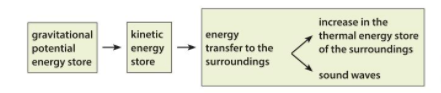
Kinetic energy stores describe the energy an object has because it is moving
Gravitational potential energy are used to describe the energy stored in an object because of its positions, such as an object above the ground.
Elastic potential energy stores describe the energy stored in a springy object when you stretch/squash it.
Thermal energy stores describe the energy a substance has because of its temperature.
Changes in energy stores in a torch lamp:
Changes in energy stores in a falling object:
Page 3
Conservation of energy
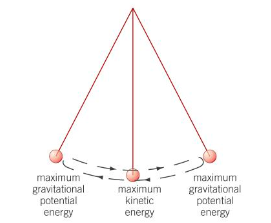
The total energy of a closed system is always the same before and after energy transfers to other energy stores within the closed system. (Closed system - No net change to the energy stored in the system)
A closed system is a system in which no energy transfers take place out of or into the energy stores of the system. However, energy can be transferred between energy stores, the total energy in the system is the same, before and after any transfers.
Result:
Energy cannot be created or destroyed
Energy can be stored in various ways:
When a rubber band is stretched - its elastic potential energy increases.
When an object is lifted - its gravitational potential energy store is increased.
Page 4
Energy and work
Work is done on an object when a force makes the object move.
Energy transferred = work done
W = F s where F is the force and s is the distance moved (along the line of action of the force).
Work done is to overcome friction is transferred as energy to the thermal energy stores of the objects that rub together snd to the surroundings.
Gravitational potential energy stores
The gravitational potential energy store of an object increases when it moves up and decreases when it moves down.
The gravitational potential energy store of an object increases when it is lifted up because work is done on it to overcome the gravitational force
The gravitational field strength at the surface of the Moon is less than on Earth.
Kinetic energy and elastic energy stores
Page 5
Information
- Description
- AQA GCSE REVISION - TOPICS : 1.1 - 1.6, 8.1 - 8.3, 9.1 - 9.4, 8.8 - 8.9
- Created by
- Kim Lam · Sep 2017
- Updated
- Jan 25, 2019
- Views
- 212
- Tags
- Rating