
Notas
General synaptic platicity
Conteúdo das notas (1)
Página 1
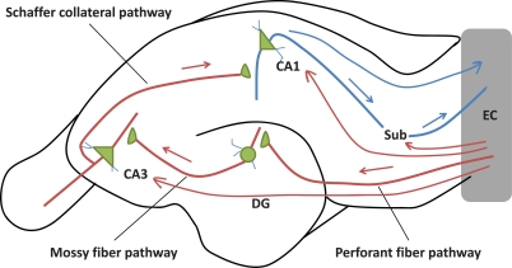
Figure 1: The Input and Output Pathways of Hippocampal Formation. Entorhinal cortex (EC) is the main input to the hippocampus. EC projects to the dentate gyrus (DG) via perforant fiber pathway and provides the critical input to CA3 via mossy fiber pathway, then to CA1 by means of the Schaffer collateral pathway. Additionally, EC can also project directly to CA3, CA1 and subiculum (Sub). Meantime, EC is the major output of the hippocampus. Arrows denote the direction of impulse flow.
CA3 has a positive feedback mechanism for amplification
Transmission through
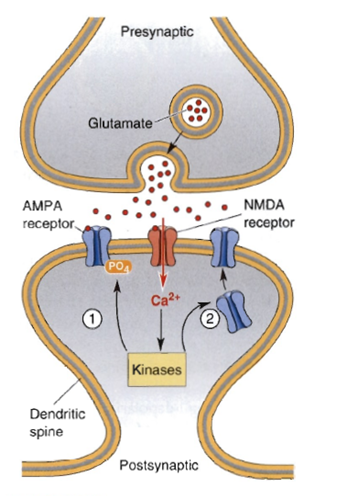
AMPA and NMDA receptors:
1.
Tettanic stimulation of the presynaptic neuron
will eventually lead to the release of glutamate into the synaptic cleft and
will bind to AMPA and NMDA receptors
2.
Binding to AMPA receptors open the channel and
allow an influx of Na ions which depolarise the postsynaptic terminal
3.
This depolarisation allows the displacement of a
blocking Mg+ ion from the NMDA channel and along with glutamate binding will
lead to the influx of Ca through the channel
4.
Ca activates 2 kinases: PKC and
calcium-calmodulin-dependent protein kinase II (CamKII) which leads to
mechanisms which increases the synapses response to stimulation by:
5.
Changes in synaptic structure>> increase
in dendritic spines
6.
Increasing the conductance of AMPA receptors by
phosphorylation (via CamKII/ PKC)
7.
Insertion of new AMPA receptors via exocytosis
(CamKII activated- see below)
hippocampal pathways
NMDA and AMPA
Informações
- Descrição
- Synaptic plasticity Notas sobre General synaptic platicity, criado por Cher Bachar em 03-05-2013.
- Criado por
- Cher Bachar · mai 2013
- Atualizado
- 22 nov 2016
- Visualizações
- 516
- Tags
- Avaliação