
Fluxograma
Labelling Crime and Deviance
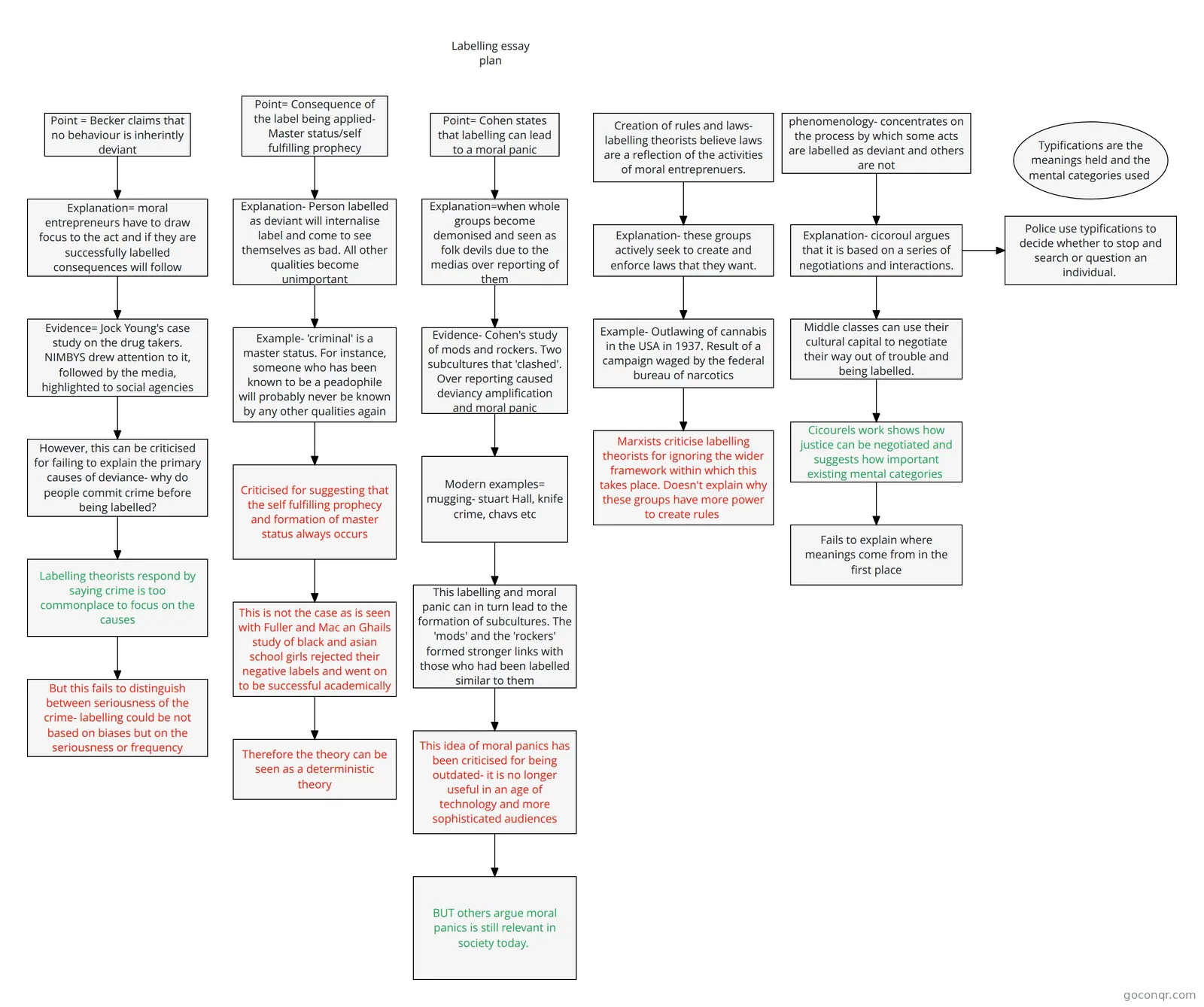
Flowchart: labelling crime and deviance
Conteúdo do fluxograma
Point = Becker claims that no behaviour is inherintly deviant
Labelling essay plan
Explanation= moral entrepreneurs have to draw focus to the act and if they are successfully labelled consequences will follow
Evidence= Jock Young's case study on the drug takers. NIMBYS drew attention to it, followed by the media, highlighted to social agencies
However, this can be criticised for failing to explain the primary causes of deviance- why do people commit crime before being labelled?
Labelling theorists respond by saying crime is too commonplace to focus on the causes
But this fails to distinguish between seriousness of the crime- labelling could be not based on biases but on the seriousness or frequency
Point= Consequence of the label being applied- Master status/self fulfilling prophecy
Point= Cohen states that labelling can lead to a moral panic
Creation of rules and laws- labelling theorists believe laws are a reflection of the activities of moral entreprenuers.
phenomenology- concentrates on the process by which some acts are labelled as deviant and others are not
Explanation- Person labelled as deviant will internalise label and come to see themselves as bad. All other qualities become unimportant
Example- 'criminal' is a master status. For instance, someone who has been known to be a peadophile will probably never be known by any other qualities again
Criticised for suggesting that the self fulfilling prophecy and formation of master status always occurs
This is not the case as is seen with Fuller and Mac an Ghails study of black and asian school girls rejected their negative labels and went on to be successful academically
Therefore the theory can be seen as a deterministic theory
Explanation=when whole groups become demonised and seen as folk devils due to the medias over reporting of them
Evidence- Cohen's study of mods and rockers. Two subcultures that 'clashed'. Over reporting caused deviancy amplification and moral panic
Modern examples= mugging- stuart Hall, knife crime, chavs etc
This labelling and moral panic can in turn lead to the formation of subcultures. The 'mods' and the 'rockers' formed stronger links with those who had been labelled similar to them
This idea of moral panics has been criticised for being outdated- it is no longer useful in an age of technology and more sophisticated audiences
BUT others argue moral panics is still relevant in society today.
Explanation- these groups actively seek to create and enforce laws that they want.
Example- Outlawing of cannabis in the USA in 1937. Result of a campaign waged by the federal bureau of narcotics
Marxists criticise labelling theorists for ignoring the wider framework within which this takes place. Doesn't explain why these groups have more power to create rules
Explanation- cicoroul argues that it is based on a series of negotiations and interactions.
Middle classes can use their cultural capital to negotiate their way out of trouble and being labelled.
Police use typifications to decide whether to stop and search or question an individual.
Typifications are the meanings held and the mental categories used
Cicourels work shows how justice can be negotiated and suggests how important existing mental categories
Fails to explain where meanings come from in the first place
Informações
- Descrição
- Essay plan in form of a flowchart
- Criado por
- Jess Bailey
- Visualizações
- 121
- Avaliação