
Flashcards
Chemistry - Anne Tindale (Chapter 1 - 3)
Flashcards do conjunto (77)
- 1Chemistry for CXCA Concise Revision Course for CSEC
Anne Tindale
(Purple Book) - 2Chapter 1The States of Matter
- 3What is Matter?Matter is anything that has mass and occupies space.
- 4What are the 3 States of Matter?They are:
1) Solid
2) Liquid
3) Gas - 5Describe the volume of a Solid, Liquid and Gas.In a solid, the volume is fixed as well as in a liquid, the volume is also fixed but in a gas, the volume varies as it expands to fill the container.
- 6Describe the shape of a Solid, Liquid and Gas.Solids have a definite volume whereas liquids take the shape of the container from the bottom come up. Gasses take the shape of the entire container.
- 7Describe the ability of a Solid, Liquid or Gas to be Compressed/ Expanded.Solids are very difficult to expand or compress. Liquids can be expanded or compressed slightly whereas gasses are easily compressed/ expanded
- 8Describe the arrangement of particles in a Solid, Liquid and Gas.In a solid, the particles are packed closely together. In liquids they are randomly arranged with small spaces between them. Gasses are randomly arranged with large spaces between them.
- 9Describe the Forces of Attraction Between a Solid, Liquid and Gas.In a solid, the forces of attraction are very strong, in a liquid they are weaker than those in a solid but stronger than those in a gas and in a gas they are very weak.
- 10Describe the Movement of Particles in a Solid, Liquid and Gas.In a solid, the particles vibrate about there position with very small amounts of kinetic energy. In a liquid, the particles slip and slide pass each other with a larger amount of kinetic energy than a solid, but less than a gas. In a gas, the particles move about haphazardly with large amounts of kinetic energy.
- 11Draw a 2D Representation of theSolid
0000
0000
0000
Liquid
0-0 0-0
0-0 0-0
0-0 0-0
Gas
0 . 0 0 . 0
0 . 0 0 . 0
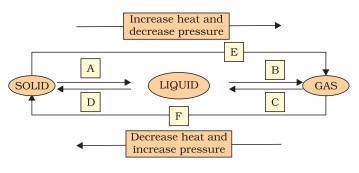
0 . 0 . 0 - 12What condition (s) are required for Change of State?The conditions needed are:
1) Temperature
2) Pressure - 13Complete the following Diagram:Labels are:
A - Melting
B - Boiling
C - Condensation
D - Freezing
E - Sublimation
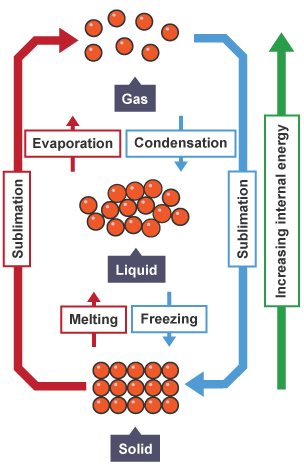
F - Sublimation - 14Draw a Similar Diagram as above
- 15What is a Heating Curve?This is a curve obtained when the temperature of a solid is recorded as it melts to a liquid then boils to a gas.
- 16What is a Cooling Curve?This is the curve obtained when the temperature of a gas is recorded as it condenses to form a liquid then freezes to form a solid.
- 17Draw a basic Heating and Cooling Curve Diagram.
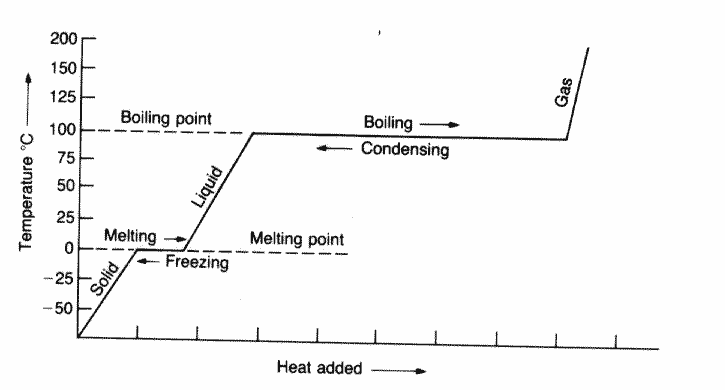
- 18Define Melting PointThe fixed temperature at which a pure solid melts to form a liquid
- 19What is Boiling Point?The fixed temperature at which a pure liquid boils to form a gas.
- 20Define Condensation PointThe fixed temperature at which a pure gas condenses to form a liquid.
- 21Define Freezing PointThe fixed temperature at which a pure liquid freezes to form a solid.
- 22Define Sublimation.This is the process by which a solid becomes a gas or a gas becomes a solid without passing through the liquid state.
- 23What are 3 Pieces of Evidence that support the theory that all matter is made up of tiny particles?They are:
1) Diffusion
2) Osmosis
3) Brownian Motion - 24Define DiffusionThe process by which particles move from an area of their higher concentration to an area of their lower concentration.
- 25Define OsmosisThe process by which water particles move from an area of their higher concentration to an area of their lower concentration, through a semi-permeable membrane.
- 26Define Brownian MotionPollen grains were seen moving around randomly in water when left alone due to the constant bombarding of water particles against them.
- 27What are the 3 Particles that make up Matter?They are:
1) Atoms
2) Molecules
3) Ions - 28What is an atom?This is the smallest particle into which an element can be divided.
- 29What is a molecule?These are groups of atoms which are bonded together.
- 30What is an Ion?These are electrically charged particles.
- 31Chapter 2Elements, Compounds and Mixtures
- 32What is an Element?This is a pure substances that can not be broken down into any simpler substance by any chemical process.
- 33What is the State of Matter of a Metal and Non - Metal at room temperature?Metals are solid except mercury.
Non - Metals can be solid liquid or gas. - 34What is the appearance of a Solid Metal and Non- metal?Metals are shiny.
Non - metals are dull. - 35'Bendability' of solid Metals and Non - MetalsMetals are malleable and ductile.
Non - metals are brittle. - 36What is the typical density of Metals and Non - Metals?Metals have usually high densities.
Non - Metals have usually low densities. - 37What is the typical melting point of Metals and Non - Metals like?Metals have generally high melting and boiling points.
Non - Metals have generally low melting and boiling points. - 38What is the Electrical and Thermal Conduction of Metals and Non - Metals like?Metals are good conductors.
Non - Metals are poor except for Graphite. - 39What are the ions formed by Metals and Non - Metals?Metals form Cations (+)
Non - Metals form Anions (-) - 40Between Metals and Non - Metals which is an oxidizing agent and which is a reducing agent?Metals are Reducing Agents.
Non - Metals are Oxidizing Agents. - 41What is the general nature of Metals and Non - Metals?Metal oxides are either Basic or Amphoteric.
Non - Metal oxides are either Acidic or neutral. - 42What is a compound?This is a substances that contains two or more different types of elements bonded together chemically.
A compounds properties varies from the elements that make it. - 43What is a Mixture?This is consists of two or more substances combined in varying proportions.
All the components of a mixture has its original properties. - 44What is a pure substance?This is a substance that contains only one type of material. They have fixed melting and boiling points. Impurities lower melting points and raise boiling points.
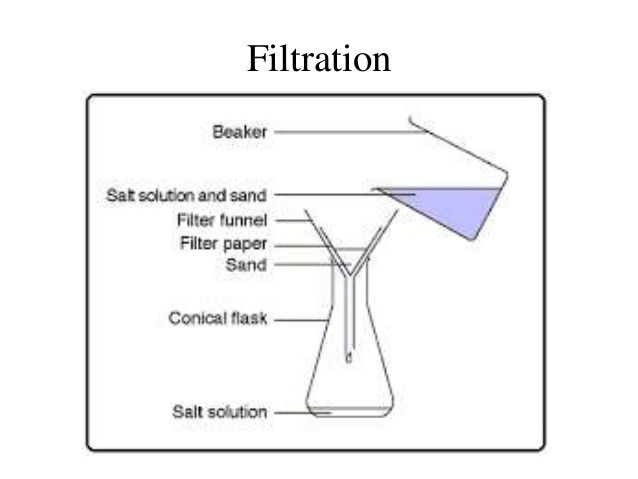
- 45What is Filtration?This is used to separate a suspension from a liquid. It is done by placing a filter paper inside a funnel, which is placed on to a conical flask. The liquid that passes through the filter paper is called the filtrate the solid remaining in the filter paper is called the residue.
- 46Draw a Basic Diagram for Filtration.
- 47What is Evaporation?This is used to obtain a solid (solute) from a solution as long as the solid does not decompose on heating.
- 48Draw a Basic Diagram of Evaporation?
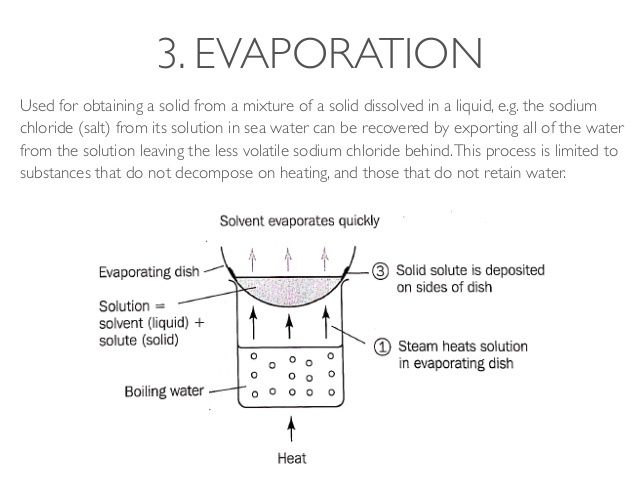
- 49What is Crystallization?This is used to obtain a solid (solute) from a solution especially when the solid contains water of crystallization.
- 50Draw a basic diagram to show Crystallization.
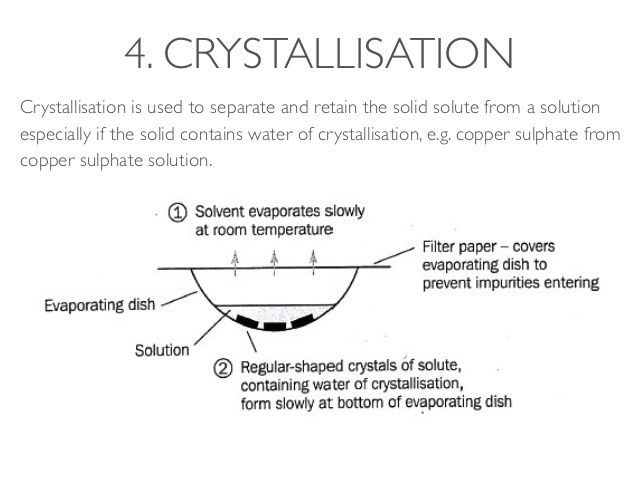
- 51Describe the usage of a separating funnel.This is used to separate two immiscible liquids.
- 52Draw a basic diagram for a Separating funnel.
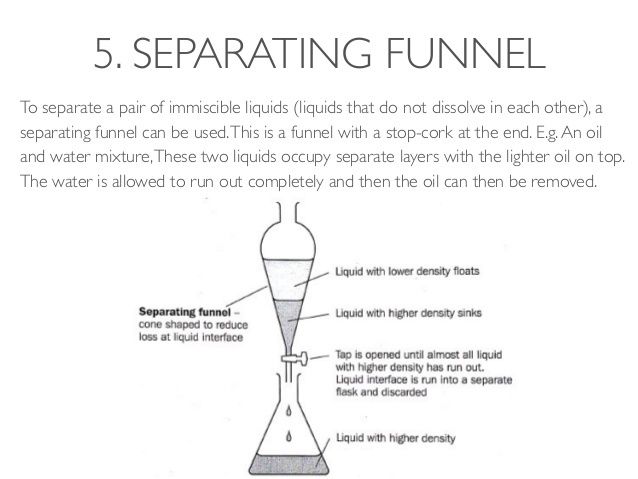
- 53What is Paper Chromatography?This is used to separate several solutes.
- 54Draw a basic Diagram for Paper Chromatography.
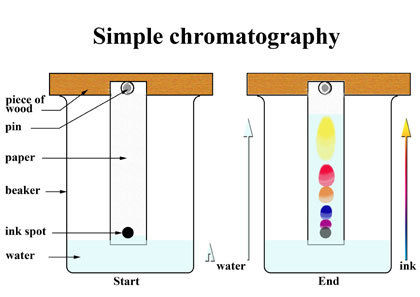
- 55What is Sublimation (Separating Technique)?Used to separate a soild that sublimes from a mixture of solids.
- 56Draw a Basic Diagram for Sublimation.
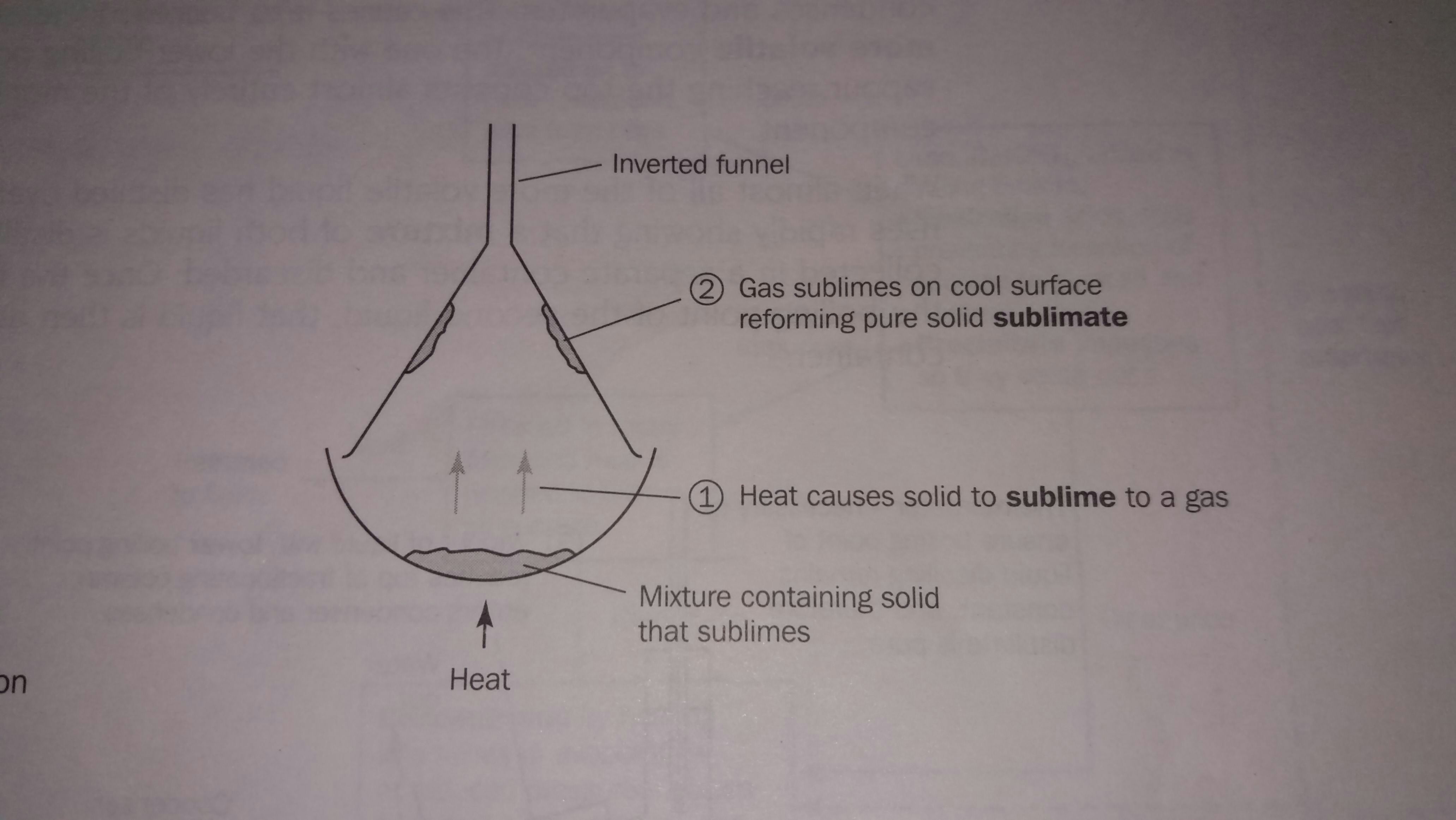
- 57What is Simple Distillation?This is used to separte to miscible liquids that have widely varying boiling points (over 51 degerees)
- 58Draw a basic Diagram of Simple Distillation..
- 59What is Fractional Distillation?This is used to separate two miscible liquids of close boiling points (50 degrees and under)
- 60Draw a basic Diagram of Fractional Distillation..
- 61Briefly state the steps required for extraction of Sugar from Sugar cane.1) Cane is cut and sent to factory.
2) The stalks a re cleaned by water jets and stripped of leaves.
3) They are cut up by shredders.
4) Then crushed, sprayed with hot water then rolled flat.
5) The cane juice extracted is a slightly acidic green suspension. The bagasse is removed.
6) Calcium Hydroxide is added to neutralize the acidity and remove impurities. The impurities form a precipitate. This is called Clarification.
7) Filtration occurs as impurities are filtered out by industrial filters. A syrup containing at least 85% water is produced.
8) Evaporation (Boiling) occurs when the syrup is passed through 3 to 4 boilers (evaporators) to concentrate it.
9) Crystallization occurs as the syrup is evaporated until it is saturated with sugar, a few crystals of sugar to help more crystals form. This mixture now contains a thick syrup called molasses as well as sugar crystals.
10)Centrifugation occurs as sugar crystals are separated from molasses as it is spun in a centrifuge at high speeds. - 62Chapter 3Atomic Structure
- 63What are the three types of sub-atomic particles?They are the protons, neutrons and electrons
- 64What is the mass and charge of a proton?Mass = 1
Charge = +1 - 65What is the mass and charge of an electron?Mass = 1/1840
Charge = -1 - 66What is the mass and charge of a neutron?Mass = 1
Charge = 0 or Neutral - 67What is Atomic Number?This is the number of Protons in an atom.
- 68What is Mass Number?This is the sum of protons and neutrons in the atom.
- 69What are the 2 parts of an atom?They are the nucleus and electron shells.
- 70What is an Isotope?These are atoms with the same atomic number but different mass number. All Isotopes of the same element have the same chemical properties.
- 71Define the term radioactive Isotope.This is the spontaneous disintegration of unstable atomic nuclei thus releasing radiation.
- 72What is the use of Cobalt-60?Used to fight cancer by directing a controlled beam of the gamma radiation.
- 73What is the use of Iodine-131?Used to help threat Thyroid problems.
- 74What is Plutonium-238 used for?Use to provide energy for heart pace makers.
- 75What is Carbon-14 used for?This is used to date fossils.
- 76What is Uranium-235 used for?This is used to generate heat energy to boil water to drive turbines.
- 77What is Relative Atomic Mass (Ar)?This is the mass of one atom compared to the mass of carbon-12, which has a mass of 12.00 units.
Informações
- Descrição
- These flash cards containing everything in Chapters 1 - 3 of Chemistry A Concise Revision Course For CXC. The topics covered are The States of Matter (Chapter 1), Elements, Compounds and Mixtures (Chapter 2) and Atomic Structure (Chapter 3).
- Criado por
- Caleb Merrique
- Visualizações
- 208
- Avaliação