
Flashcards
C4 AQA (9-1) GCSE Revision
Flashcards do conjunto (36)
- 1What does iron ore look like and where are some of its biggest mines?It is a red-brown, often dirty rock
The largest mines are in Australia and Brazil
The most common ore is haematite - 2What is an oxidation reaction?A reaction where something gains oxygen
e.g Iron + Oxygen -> Iron oxide - 3What is reduction?A reaction where something loses oxygen
- 4Describe aluminium in a world contextIt is the most common metal on earth and the third most abundant element
One common aluminium ore is Bauxite (aluminium oxide) - 5What dictates if something can be reduced or if it needs electrolysis to separate it?If it is less reactive than carbon then it can be removed by reduction
If it is more reactive it must be removed by electrolysis - 6What is a soluble base?An alkali which dissolves to make an alkaline solution
- 7How does magnesium and calcium react with water?Magnesium = Only with steam
Calcium = less vigorously than lithium - 8What metals form positive ions?Potassium, sodium, lithium, calcium, magnesium, zinc, iron, copper
- 9How does displacement work?A more reactive metal can replace a less reactive metal in a compound
- 10When magnesium displaces iron what happens?The iron coats the magnesium when it is displaced
- 11Which metals need to be extracted by electrolysis and why?Potassium, sodium, calcium, magnesium and aluminium need to undergo electrolysis because they are more reactive than carbon
- 12What are some metals that can be reduced by carbon?Zinc, iron and lead
- 13How is iron extracted?Carbon is heated for form carbon monoxide
Carbon monoxide reduces the oxygen from iron and forms carbon dioxide and pure iron - 14What happens when something is displaced?The electrons are forced onto the ions of less reactive metals
- 15How would you make a crystallized salt?Add excess of the metal in use
Filter the solution into a crystallizing dish
Evaporate the solution to condense - 16What are the charges of key metals?Mg 2+
Fe 2+
Zn 2+
Na +
K +
Ca 2+ - 17What are the ions that make up sulfuric and hydrochloric acids?Sulfuric (H2So4) = 2H +, So4 2-
Hydrochloric = H +, Cl - - 18What is a redox reaction?A reaction where at least one thing is oxidized and at least one thing is reduced
- 19What is the difference between an Alkali and a Base?A base is anything with a PH of over 7
An Alkali is a base which can be dissolved in water - 20What is the word equation for a neutralization reaction? (give an example too)Acid + Base -> Salt + Water
ZnO + H2So4 -> ZnSO4 + H20 - 21What happens when a metal carbonate does this?It does the same but forms carbon dioxide too
- 22What are the four ways of making a metal salt?Metal + acid -> metal salt + hydrogen
Metal oxide + acid -> metal salt + water
Metal hydroxide + acid -> metal salt + water
Metal carbonate + acid -> metal salt + hydrogen + carbon dioxide - 23List all of the key ion chargesSingle:
Cl- , NO3 - , OH- , Na+ , K+ , H+
Double:
So4 2- , Ca 2+ , Mg 2+ , Zn 2+ , Fe 2+, Cu 2+ - 24How does universal indicator work / what is the pH scale based on?The number of H+ ions (the higher the number of H+ the lower the pH)
- 25What type of ion does an alkali contain?OH- (hydroxide)
- 26In a burette what is the volume measured in and where is it measured from?cm cubed
The bottom of the meniscus - 27List some strong and weak acidsStrong:
Hydrochloric
Nitric
Sulfuric
Weak:
Ethanoic
Citric
Carbonic - 28What is the difference between strength and concentration?The stronger the acid the more ionized the liquid is
The more concentrated an acid is the more of it is found in a mixture or substance (mmol/dm cubed or g/dm cubed) - 29What is electrolysis?The process of passing direct current through a solution or melted ionic compound to move the ions apart and so break the compound down and discharge some of the elements at the electrodes
- 30What is an electrolyte?A liquid where ions are free to move about and carry electricity
- 31What are the two rods inserted into the electrolyte?Electrodes:
Cathode = negative
Anode = positive - 32How / why do electrons move during electrolysis?Electric current is passed through causing the ions to move to the electrodes
Positive to cathode (negative), called cations
Negative to anode (positive), called anions - 33What happens when the ions reach their electrodes?Negative ions at the anode lose electrons to the current
Positive ions at the cathode gain electrons from the current - 34How is aluminium ore extracted?Bauxite (aluminium ore) is mixed with cryolite to lower its melting point
This solution is placed in a steel electrolysis cell and then electrolysed with carbon electrodes
The oxygen is drawn to the anode where oxygen ions ate discharged and then the carbon reacts with the oxygen to form carbon dioxide
The liquid aluminium pools and is collected at the bottom - 35What happens in the electrolysis of an aqueous solution?There is PREFERENTIAL DISCHARGE
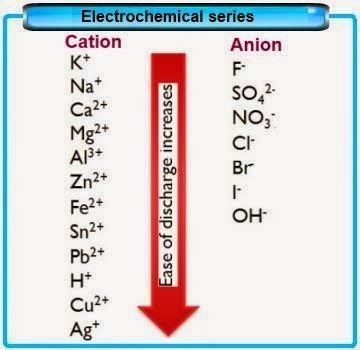
The least reactive ions are preferentially discharged as elements - 36During the electrolysis of an aqueous solution what happens at the electrodes?
Informações
- Descrição
- GCSE Chemistry GCSE (Paper 1) FlashCards sobre C4 AQA (9-1) GCSE Revision, criado por Oliver Faragher em 24-04-2019.
- Criado por
- Oliver Faragher
- Visualizações
- 36
- Avaliação