
Flashcards
Evolution
Flashcards do conjunto (70)
- 1Natural selection (Charles Darwin & Alfred Wallace)the process process where organisms with favourable traits are more likely to reproduce.
- 2Favourable traits from the fittest are passed on ___to the next generation
- 3What allows organisms to adapt to their environment?Traits passed on throughout generations
- 4Evolution- Process by which species change over time, considered a gradual process of adaptations.
- Evolution comes from the Lation word "unfolding"
- These changes cause an organism to evolve into a new species or become extinct - 5SpeciesGroup of organisms that are closely related and can produce fertile offspring
- 6PopulationA species that live in the same area
- 7Who first proposed the idea of evolution and when?Charles Darwin, in 1831
- 8What was the book that Charles Darwin's ideas were written in?On the Origin of Species by Means of Natural Selection
- 9Who was the scientist before Darwin?Lamarck in, 1809
- 10What did Lamarck notice?Noticed that organisms usually adapt to its habitat, but he had an incorrect idea. He said changes in an organism that are due to the use or disuse of a characteristic during an organisms lifetime could be inherited. His was the theory of inheriting acquired characteristics. They are not determined by genes. He started the study of anatomy
- 11What did Lamarck start the study of?Anatomy
- 12Darwin's main idea from his researchIndividuals that have traits that better suit their environment are more likely to survive and reproduce
- 13Natural selectionThe process by which organisms with favorable traits reproduce at higher rates than those without such variations. This is a method of selecting individuals who pass on their traits to the next generation
- 14Darwin said natural selection is a ________Cause of evolution
- 15What ideas led Darwin to form his theory of natural selection?Artificial selection, overpopulation, variation, adaptations
- 16Artificial selectionBreeding- human control
- 17OverpopulationEvery population is capable of producing more offspring than can survive, this increases competition for resources
- 18VariationThere can be variation of inherited traits in a population
- 19AdaptationsOver time, traits that improve survival and reproduction will become more common, ex. Camouflage
- 20Survival of the fittestThe fittest survive and pass on their traits. Evolution does not always produce the fittest forms, just those fit well enough to leave offspring (survival of the more fit)
- 21SpeciationFormation of new species as a result of evolution. This process occurs over thousands or missions of years.
- 22Gene pool- The total genetic information available in a population.
- An example of processes that can affect the kinds of genes that will exist in a population from generation to generation - 23MigrationMovement of individuals into(immigration) or out(emigration) of or between populations. It can change the numbers and types of alleles in a population
- 24Natural selectionCan increase or decrease a certain allele in a population
- 25MutationCan change type of alleles, rare change
- 26Mate choiceRandom assortment of parents pair up randomly, or form another population. Certain traits may improve matin success, limits the frequency of dominant or recessive alleles
- 27Genetic driftRandom change in allele frequency in a small population, takes alleles out of the population. Due to chance alone
In each generation, some descendants may leave behind more genes than other individuals. The genes of the next generation will be the genes of the "lucky" individuals, not necessarily the the "better" or "healthier" ones. Like a boat sinking and some dying, the "lucky" ones survive (it's random) - 28Geographic isolationThe physical separation of members of a population. Can result from: ponds drying up, canyons forming, earthquakes, etc
When populations become isolated they can no longer mate - 29Evidence of evolution1. Paleontology
2.comparative anatomy
3. Embryology
4.comparative biochemistry - 30PaleontologyStudy of fossils, show modern organisms with characteristics of older ancestors (comparing things)
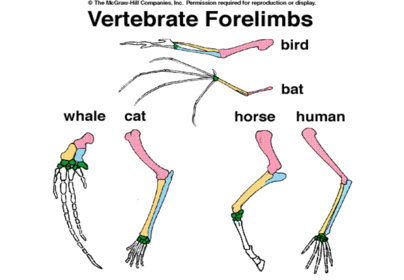
- 31Comparative anatomyHomologous structures
Analogous structures
Vestigial structures - 32Homologous structuresSimilar features resulting from a common ancestor (ex. Beaks in birds), the greater the number of shared features two organisms have, the more closely related they are. An organism with similar structure and different function
Ex: bones of whales flipper and tiger paw - 33Analogous structuresSame function, not the same ancestral origin
Examples
butterfly wings and bird wings
bird lung & fish gill - 34Vestigial structuresStructures with little or no function in the organism. Probably were useful to an ancestor, but have decreased in size Diego lack of use (ex. Appendix)
- 35EmbryologyComparing development of the embryos of organisms
- 36Comparative biochemistrySimilarities in the DNA, the genetic code
- 37Types of evolutionMicroevolution
Microevolution
Convergent evolution
Divergent evolution - 38MicroevolutionIs used to refer to changes in the gene pool of a population over time which result in relatively small changes to the organisms in the population- changes which would not result in the newer organisms being considered a different species.
Examples would include a change in a species' coloring or size - 39MacroevolutionIs used to refer to changes in organisms which are significant enough that, over time, the newer organisms would be considered an entirely new species. In other words, the new organisms would be unable to mate with their ancestors, assuming we were able to bring them together
- 40What types of evolution are darwins finches?Macroevolution
And divergent evolution - 41Divergent evolutionDevelops when 2 or more related species become more dissimilar because of a response organisms a different habitat. This makes new species.
Ex: -Darwin's finches
-Lizard species
-dog breeds - 42Convergent evolutionOccurs when 2 organisms develop similar characteristics as they adapted to similar environmental challenges. Not because they adapted from the same ancestor. Example streamlined bodies of a tuna and a dolphin
- 43Phylogenic treeA tree shows evolutionary relationships between species that are believed to have a common ancestor
Each new branch represents the most recent common ancestor of the next group
Basically shows how organisms have evolved over time from a common ancestor
Common ancestor is at fork where two or more organisms divided
Only one species can be at the end of each branch - 44What does Darwin predictThat over time he individuals that carry advantageous traits will increase in a population
- 45He individuals that carry advantageous traits will ____ in a populationIncrease
- 46Darwins theories- the world and all its organisms undergo perpetual or slow change
- all life shares a common descendant or ancestor (descent with modification)
-descent with modification:
•new species form from older species
•genetic mutations occur gradually over long periods of time
• organisms adapt to their environment by acquiring favorable characteristics - 47Descent with modification bullets•new species form from older species
•genetic mutations occur gradually over long periods of time
• organisms adapt to their environment by acquiring favorable characteristics - 48Descent with modification definedto come for something before with changes. Selection also called descent with modification- having a particular trait can make individuals more or less likely to survive and have successful offspring
- 49IsotopeForm of an element that has the same number of protons but a different name never of neutrons as another element
- 50Radiometric datingUses decay rate of isotopes to see how old a material is
- 51VariationsDifferences in physical traits of organisms
- 52TheoryProposed explanation for a wide variety of experimental results
- 53PhylogenyEvolutionary history of a group of related species
- 54What is the oldest known bird?-Archaeopteryx
-165 MYA
-Intermediate bird/dinosaur
Feathers
Teeth
Bony tail - 55What is the molecule of heredity?DNA
- 56DNA Code:3 Nucleotide code for 1 amino acid
- 57How many species of finches did Darwin collect?14 closely related groups of finch species
- 58Where did Darwin get his finches?Galapagos Islands
- 59What was similar with the finches?Everything except for the beak characteristics
- 60What did this difference in finches suggest to Darwin?-They were shaped by evolution
-Each species adapted to a specific niche on available food supply - 61Adaptive Radiation results in __ .species clusters
- 62T/F Moth color is not inherited?False
- 63What caused British peppered moths have predominantly dark colored wings in 1850?Industrial smog caused the trees to become darkened, which caused birds to prey upon the moths with contrasting colors of the trees, thus for the species to survive they had to evolve.
- 64T/F - The second half of the twentieth century didn't see a widespread implementation of pollution controls, thus trends reversed and light colored moths again dominated.False
- 65Artificial selection __ another example of ___.is;evolution
- 66Examples of Artificial Selection are:-Abdominal bristles on fruit flies (experimental studies)
-Ear size of corn plants (agricultural)
-Fat content in cattle and poultry, Milk production in cows, domestication of cats, dogs, & livestock (Domestication) - 67What three events require fossilization?-Organism buried in sediment
-Material must mineralize
-Surrounding sediment hardens - 68Is it common for organisms to be fossilized?Very few of the organisms that die are fossilized
- 69How are fossil dates determined?-Radioactive isotopes are decayed more in older rocks
-steady decay rates allow age determination - 70Convergent evolutionSpecies where organisms who are not closely related independently evolve similar traits as a result of having to adapt to similar surroundings.
(i.e. shape of marine predators moving through water minimize friction with stream-lined body type)
Informações
- Descrição
- Science FlashCards sobre Evolution , criado por Mischa Cole em 26-10-2016.
- Criado por
- Mischa Cole
- Visualizações
- 0
- Avaliação