
Flashcards
Chemistry Unit 2
Flashcards do conjunto (93)
- 1What is the definition of a compound?Compounds are substances in
which atoms of two or more
elements are chemically
combined. - 2Why do atoms take part in chemical bonding?Atoms take part in chemical
bonding in order to achieve the
electronic structure of a noble
gas (full outer energy level). - 3When an atom loses an electron, what charge does the remaining ion have?When an atom loses an
electron, the remaining ion has
a positive charge. - 4When an atom gains an electron, what charge does the remaining ion have?When an atom gains an
electron, the remaining ion has
a negative charge. - 5What can we say about the electronic structure of ions?Ions have the electronic
structure of a noble gas
(Group 0). - 6What do we call the elements in Group 1Elements in Group 1 are called
the Alkali metals. - 7When Group 1 metals react with non-metal elements, what type of ion is formed?When Group 1 metals react
with non-metal elements, the
Group 1 element forms an ion
with a single positive charge. - 8What do we call the elements in Group 7?The elements in Group 7 are
called the Halogens. - 9When Group 7 elements react with alkali metals, what charge does the halide ion gain?When Group 7 elements react
with alkali metals, the halide
ion has a negative charge. - 10What type of structure is formed by ionic compounds?Ionic compounds form giant
structures. - 11What type of bonding happens when atoms share pairs of electrons?When atoms share pairs of
electrons, this is called
covalent bonding. - 12What do we call covalent molecules with only a small number of atoms e.g. H2, Cl2, O2, HCl, H20, NH3 and CH4?Covalent molecules with only a
small number of atoms are
called simple molecules. - 13What can we say about the melting and boiling points of simple molecules?Simple molecules have low
melting and boiling points? - 14Why do simple molecules have low melting and boiling points?Simple molecules have low
melting and boiling points as
they have weak forces
between the molecules.
(HIGHER TIER) - 15Why do simple molecules not conduct electricity?Simple molecules do not
conduct electricity because the
molecules do not have an
overall electric charge. - 16Why do ionic compounds have high melting and boiling points?Ionic compounds have high
melting and boiling points
because there are strong
electrostatic forces between
oppositely charged ions. - 17Why do solid ionic compounds not conduct electricity?Solid ionic compounds cannot
conduct electricity because the
ions are not free to move. - 18Why do ionic compounds conduct electricity when they are melted or dissolved in water?Ionic compounds can conduct
electricity when melted or
dissolved in water because
now the ions are free to move. - 19What type of molecules are diamond, graphite and silicon dioxide?Diamond, graphite and silicon
dioxide are giant covalent
lattices (macromolecules). - 20Why do giant covalent structures have very high melting points?Giant covalent structures have
very high melting points as all
the atoms are linked to other
atoms by strong covalent
bonds. - 21Damond and graphite are formed from which element?Diamond and graphite are
formed from the element
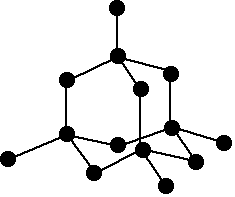
carbon. - 22What is this molecule?This molecule is diamond.
Each carbon atom is forming
four covalent bonds. - 23What is this molecule?This molecule is graphite.
Each carbon atom is forming
three covalent bonds.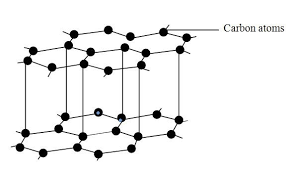
- 24Why is diamond very hard?Diamond is very hard because
each carbon atom forms four
covalent bonds. - 25Why is graphite soft and slippery?Graphite is soft and slippery
because it consists of layers.
There are no covalent bonds
BETWEEN the layers so they
are free to slide. - 26Why is graphite a good conductor of heat and electricity? (HIGHER TIER)In graphite, one electron from
each carbon atom is
delocalised (free to move).
These allow graphite to
conduct heat and electricity. - 27What is the structure of fullerenes? (HIGHER TIER)Fullerenes consist of hexagonal rings of carbon atoms. They have uses such
as lubricants and in nanotubes.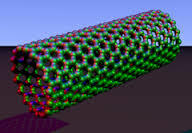
- 28Why are metals good conductors of heat and electricity? (HIGHER TIER)Metals are good conductors of
heat and electricity because
they have delocalised (free)
electrons which can move. - 29Why can metals be bent and shaped?Metals can be bent and
shaped because the layers of
atoms in metals are able to
slide over each other. - 30What are alloys?Alloys are usually made from
two or more different metals
(however a metal plus a nonmetal
such as carbon would
also be an alloy). - 31Why are alloys harder than pure metals?Alloys are harder than pure
metals because the different
sized atoms distort the layers
so it is difficult for them to slide
over each other. - 32What are shape memory alloys?Shape memory alloys can
return to their original shape
after being deformed (eg
dental braces). - 33What conditions can we change to alter the properties of a polymer?To alter the properties of a
polymer, we can change the
reaction temperature or use a
different catalyst. - 34What is meant by a thermosoftening polymer?Thermosoftening polymers
consist of individual tangled
polymer chains. When we heat
them, these polymers melt and
can be reshaped. - 35What is meant by a thermosetting polymer?Thermosetting polymers
consist of polymer chains with
cross-links between them.
They do not melt when they
are heated. - 36In terms of intermolecular forces, why can thermosoftening polymers melt when heated? (HIGHER TIER)Thermosoftening polymers
have weak intermolecular
forces between the chains.
These are easily broken, so
the polymer can melt easily - 37What is meant by nanoparticles?Nanoparticles are between
1-100nm in size (very small).
They consist of a few hundred
atoms. - 38Why are nanoparticles useful? (a role may be described in the exam).Nanoparticles are useful
because they have a high
surface area to volume ratio. - 39What is shown by the atomic number of an element?The atomic number of an
element tells us the number of
protons in the nucleus of an
atom. - 40What is shown by the mass number of an element?The mass number tells us the
total number of protons and
neutrons in the nucleus of an
atom. - 41How do we calculate the number of neutrons in the nucleus of an atom?To calculate the number of
neutrons in the nucleus of an
atom, subtract the atomic
number from the mass
number. - 42What do we call atoms of the same element with different numbers of neutrons?Atoms of the same element
with different numbers of
neutrons are called isotopes. - 43What is meant by the relative atomic mass (Ar) of an element? (HIGHER TIER)The relative atomic mass (Ar)
of an element is an average
mass of the atoms of the
isotopes compared with the
12C isotope. - 44What is meant by the relative formula mass (Mr) of a compound?The relative formula mass (Mr)
of a compound is the sum of
the relative atomic masses of
the atoms in the numbers
shown in the formula. - 45What is one mole of a substance?One mole of a substance is
the relative formula mass in
grams. - 46Elements and compounds can be detected and identified by instrumental methods. What does this mean and give an example.An instrumental method
involves using a machine. An
example is gas
chromatography. - 47What are the advantages of analysing a substance using an instrumental method?Instrumental methods are
accurate, sensitive and rapid.
They are useful when the
amount of a sample of very
small. - 48How can we identify artificial colours in foods?Artificial colours in foods can
be identified using paper
chromatography - 49Describe how gas chromatography works.In gas chromatography, different
substances carried by gas, travel
through a column packed with solid
material. Each substance travels
through the column at a different speed
so they are separated. - 50How can we tell from a gas chromatograph how many different compounds are present?The number of peaks on a gas
chromatograph shows the
number of compounds. - 51How can we work out the retention time from a gas chromatograph?The position of the peak
indicates the retention time. - 52How can we work out the relative molecular mass of a substance from a mass spectrum? (HIGHER TIER)The rightmost peak on a mass
spectrum is called the
molecular ion peak. This tells
us the relative molecular mass
of the substance. - 53Suggest why the yield of a reaction is often less than the maximum calculated amount.The yield of a reaction is often less than the maximum calculated amount because
• some of the compound may be lost when it is separated from the reaction mixture
• There may be unexpected side-reactions
• The reaction may not go to completion
because it is irreversible - 54How do we calculate the percentage yield for a reaction.percentage yield =
(mass of product / theoretical maximum
mass) x 100 - 55What does this symbol mean?This symbol shows that the
reaction is reversible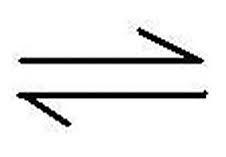
- 56How can we calculate the rate of a reaction?The rate of the reaction is calculated
by either
• dividing the amount of product
formed by the time taken.
• dividing the amount of reactant used
by the time taken. - 57What is meant by the activation energy?Activation energy is the
minimum energy particles
must collide with to react. - 58How does increasing the temperature of a reaction increase the rate of that reaction?If we increase the temperature
of a reaction, the particles
collide more frequently and
with more energy. This
increases the rate of reaction. - 59How does increasing the pressure of reacting gases increase the rate of a reaction?Increasing the pressure of
reacting gases makes the
particles collide more
frequently which increases the
rate of the reaction. - 60How does increasing the concentration of reactants in solution increase the rate of reaction?Increasing the concentration of
reactants in solution makes
the particles collide more
frequently which increases the
rate of the reaction. - 61How does increasing the surface area of solid reactants increase the rate of reaction?Increasing the surface area of
solid reactants increases the
frequency of collisions. This
increases the rate of the
reaction. - 62What is the effect of a catalyst on a chemical reaction?Catalysts increase the rate of
a chemical reaction. - 63How can using a catalyst save money when carrying out a chemical reaction?Catalysts increase the rate of
a reaction so we can use a
lower temperature and save
energy costs. - 64What is meant by an exothermic reaction?An exothermic reaction
releases energy to the
surroundings. Generally
exothermic reactions get hot. - 65What is meant by an endothermic reaction?An endothermic reaction takes
in energy from the
surroundings. Generally
endothermic reactions get
cold. - 66How can we use anhydrous copper sulfate to test for the presence of water?Anhydrous copper sulfate is copper
sulphate without water. It is white.
If we add water, we get hydrated
copper sulfate which is blue.
Hydrated means “contains water”. - 67What are the state symbols for • solid • liquid • gas • dissolved in waterSolid = s
Liquid = l
Gas = g
Dissolved in water = aq - 68Describe how we can make a soluble salt by reacting a metal with an acid.Add metal to the acid. Some metals are too unreactive (eg gold) and some metals are too reactive (eg group 1). The metal will effervesce (fizz) as the reaction releases hydrogen. When the metal stops reacting, all the acid has reacted. Now filter off the unreacted metal. Crystallise the salt produced by evaporation.
- 69Describe how we can make a soluble salt by reacting an insoluble base with an acid.Add the insoluble base to the acid.
Keep adding until the insoluble base
stops reacting (as the acid has all
reacted). Now filter off the unreacted
base. Crystallise the salt produced by
evaporation. - 70Describe how we can make a soluble salt by reacting an alkali with an acid.Add the alkali to the acid until the pH
is 7 (neutral). This can be determined
using indicator paper. Now crystallise
the salt produced by evaporation
(note: you do not need to filter). - 71When we mix two solutions together and produce a solid, what name do we give to the solid?A solid produced by mixing two
solutions together is called a
precipitate. This is a
precipitation reaction. - 72What is an alkali?An alkali is a soluble metal
hydroxide (eg sodium
hydroxide). Alkalis have a pH
value of 8-14. - 73Suggest a pH value for an acid.Acids have a pH between 1 and 6.
- 74What pH is a neutral solution?A neutral solution has a pH of 7.
- 75Which ion makes solutions acidic?The hydrogen ion (H+) makes
solutions acidic. - 76Which ion makes solutions alkaline?The hydroxide ion (OH-)
makes solutions alkaline. - 77What is the equation for neutralisation?The equation for neutralisation
is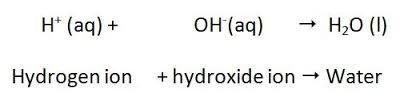
- 78Which salts are produced from: • hydrochloric acid • sulfuric acid • nitric acid• hydrochloric acid = chloride
• sulfuric acid = sulfate
• nitric acid = nitrate - 79How is ammonium nitrate produced and what is it used for?Ammonium nitrate is produced
by reacting ammonia solution
with nitric acid. Ammonium
nitrate is used as a fertiliser. - 80What is meant by electrolysis?Passing an electric current
through an ionic substance
which is melted or dissolved in
water, causing the substance
to break down into elements. - 81In electrolysis, what is meant by the electrolyte.In electrolysis, the electrolyte
is the ionic compound which is
broken down to its elements
as electric current is passed. - 82During electrolysis, which ion moves to the negative electrode and why?During electrolysis, the
positive ion moves to the
negative electrode. This is
because opposite charges
attract. - 83Suggest a reason why we electroplate a metal with a different metal.Electroplating can be used to
prevent corrosion. It can also
be carried out to make a metal
more attractive. - 84During electrolysis, what takes place at the negative electrode?At the negative electrode,
positive ions gain electrons.
Gaining electrons is called
reduction. - 85During electrolysis, what takes place at the positive electrode?At the positive electrode,
negative ions lose electrons.
Losing electrons is called
oxidation. - 86When electrolysing an ionic compound in solution, how do we work out what is produced at the negative electrode?If the metal is more reactive than
hydrogen, then hydrogen is
produced at the negative electrode.
If the metal is less reactive than
hydrogen, the metal is produced at
the negative electrode. - 87Write the half equation for the oxidation of chloride at the positive electrode. (HIGHER TIER)
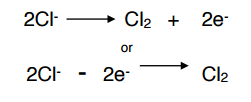
- 88What is the role of cryolite during electrolysis of molten aluminium oxide?Cryolite lowers the melting
point which reduces the
energy needed, saving money - 89During the electrolysis of molten aluminium oxide, what is produced at the negative electrode and what is produced at the positive electrode?During electrolysis of aluminium
oxide, aluminium is produced at
the negative electrode and
oxygen is produced at the
positive electrode. - 90During electrolysis of molten aluminium oxide, why does the positive electrode need to be replaced regularly?During electrolysis of molten aluminium
oxide, graphite electrodes are used.
Oxygen is produced at the positive
electrode. The oxygen reacts with the
carbon graphite, producing carbon
dioxide. The positive electrode therefore
needs replacing regularly. - 91During electrolysis of sodium chloride solution, what is produced at the negative electrode?During electrolysis of sodium
chloride solution, hydrogen
gas is produced at the
negative electrode. - 92During electrolysis of sodium chloride solution, what is produced at the positive electrode?During electrolysis of sodium
chloride solution, chlorine gas
is produced at the positive
electrode. This is used to
make bleach and plastic. - 93During electrolysis of sodium chloride, what solution remains at the end?During electrolysis of sodium
chloride solution, sodium
hydroxide solution remains at
the end. This is used to make
soap.
Informações
- Descrição
- GCSE Chemistry FlashCards sobre Chemistry Unit 2, criado por Rick Wear em 11-04-2017.
- Criado por
- Rick Wear
- Visualizações
- 38
- Tags
- Avaliação