
Flashcards
Sem. 2 Exam PE Flashcards
Flashcards do conjunto (46)
- 1Define "Health and Wellbeing".HEALTH: “a state of complete physical, mental and social well being, not merely the absence of disease or infirmity”
WELLNESS: The active process of becoming aware of and making choices to create a healthier lifestyle in all of life’s dimensions - 2What are the three main aspects of health?- Social Health
- Mental Health
- Physical health - 3What are the benefits of a healthy lifestyle?Improved cardiovascular efficiency
Increased muscle tone, strength flexibility and endurance
Reduced risk of injuries
Improved sense of self-control and self-esteem
Improved stress management
Improved outlook on life
Improved interpersonal relationships
Decreased mortality (death) - 4What is peristalsis?the involuntary constriction and relaxation of the muscles of the intestine or another canal, creating wave-like movements which push the contents of the canal forward.
- 5What is blood made up of?It has four main components: plasma, red blood cells, white blood cells, and platelets.
- 6What is plasma?Plasma is the clear, straw-colored liquid portion of blood that remains after red blood cells, white blood cells, platelets and other cellular components are removed. It is the single largest component of human blood.
- 7What are red blood cells?Hemoglobin is the protein inside red blood cells that carries oxygen. Red blood cells also remove carbon dioxide from your body, transporting it to the lungs for you to exhale. Red blood cells are made inside your bones, in the bone marrow.
- 8What are white blood cells?White blood cells, also called leukocytes, are essential for good health and protection against illness and disease. Think of white blood cells as your immunity cells. White blood cells are made inside the bone marrow and stored in your blood and lymphatic tissues.
- 9What are platelets?Platelets are tiny blood cells that help your body form clots to stop bleeding. If one of your blood vessels gets damaged, it sends out signals that are picked up by platelets. The platelets then rush to the site of damage and form a plug, or clot, to repair the damage.
- 10What is Type 1 Diabetes?A condition that results from the body's failure to produce insulin - NOT a lifestyle disease. Is usually diagnosed in early childhood, and is contracted through a genetic predisposition.
- 11What is Type 2 Diabetes?Results from insulin resistance, when cells fail to use insulin properly. It is a lifestyle disease usually contracted during adulthood as a result of obesity or excessive amounts of sugar in the bloodstream.
- 12How can Type 2 Diabetes be treated?Self-care: Physical exercise, Quitting smoking, Weight loss, Nutrition counselling, Diabetic diet and Dietary fibre
Medications: Anti-Diabetic medication, Blood Thinners, Statin and Insulin
General Practitioner (GP), Ophthalmologist, Endocrinologist and Nutritionist - 13What are the most problematic lifestyle diseases in Australia?- Cardiovascular disease
- Cancer
- Asthma
- Diabetes
- Mental health - 14What is cancer?A condition that occurs when cells mutate and these mutated cells begin multiplying rapidly in the body. These mutated cells then form lumps or tumours which can grow and become seriously detrimental to a person's health.
- 15What is a benign tumour?BENIGN: A tumour that has definite boundaries it doesn't spread out of. It is not cancerous, however, must be checked regularly or removed.
- 16What is a malignant tumour?MALIGNANT: A tumour that has no definite boundary and divides and grows, forcing its way into healthy cells in a process known as infiltration. When cancerous cells begin entering the blood vessels or lymphatic system (metastasis) it is known as a secondary tumour, which can often become terminal (fatal).
- 17What are some common types of cancer?Lung, skin, breast, testicular, ovarian, leukaemia (bone cancer), cervical, prostate
- 18What are some cancer risk factors?For some cancers, the risk factors are more lifestyle-related (e.g smoking, obesity, poor diet, overexposure to the sun, etc.), while others are hereditary.
- 19What are the cancer mortality rates like in Australia?Cancer is quickly overtaking cardiovascular disease as the number one killer in Australia. Cancer is responsible for approximately 36% of deaths. Approximately 1/3 of males and 1/4 of females will develop cancer at some point in their life, and that statistic only increases when sun cancer is included.
- 20What is melanoma?Melanoma occurs when the pigment-producing cells that give colour to the skin become cancerous.
Symptoms might include a new, unusual growth or a change in an existing mole. Melanomas can occur anywhere on the body.
. - 21What is cardiovascular (heart) disease?Cardiovascular disease generally refers to conditions that involve narrowed or blocked blood vessels that can lead to a heart attack, chest pain (angina) or stroke. Other heart conditions, such as those that affect your heart's muscle, valves or rhythm, also are considered forms of heart disease.
- 22What is atherosclerosis?A build-up of cholesterol plaque in the walls of arteries, causing obstruction of blood flow. Plaques may rupture, causing acute occlusion of the artery to clot.
Atherosclerosis often has no symptoms until a plaque ruptures or the build-up is severe enough to block blood flow. - 23What are the risk factors for cardiovascular disease?- Sedentary lifestyle
- Smoking + drinking
- Stress/anxiety
- Fat + cholesterol consumption
- High blood pressure - 24What is high blood pressure?Usually, hypertension is defined as blood pressure above 140/90.
Over time, if untreated, it can cause health conditions, such as heart disease and stroke.
Eating a healthier diet with less salt, exercising regularly and taking medication can help lower blood pressure. - 25What is a radial pulse?A pulse that can be located on the lateral of the wrist (radial artery).
- 26What is the role of the circulatory system?These are the main roles of the circulatory system. The heart, blood and blood vessels work together to service the cells of the body. Using the network of arteries, veins and capillaries, blood carries carbon dioxide to the lungs (for exhalation) and picks up oxygen.
- 27What are the 3 main elements of the circulatory system?The circulatory system consists of three independent systems that work together: the heart (cardiovascular), lungs (pulmonary), and arteries, veins, coronary and portal vessels (systemic).
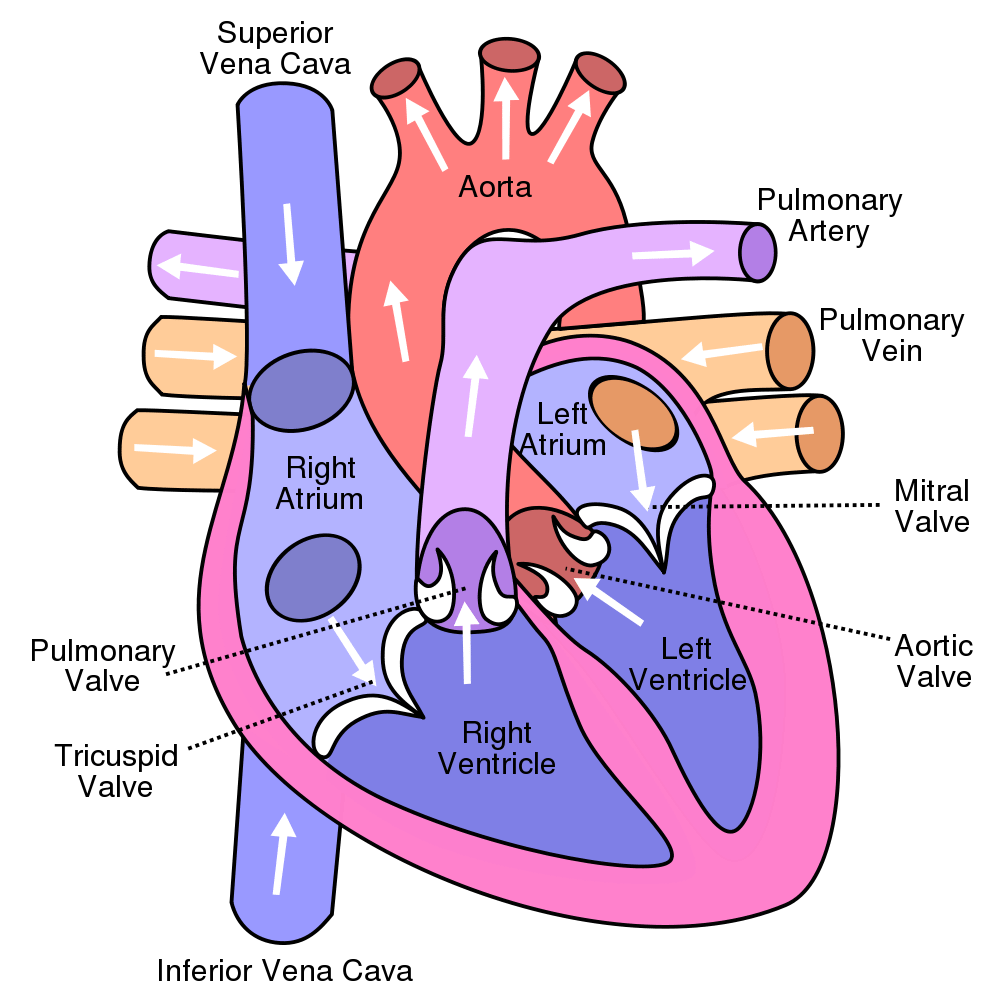
- 28What are the main functions of the heart?The human heart is an organ that pumps blood throughout the body via the circulatory system, supplying oxygen and nutrients to the tissues and removing carbon dioxide and other wastes.
- 29What is the anatomy of the heart? (13 parts to remember)
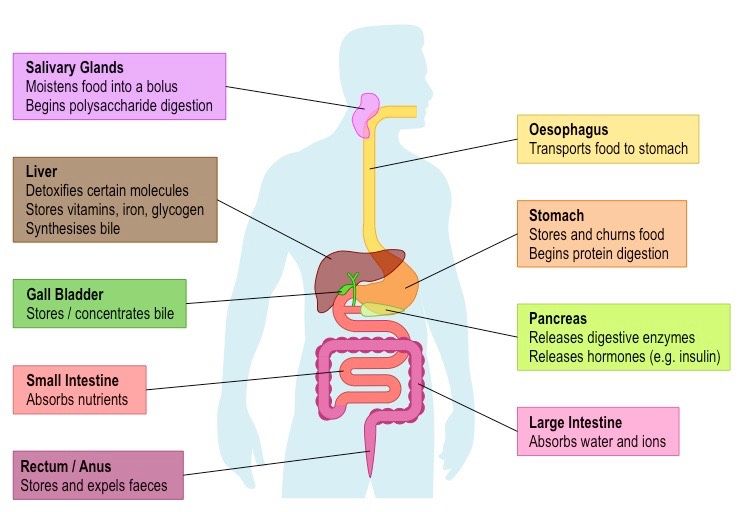
- 30What is the anatomy of the digestive system? (9 parts to remember)
- 31What is asthma?A condition in which a person's airways become inflamed, narrow and swell and produce extra mucus, which makes it difficult to breathe.
- 32How can asthma be treated?Medications: Bronchodilator, Steroid and Anti-Inflammatory
Supportive care; Oxygen therapy
Specialists: Pulmonologist, Paediatrician, General Practitioner (GP) and Respiratory Therapist - 33What is the definition of mental health?Mental health is not just the absence of mental disorder. It is defined as a state of well-being in which every individual realizes his or her own potential, can cope with the normal stresses of life, can work productively and fruitfully, and is able to make a contribution to her or his community.
- 34What are four of the most common mental health conditions?1. Anxiety
2. Depression
3. Bipolar disorder
4. Schizophrenia - 35What is anxiety and how prevalent is it?- Affects 14% of Australians
- Women are more susceptible
- Causes include stress, trauma, genetic predisposition, physical injury - 36What is bipolar disorder?- A fluctuation of extreme moods, usually episodes of mania followed by episodes of depression
- Makes it hard to function in daily life - 37What is depression and how prevalent is it?- Characterised by long and intense periods of low mood
- Affects the ability to function and relate to others
- 1 in 7 (15%) of Australians suffer depression
- More common in women - 38What is schizophrenia?- A condition that causes an altered experience of reality
- Also known as psychosis
- Main symptoms include hallucinations and delusions
- Affects 1 in 100 people
- Can cause serious disability if untreated - 39What are communicable diseases?A communicable disease is one that is spread from one person to another through a variety of ways that include: contact with blood and bodily fluids; breathing in an airborne virus; or by being bitten by an insect.
- 40What is a 'roll ball' in touch football?Roll ball – occurs after being touched or at a change of possession.
- 41Who is the 'acting half' in touch football?The player behind the person rolling the ball is designated as the acting half and is
there to pick the ball up. All the players in the defending team must be back at
least five (5) meters from the mark of the roll ball and cannot move forward until
the acting half has touched the ball. - 42What field is touch football typically played on?A grass field measuring 80m long and 50m wide.
- 43What are some examples of attacking skills used in touch football?Attacking Skills - used by the team in order to gain ground advantage.
Includes rucking, wraps, switches, drawing a player, running into gaps,
player movement off the ball, creating an overlap, communication &
using predetermined moves in order to create options. - 44What are some examples of defending skills used in touch football?Defensive Skills – used by the team not in possession of the ball in order
to stop the attacking team gaining a ground advantage and
pressuring the attacking team to cause a change of possession. - 45What does a penalty in touch football entail?Penalties are awarded for infringements of the rules and can be taken
as a tap or roll ball with the acting half being able to be caught in possession of
the ball. Defending players must move back 10 metres for a penalty. - 46What does 'The Tap' refer to in a game of touch football?It is used to start the game,
recommence after a score and after half -time, and is used when a penalty is
awarded. A tap is taken by placing the ball on the ground on or behind the
location of the mark and releasing it from the hands, tapping the ball with either foot (a distance less than one metre) and picking the ball up cleanly from the ground.
Informações
- Descrição
- PE FlashCards sobre Sem. 2 Exam PE Flashcards, criado por Vivi Grace em 06-11-2017.
- Criado por
- Vivi Grace
- Visualizações
- 26
- Tags
- Avaliação